
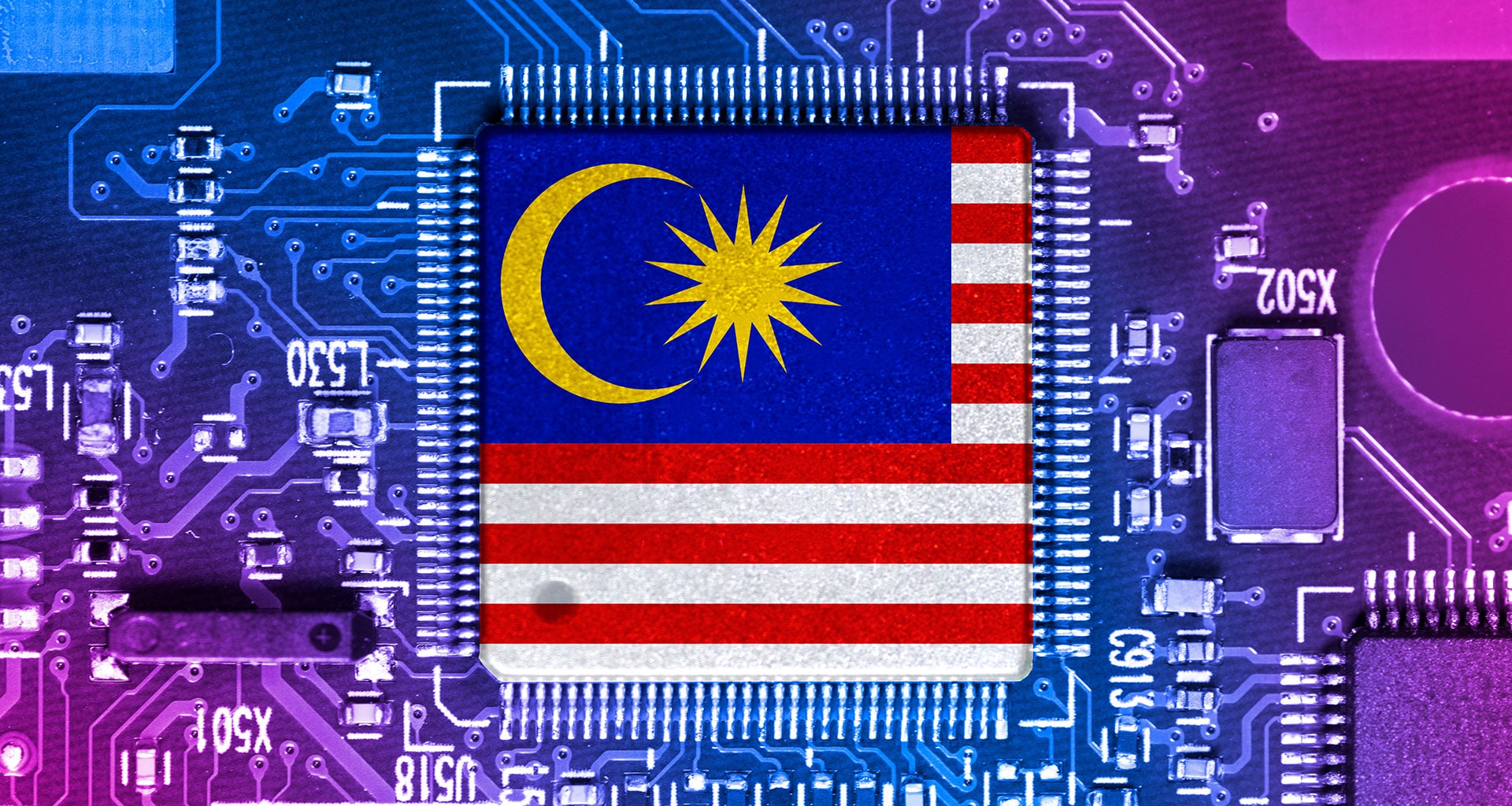
Few countries have embedded themselves into the global semiconductor supply chain as quietly yet as effectively as Malaysia.
For more than half a century, the country has been an understated pillar of the global semiconductor supply chain.
Long known for its strengths in computer chip assembly, packaging, and testing, the country has quietly enabled the electronics industry worldwide.
Today, as Washington and Beijing jostle for market domination, the quiet truth is that 13% of the world’s computer chips are packaged in the country.
Now, the country is at a pivotal moment as it attempts to establish itself in activities further up the semiconductor value chain like chip design and AI just as geopolitical tensions and shifting trade policies reshape the world as we know it.
Panang: curry and chips
Malaysia started producing semiconductors in the early 1970s after the government set up a free trade zone close to the village of Banyan Lepas on the southern tip of the island of Panang and invited US and German companies to build assembly plants on what had been paddy fields.
The move attracted tech giants such as Intel, Advanced Micro Devices (AMD), and National Semiconductor which at the time were looking for stable, cost-effective locations to support the rapid expansion of global chip production. Panang quickly became known in the industry as ‘Silicon Island.’
Over the following decades, Malaysia built a dense industrial ecosystem encompassing suppliers, subcontractors, logistics providers, and a skilled engineering workforce.
By the 1980s and 1990s, semiconductor manufacturing had become a cornerstone of the country’s export-led growth model. Rather than competing in capital-intensive, leading-edge wafer fabrication, Malaysia specialised in back-end manufacturing, steadily moving from basic assembly into increasingly complex packaging and testing operations.
Intel has committed billions of dollars to strengthen its advanced packaging operations in Penang, while Infineon has expanded its Kulim facility to support rising demand for power devices used in electric vehicles, renewable energy systems, and industrial applications.
NXP, which has operated in Malaysia for more than 50 years, continues to focus on advanced assembly and packaging, particularly for automotive electronics, secure payment systems, and IoT solutions.
Overseas investment also spawned a burgeoning domestic economy as local engineers, trained at the multinationals, went on to set up their own companies.
Unisem and Inari Amertron have built strong positions in assembly, testing, and radio frequency devices, while Vitrox has gained recognition as a manufacturer of semiconductor inspection and automation equipment.
Penang-based Infinecs has emerged as a notable example of Malaysia’s growing ambitions in integrated circuit and system-on-chip design, serving applications in AI, 5G, and advanced computing.
In 2019, Malaysia saw another wave of overseas investment as Western companies such as Micron and Jabil, which have extensive manufacturing operations in China, relocated at least some operations to southeast Asia under the threat of US trade tariffs on Chinese manufactured goods.
Up, up and Malay(sia)
Malaysia’s strengths increasingly lie in advanced packaging and power semiconductor manufacturing, areas that are becoming more strategically important as the industry seeks alternatives to traditional scaling. Technologies such as system-in-package, wafer-level packaging, and multi-die integration are now central to many Malaysian operations, enabling performance improvements without relying solely on smaller process nodes.
The country has also become an important base for wide-bandgap semiconductors, particularly silicon carbide and gallium nitride. These materials are critical for next-generation power electronics, supporting higher efficiency and smaller form factors in electric vehicles, charging infrastructure, and renewable energy systems. With global demand accelerating, Malaysia’s established manufacturing expertise positions it well to capture further growth.
Manufacturers are also investing heavily in automation, robotics, and AI-driven manufacturing processes. These technologies are being deployed to improve yields, manage rising costs, and support increasingly complex products. Industry leaders have been clear that productivity improvements will be essential for maintaining global competitiveness, particularly as cost pressures and policy uncertainty increase.
Malaysia’s latest phase of semiconductor development is being shaped by its National Semiconductor Strategy (NSS), launched in May 2024.
The strategy aims to strengthen the country’s position across the value chain, with a particular focus on chip design, advanced packaging, manufacturing equipment, and talent development.
Under the plan, Malaysia is targeting the creation of 10 domestic semiconductor companies with annual revenues exceeding $1 billion, alongside a broader base of firms approaching that scale.
Speaking at the Asean Semiconductor Summit 2025, a year after the initiative was launched, Prime Minister Datuk Seri Anwar Ibrahim said that under the initiative, the country had so far secured RM63 billion (S$15.5 billion) worth of semiconductor investments.
These include a move by Infineon to open the world’s largest 200mm silicon carbide power fab in Kulim; Syntiant’s MEMS microphone and sensor operations; as well as Plexus’ manufacture and re-manufacture of printed circuit boards.
“15 years from now, we want Malaysia to be able to look back at this moment as the tipping point when the country began grooming its very own Fortune 500 tech companies,” Anwar said.
Another key element of the NSS is a strategic partnership with ARM Holdings.
Under the agreement, Malaysia will invest $250 million over 10 years to access advanced chip design blueprints and train 10,000 local engineers. The move is intended to accelerate Malaysia’s transition from a production-focused hub to a participant in higher-value semiconductor activities, particularly intellectual property development and design enablement.
ASEAN-able limits
Yet, despite this, Malaysia still faces a number of hurdles in its quest to move up the value chain.
Malaysia faces hurdles in areas such as long-term research funding, venture capital availability, and talent retention.
Brain drain continues to be a concern, with skilled engineers often drawn to higher-paying opportunities in the West or in regional competitors such as Taiwan, South Korea, and China.
As a result, many observers expect Malaysia to focus initially on licensed and customised designs rather than fully independent, cutting-edge innovation.
Another issue at the moment is increasing global uncertainty. In recent months, companies have adopted a cautious stance as they await clarity on potential US tariffs affecting semiconductor-related trade. With the US representing Malaysia’s third-largest market for semiconductor exports, any shift in trade policy could have a material impact on investment decisions.
As global supply chains continue to diversify, Malaysia’s willingness to engage with both Western and Asian markets has made it an attractive ‘neutral’ manufacturing location. While it is not seeking to compete with the most advanced fabrication hubs, Malaysia’s focus on legacy chips, advanced packaging, power devices, and design support reflects a pragmatic strategy to move up the value chain without overextending.
This article originally appeared in the Jan/Feb 26 issue of Procurement Pro.