
NAND Flash memory has become one of the most critical components in modern electronics. From smartphones and SSDs to industrial automation and automotive systems, it forms the backbone of data storage in both consumer and enterprise applications.
As demand continues to surge – driven by AI workloads, Cloud data centres, and connected devices – the competitive landscape among NAND Flash manufacturers had intensified, shaping supply chain strategies across the electronics industry.
The role of NAND Flash in modern electronics
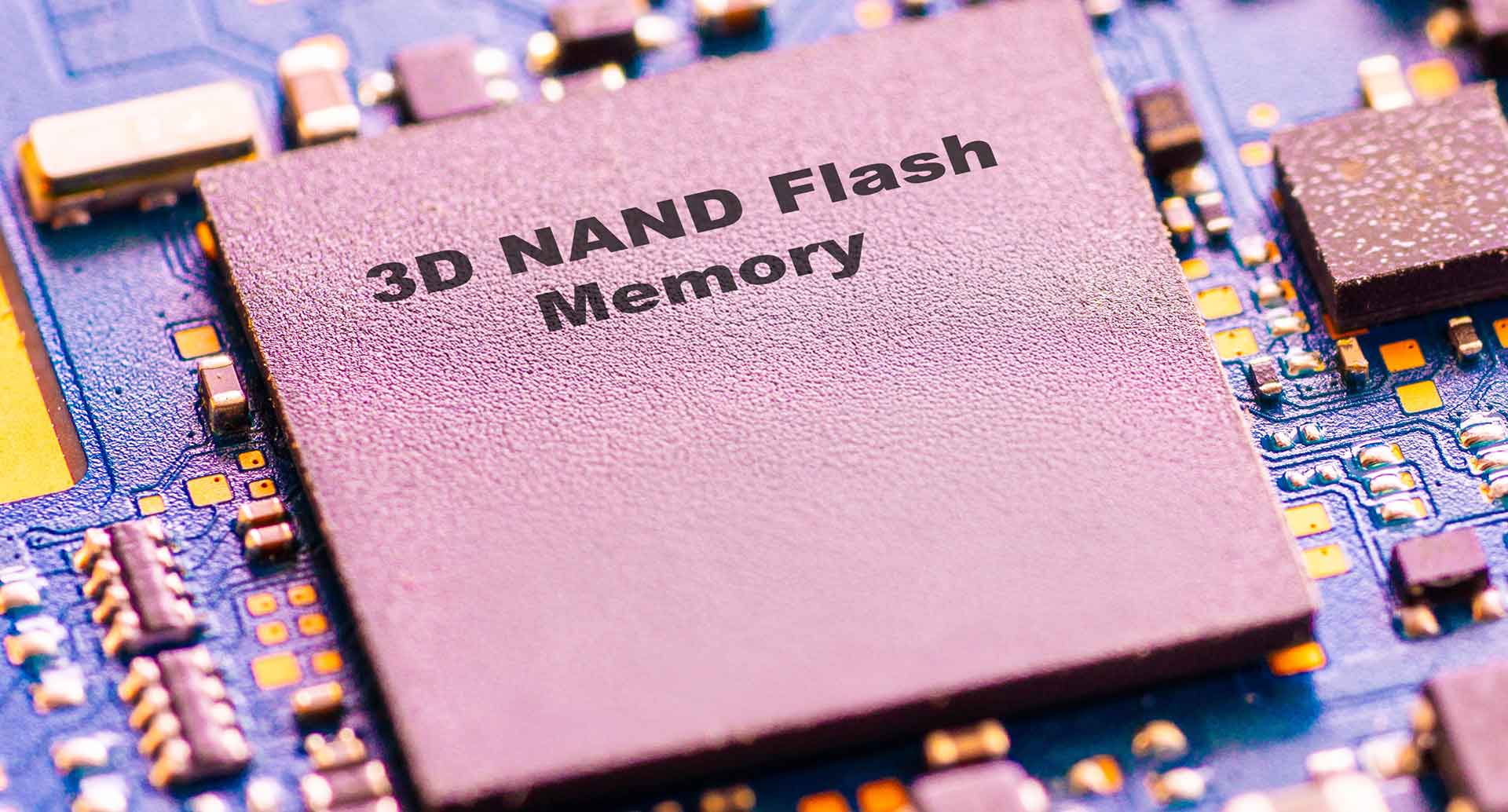
NAND Flash is a type of non-volatile memory, meaning it retains data without power. Unlike DRAM, which requires constant refreshing, NAND stores information in memory cells organised in blocks. Its ability to deliver high storage density, low power consumption, and rapid read/write speeds make it indispensable for portable and embedded systems.
Over time, manufacturers transitioned from planar (2D) to three-dimensional (3D) architectures, stacking layers of cells vertically to boost capacity and efficiency. Today’s advanced 3D NAND devices exceed 200 layers, offering higher endurance and reduced cost per bit.
These innovations enable diverse applications:
- Consumer electronics: smartphones, tablets, and laptops rely on NAND-based SSDs for faster boot and load times
- Automotive systems: NAND supports ADAS, infotainment, and real-time navigation data
- Industrial and IoT devices: embedded NAND provides reliable, ruggedised storage for mission-critical environments
- Data centres: enterprise-grade NAND SSDs power AI inference, Cloud storage, and high-performance computing workloads
Leading NAND Flash manufacturers
The global NAND Flash market has been dominated by a handful of large players, each with unique manufacturing capabilities, technology roadmaps, and supply chain strategies.
Samsung Electronics
Samsung holds the top position in NAND Flash production. Its V-NAND technology, first introduced in 2013, evolved into some of the highest-density NAND products available. Samsung’s focus on vertically integrated production – from wafer fabrication to SSD assembly – enables tight control over quality and cost. Its NAND devices are widely adopted in both consumer SSDs and enterprise storage systems.
KIOXIA (formerly Toshiba Memory)
KIOXIA, the pioneer of NAND Flash in the 1980s, continues to play a key role in advancing 3D NAND architectures. Its BiCS Flash technology has become central to high-capacity SSDs and embedded solutions. The company maintains a strategic partnership with Western Digital to co-develop and produce NAND at its Yokkaichi and Kitakami plants in Japan.
Western Digital
Western Digital’s collaboration with KIOXIA allows it to offer a complete range of storage solutions – from client and enterprise SSDs to removable storage. The company focuses on optimising NAND for data-intensive applications, such as Cloud workloads and Edge computing. Its emphasis on vertical integration supports long-term supply chain stability.
SK hynix
SK hynix remains a major force in memory technology, producing NAND solutions through its proprietary 4D NAND structure. Following its acquisition of Intel’s NAND and SSD business in 2021, SK hynix expanded its global reach and technological depth. The company targets applications ranging from mobile devices to hyperscale data centres.
Micron Technology
Micron is known for pushing the limits of NAND scalability and performance. Its 232-layer NAND represents one of the most advanced structures on the market, offering faster data transfer and lower latency. Micron’s products serve both consumer and enterprise markets, and it has increasingly focused on sustainability within its production processes.
YMTC (Yangtze Memory Technologies Co.)
China-based YMTC entered the global NAND market with its Xtacking architecture, which separated the memory cell array from the logic circuits to enhance performance and yield. Despite facing export restrictions, YMTC continues to develop competitive technologies for domestic applications and select international markets.
NAND Flash memory manufacturing is a cornerstone of the semiconductor supply chain, supporting virtually every digital application in use today. While the market is consolidated among a few major players, the competitive dynamics among them continue to drive innovation and resilience in global supply chains.
For procurement teams, keeping pace with technological advancements, capacity trends, and regional policies surrounding NAND production remains essential to securing long-term supply and maintaining competitive advantage.