


The World Semiconductor Trade Statistics (WSTS) organisation has released its Autumn 2025 forecast, raised the 2025 growth outlook, and confirmed strong continued momentum for the global semiconductor market through 2026.
2025: strong growth driven by logic and memory; other segments show gradual recovery
Following a stronger-than-expected third quarter, the global semiconductor market is now projected to grow 22% in 2025, reaching $772 billion. This represents an upward revision of nearly $45 billion (about 7 percentage points) compared to the Summer 2025 update.
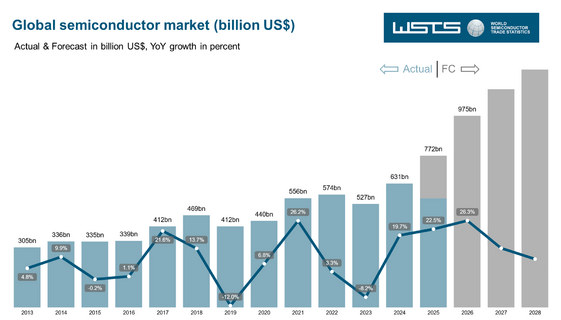
The upward revision is mainly driven by logic and memory, boosted by AI-related applications and continued demand in computing and data centre infrastructure. Logic is now expected to grow 37% (up 8 percentage points) and memory 28% (up 11 percent points). Other product categories are improving after the 2024 down-cycle, but the recovery remains moderate: sensors +10%, microprocessors +8%, analog +7%, and optoelectronics with +4%. The discretes product segment is expected to decline slightly, mainly due to ongoing weakness in automotive applications.
Regionally, the Americas and Asia Pacific are expected to expand by 25 to 30%, reflecting the strength in logic and memory. Europe is projected to grow 6%, while Japan is set to decline by 4%.
2026 outlook: continued global semiconductor growth towards nearly $1Tn
For 2026, WSTS forecasts the global semiconductor market to grow by more than 25%, reaching $975 billion. Growth is expected across all regions and product categories. Memory and logic are again projected to lead, both increasing by over 30% year over year. Most other product categories are expected to continue their gradual recovery, expanding at a more moderate pace.
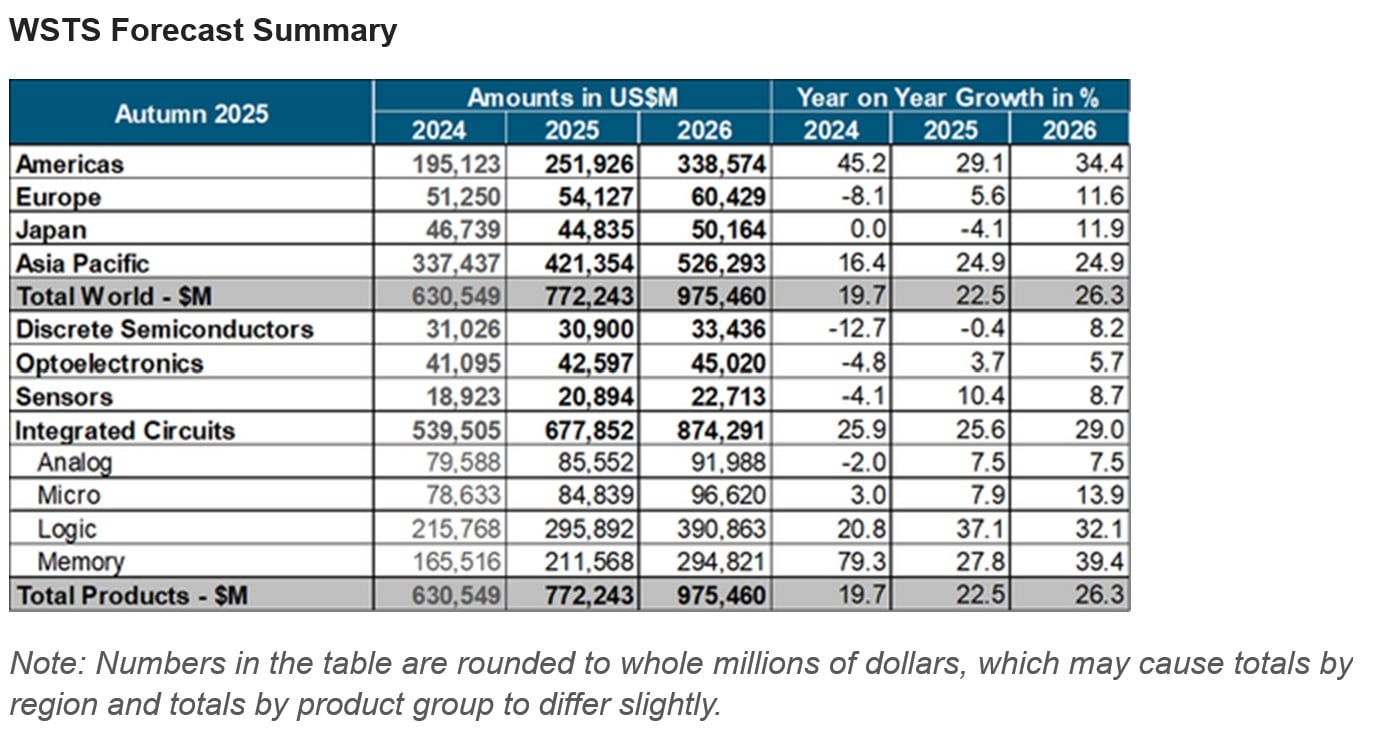
Regionally, all major markets are expected to expand. The Americas and Asia Pacific remain the strongest contributors, while Europe and Japan are forecast to see low double-digit growth.