
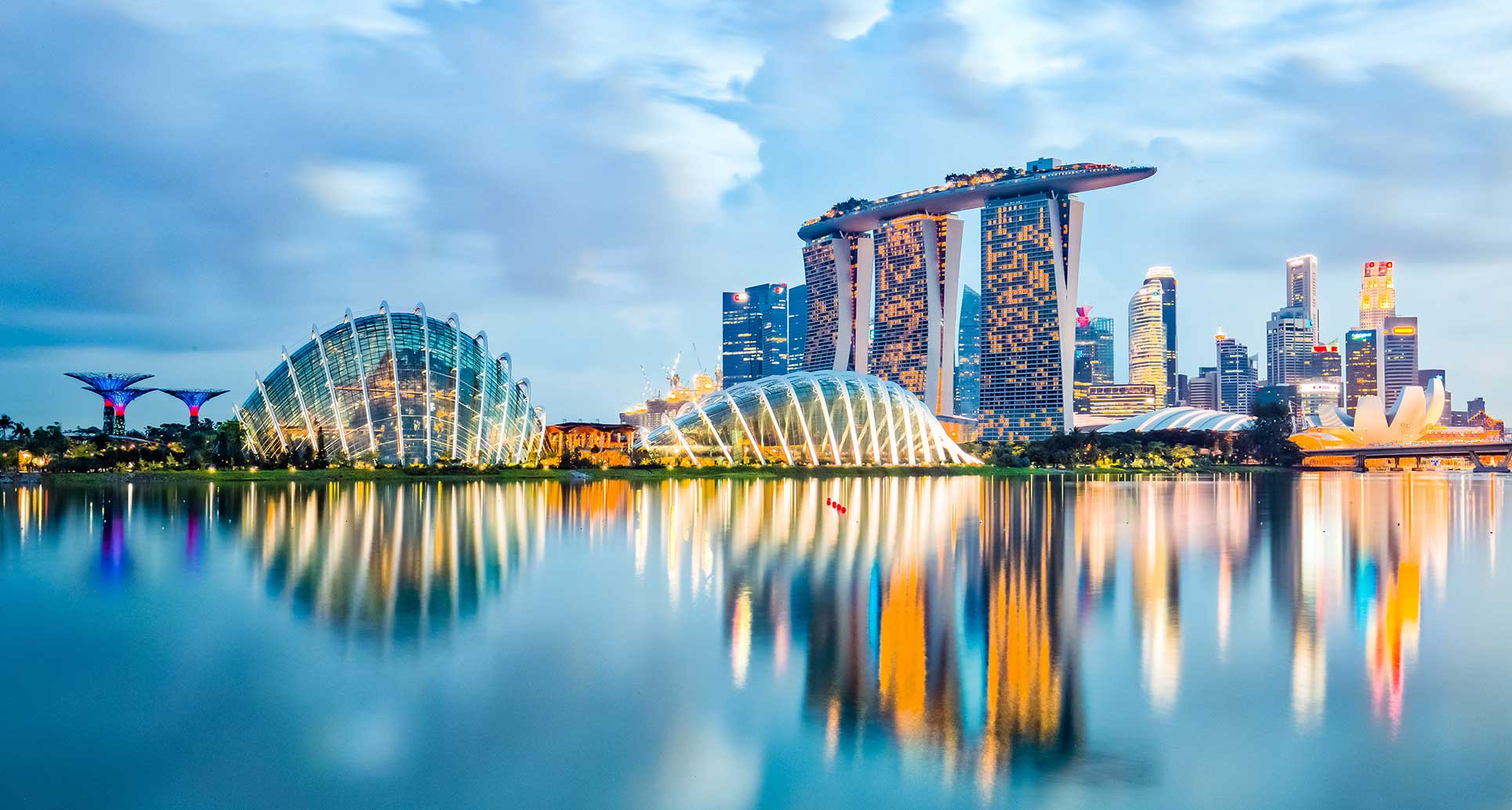
In a speech delivered by Alvin Tan, Minister of State for National Development of Singapore, he listed three key reasons why Singapore is important in the global semiconductor industry: its reputation as a safe and trusted country, its strong ecosystem and infrastructure, and governmental support.
His reasoning and belief in the part Singapore has to play in the wider semiconductor space is not necessarily a new take on what has been a country with deep-rooted
know-how in manufacturing, but reflects how Singapore is looking to position itself in the post-tariff era.
Why Singapore?
Singapore has a storied history in semiconductor manufacturing: National Semiconductor, which later became part of Texas Instruments in 2011, set up the country’s first semiconductor facility in 1968. Fairchild and Texas Instruments shortly followed suit. More than 7,000 jobs were created in three years thanks to those companies setting up operations.
In 1986, Singapore dipped its toes into the waters of foundry manufacturing when it established Chartered Semiconductor Manufacturing, which was later acquired by GlobalFoundries in 2010.
These early investments went a long way in establishing Singapore as a semiconductor hub and generating over a dozen semiconductor fabricators with $1 billion or more in investment.
Today, electronics manufacturing is the bedrock of Singapore’s manufacturing sector. Singapore plays host to both domestic manufacturers – such as UTAC Holdings, Avi-Tech Electronics, Systems on Silicon Manufacturing Company (SSMC), and AEM Holdings in the field of test and assembly; Excelpoint Technology, Multi-Chem, and Ellipsiz DSS are distributors – and international. Infineon, UMC, MediaTek, and Qualcomm all have bases in Singapore.
Its semiconductor industry spans the entire value chain, from integrated circuit design to wafer fabrication, packaging, and testing.
To return to the question of ‘why Singapore’ that Minister Tan addressed in his speech, its prime location, robust infrastructure, and pro-business policies are all extremely attractive to semiconductor companies.
The proof can be found in the number of investments being made. EDB reported earlier this year that geopolitical tensions and economic uncertainties would pose challenges in 2025, but it also reported a rise in investment commitments in 2024. The electronics sector was responsible for 57% of total investment commitments, thanks to the growth of AI and digitalisation.
Micron, UMC, Vanguard International Semiconductor, NXP Semiconductors, and Pall are just some of the names that have broken ground with new facilities they have unveiled in the last year or so. UMC’s facility, for instance, hopes to start volume production in 2026 – a move that will increase UMC’s total production capacity in Singapore to more than one million wafers annually, and draw on its 22nm and 28nm solutions.
Pall invested $150 million into its facility, which will produce lithography and wet-etch filtration, as well as purification and separation solutions to meet growing demand for advanced node semiconductor chips necessary for AI applications.
A chance to capitalise
However, increased competition from countries like Taiwan, China, and South Korea means that Singapore has not necessarily enjoyed a position of dominance in recent years. For example, in 2022 China had an 18.2% share of integrated circuit production for 8” wafers, and by 2024 this had increased by 20.1%. Meanwhile, the rest of the world (including Singapore) shrunk from 7.5% to 7.1% – a figure that is expected to reduce even more. This is according to figures supplied by the Taipei Representative Office in Singapore in November 2024.
This has been compounded by increasingly protectionist policies from the US and its push for domestic manufacturing on homegrown soil culminating in President Trump’s announcement of a 100% tariff on imported semiconductors (at the time of writing). Singapore may yet emerge as a desirable location for semiconductor manufacturing, one whose history and expertise will prove a boon for companies looking to avoid steep tariffs on manufacturing imposed on Taiwan and China. Singapore’s status as a major shipping hub may come into play, also.
A report from Oxford Economics in March 2025 speculated that the US’ desire to become self-sufficient in manufacturing semiconductors will take years to realise due to the complexity and cost, and in the duration period, it will need to turn to alternative suppliers. Outside of Taiwan, Singapore is a key producer. It also has a further notch in its belt in the form of Micron and GlobalFoundries, both American companies, operating in the country. The report concluded that Singapore is due to be the regional winner from trade re-routing and re-exporting.
Furthermore, its 10% tariff figure may prove attractive to those looking to avoid Taiwan’s 20%, or China’s 50% (at the time of writing). In April 2025, Singapore set up a multi-agency taskforce to support businesses and workers in navigating the impact of US tariffs through the distribution of information and coordination of support.
Although the 10% of tariffs levied against Singapore – who were hoping the pre-existing Free Trade Agreement it has enjoyed with the US might safeguard them – is not ideal, Singapore has a real chance to capitalise.
Ultimately, it will need to continue to pour serious money into its semiconductor industry if it wants to compete on a global stage. It is already doing this through opening new facilities that will support research and development of advanced technologies like GaN and training a new semiconductor workforce.
In March 2025, the government unveiled a $500 million national fabrication facility, which will offer research and fabrication expertise to Singaporean semiconductor companies and startups. The facility has cleanroom infrastructure and industry-grade tools.
It has been established under the National Semiconductor Translation and Innovation Centre (NSTIC) which was first set up as the National Gallium Nitride Technology Centre (NGTC) to address challenges faced by companies including limited local access to facilities and closer collaboration across the ecosystem needed.
NSTIC was officially opened in June 2025. It marks the country’s first national facility dedicated to working on GaN semiconductors and will provide companies with the capabilities needed to compete in markets like communication systems, radar, and satellite communications. It will include 6” GaN-on-SiC and 8” GaN-on-silicon wafer fabrication lines and advanced GaN technology with the gate length less than 0.1 micrometres and operation frequencies above 100GHz.
From mid-2026, the facility will offer commercial foundry services and prototyping and fabrication in a deliberate move to reduce reliance on overseas manufacturing.
Singapore’s semiconductor workforce sits at around 35,000 people. But with new facilities opening and investments from international companies increasing, the country has recognised a pressing need for training the next generation.
In November 2024, the Ministry of Manpower created three new semiconductor-related roles to its Shortage Occupation List (SOL) to support the industry in meeting labour shortages and skill gaps. These occupations are evaluated against three criteria:
• Importance to Singapore’s economic priorities
• Degree and nature of the labour shortage
• Sector’s commitment to developing the local pipeline
To this end, the Institute of Technical Education has signed MoUs with GlobalFoundries, Micron, STMicroelectronics and A&STARs for student internships and industry exposure. The Economic Development Board (EDB) also partners with companies through platforms like the Singapore Industry Scholarships and Industry Postgraduate Programme which looks to attract more young people.
Looking ahead
Stiffer competition from emerging players like Malaysia and Indonesia – who are all trying to attract investment – means Singapore will need to continue its own investments and focus on becoming the semiconductor manufacturing power it once was.
The US’ tariffs, although challenging for semiconductor companies, could lead them to Singapore, whose pro business environment, growing number of advanced facilities, and existing expertise could prove extremely attractive, and put it in better stead for the future. What the manufacturing environment will look like after the tariffs remains unclear, but one thing is for certain: Singapore wants to be on top.
Key facts:
• One in 10 chips globally are made in Singapore
• One fifth of semiconductor equipment production is in Singapore
• The electronics industry represents 6% of Singapore’s GDP (8% at its peak in 2022)
• Approximately 35,000 people are employed
• In 2022, for every S$100 of GDP, the semiconductor industry contributed S$8
By Caitlin Gittins, Editor, Electronic Specifier
This article originally appeared in the Sept/Oct issue of Procurement Pro.