





The global RF industry is entering a new phase. For over a decade, smartphones drove its growth. Now, the market faces a short-term reset. Defence, automotive, and early 6G lead the way.
Against this backdrop, Yole Group is releasing its latest report, Status of the RF Industry 2026. The report covers the market, the ecosystem, the supply chain, and the technology trends shaping the industry’s future.
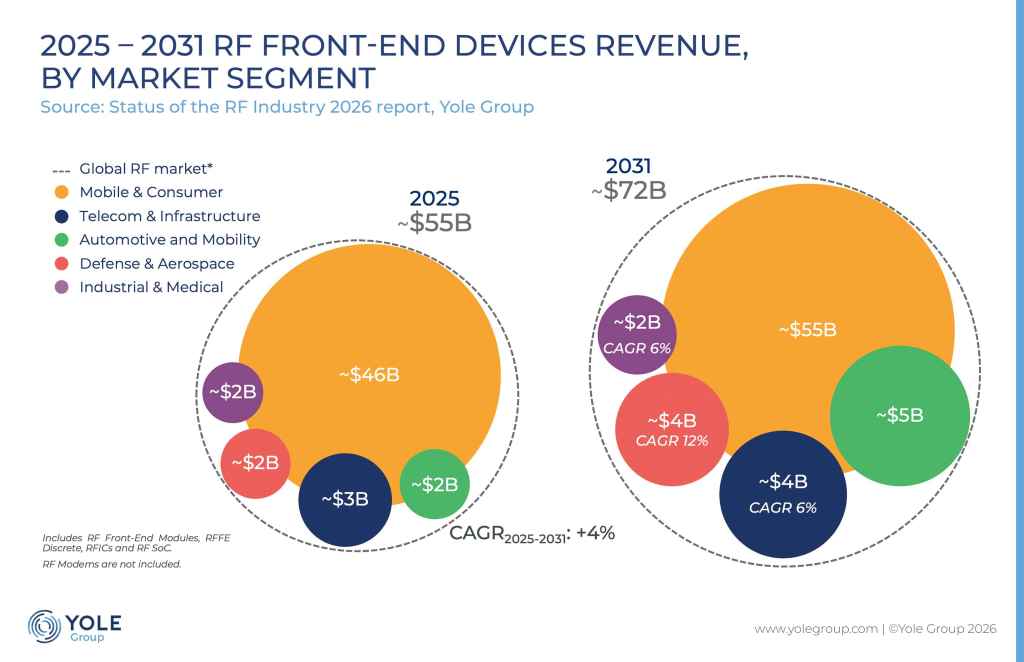
2026 brings a slowdown with smartphone shipments dropping around 13% year over year, especially in the mid- and low-tier segments. As a result, the market is expected to be worth $55.8 billion in 2026, flat versus 2025. Smartphone shipments are expected to normalise after that. RF SoC, RFFE modules, and discrete devices markets are being hit hard as they scale directly with handset volumes.
“2026 looks like a pause. It isn’t a plateau. Indeed, the centre of gravity is shifting. Smartphones matter less. Defence, automotive, and 6G matter more. That’s where the real growth is building,” said Cyril Buey, Technology & Market Analyst, Radio Frequency, at Yole Group.
Structural growth engines continue moving, whatever the consumer cycle does.
Defence & aerospace will grow to about $4 billion in 2031. Radar and electronic-warfare modernisation drive this. So does sovereign procurement. So does the shift toward mass-produced drones and counter-UAS systems. This demand relies more on GaN-based discrete power devices.
Automotive & mobility grows even faster, to more than $5 billion. Radar, V2X, and ADAS adoption push volumes higher every year.
The competitive landscape is also consolidating. Qualcomm remains the largest RF-device supplier globally. Broadcom, Skyworks, Qorvo, Murata, and NXP follow. MediaTek and Samsung hold strong positions in high-volume Asian markets.
At the top, Skyworks and Qorvo signed a merger agreement in late 2025. Together, they form a US-based RF, analog, and mixed-signal leader.
It’s a direct response to Chinese competition and a slower growth outlook. On the other hand, Chinese suppliers continue expanding. Maxscend, Vanchip, Smarter Micro, and a returning HiSilicon are building out the country’s domestic RF supply chain.
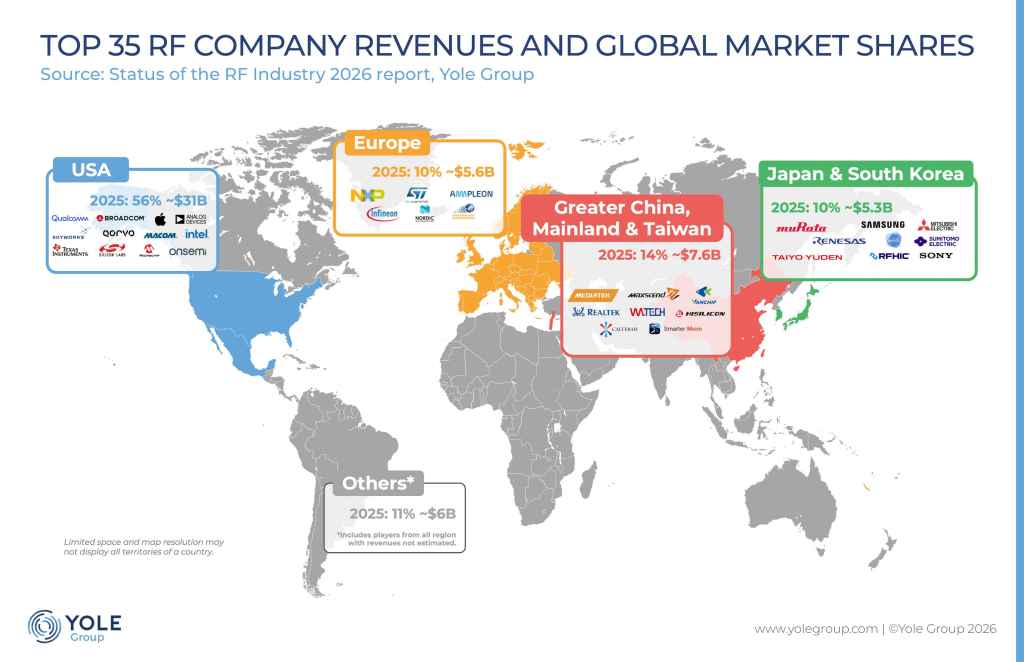
Regionally, the US holds roughly 55% of global RF revenue. It leads in mobile & consumer and in defence & aerospace. China holds around 14%. It invests heavily in consumer, its weakest segment. It also builds capacity for telecom infrastructure ahead of 6G. Europe holds roughly 10%. It leads the fast-growing automotive segment, through NXP and Infineon Technologies. But it depends on external semiconductor technology for defence. That’s a strategic gap. Japan and South Korea hold about 10% combined. They remain concentrated in filters and RF SoCs, not in the segments driving the next growth cycle.
Looking further out, 6G, defence, and space define the 2029-2031 trajectory, with new RF front-end content. Telecom infrastructure revenue has hovered around $3 billion for three years. It’s expected to climb to roughly $4 billion by 2031, driven by advances in 5G and early 6G massive MIMO architectures.
Demand continues to build across defence, automotive, and space. Understanding the RF industry’s evolution matters more than ever. This applies to device manufacturers, module suppliers, equipment providers, system integrators, and investors alike.