






Even given the turbulent macro-economic and geopolitical environment, the shortages of some key semiconductors and capacitors that members of both the UK’s Electronics Components Supply Network (ecsn) and the International Distributors of Electronics Association (IDEA) are currently experiencing really should not be happening. There was – and still is – sufficient manufacturing capacity across the electronic components supply network to sustain modest, low single digit growth across the professional, industrial, medical, and automotive markets in 2026.
According to Adam Fletcher, Chairman of both professional associations, a return to the panic buying and selfish, multiple ordering by customers last seen during the COVID-19 pandemic is frankly ridiculous and can only exacerbates the problem for all.
In common with many other analysts, I suggested throughout 2025 that UK-based system integration companies (customers) were lagging way behind their peers in other geographic markets and failing to place sufficient order cover with their suppliers.
Our concern was that if global economic activity improved and manufacturers’ lead-times for electronic components, which remained elevated and for any reason, started to extend beyond the then current average of 16 weeks, UK customers could experience supply shortages. We strongly advised customers to help mitigate possible supply problems by reviewing their organisations’ needs against manufacturer lead-times and, where required, add a modest increase in future order cover to strengthen their material pipeline.
Extending lead times = more order cover needed
All inventory control systems reflect increases in manufacturer lead-times by suggesting an equal increase in both order cover and safety stock levels. Experience has proven that an effective (not necessarily the most efficient) operational inventory pipeline is for customers to hold a little more in-house inventory and have a strong, reasonably accurate inventory pipeline with their suppliers that has modest flexibility for reschedules both in and out. This is less expensive for customers than the alternative of constantly chasing suppliers to expedite delivery and risking the production line stops that lead to an inability to ship their end products. Sadly, many customers are again reacting by increasing their order cover on their existing (and new suppliers) way beyond what their organisation requires by double, and even triple ordering, which is further skewing the market. If this trend continues and is replicated globally, lead-times will quickly extend further and trigger a vicious circle that will only exacerbate global supply network problems.
Change – dramatic order increase
The ‘green circle’ in the graphic All Industrial Components demonstrates the reason for my concern. The ‘blue line’ compares monthly Book (New Orders) to Billing (Invoiced Shipments) and shows that the ratio between the two has consistently been well below unity (=1) throughout most of 2025. UK customers consistently failed to provide sufficient order cover with their suppliers against extending manufacturer lead-times to meet their future production requirements.
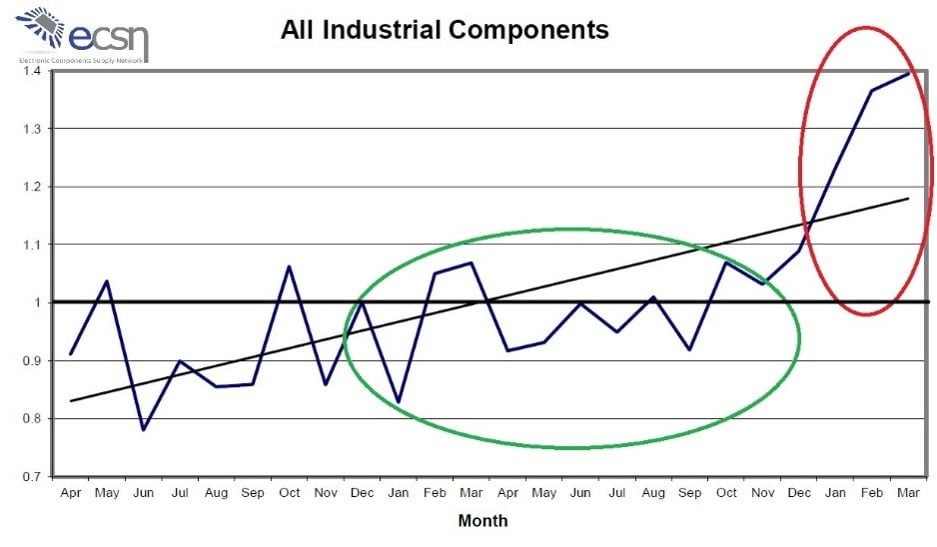
In their forecast for 2026, released at the beginning of December last year, ecsn member companies forecast that both Booking and Billings would likely increase in line with the overall UK economic activity in Q1’26, albeit very slowly. In November and December the Book-to-Bill (B2B) ratio improved to 1.1:1. In normal times (and that’s a long time ago!) a B2B ratio in the range 1.05:1 to 1.1:1 would have been considered ‘normal’ and indicative of a strong industry growth cycle, but the ‘red circle’ on the graphic revels a very different outcome! The overall B2B ratio for all components jumped to 1.40:1 in March ‘26 and this trend looks likely to continue into Q2’26 and beyond.
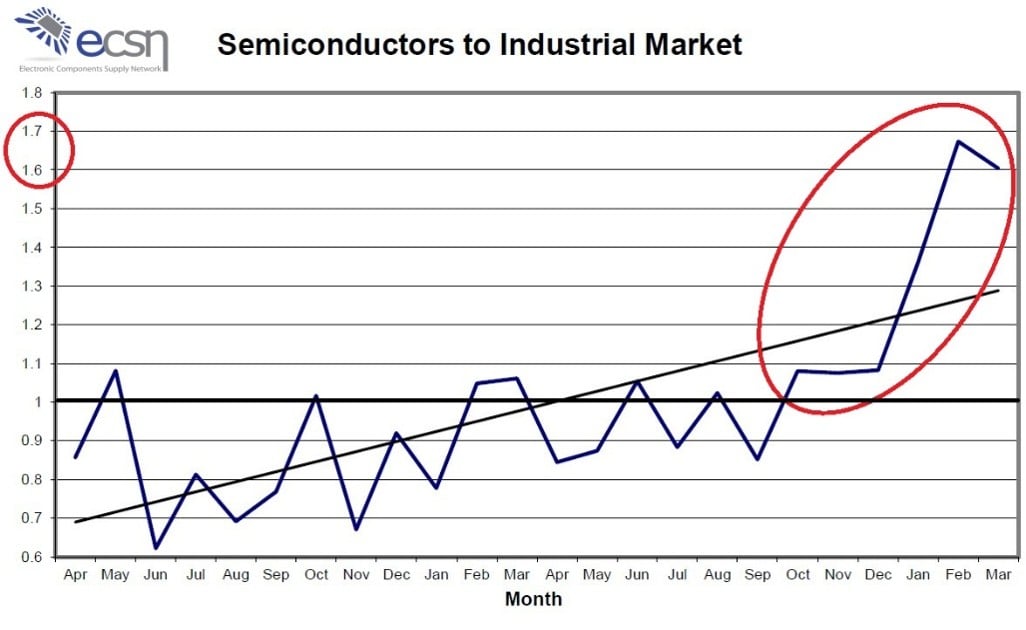
The graphic Semiconductors to Industrial Market covers the past two years and reveals that the B2B outcome over the last 17 months has been fairly consistently below unity. In January ’26 (circled in red) however, the semiconductor products B2B ratio achieved 1.1:1 before going ballistic, climbing to 1.67:1 in February and falling back (??) to 1.60:1 in March. This is crazy and a wholly unsustainable bookings trend that will inevitably herald a return to the major supply problems that the electronic components supply network had to contend with at the end of the COVID-19 pandemic.
Inadequate demand forecasting
Ideally, electronic components manufacturers and their authorised distribution partners would like their customers to provide them with a rolling six-to-nine-month order cover, linked to a reasonably accurate longer-term forecast of their organisations’ likely demand. Unfortunately, for many years, most customers have been unable to provide either and as a result, and compounded by spurious order patterns, authorised distributors are continuing to struggle to provide accurate forecasts to component manufacturers who, in turn, are struggling to effectively allocate their existing assets, let alone plan future investment in manufacturing capacity. Investment has been severely restrained across the board and manufacturer lead-times for electronic components remain much longer than in the pre-COVID-19 era.
Despite the difficulties, demand forecasting has principally fallen to manufacturer authorised distributors who support 98% of the global customer base and, pre-COVID-19, were reasonably successful in providing accurate demand dates to the manufacturers they represent and the wider industry. The product and inventory groups at authorised distributors apply regression analysis to their known sales history and add market and proprietary customer intelligence to determine the inventory levels necessary for their organisation to support their many 1,000s of customers. Part of the current problem is that the historic patterns of customer order and shipment history post-COVID-19 are deeply flawed and so any regression analysis leads to inaccurate results, a classic case of Rubbish In = Rubbish Out (RIRO). As a result, components manufacturers are only committing capacity expansion where there is proven demand and return on capital.
Non-cancellable and non-returnable
During the COVID-19 period many, probably justifiable, concerns were raised about the availability of a wide range of electronic components. Many customers struggled to find the (relatively) small quantities of the components they needed via their existing supply network partners and resorted to purchasing via brokers on the ‘grey market’, further exposing their organisation to risk. Widespread fear, uncertainty, and doubt (FUD) encouraged larger customers to place order cover on their suppliers far beyond their organisations’ real demand. Many resorted to ‘multiple ordering’, placing the same order on many suppliers with the cynical intention of cancelling once any one supplier delivered.
Then – as now – the unhealthy practice of multiple ordering was a major headache for manufacturers of electronic components and their authorised distribution partners, who eventually concluded that the only realistic way to curb the practice was to make all new orders non-cancellable and non-returnable (NCNR in the jargon). No organisation wants to invoke NCNR contract terms. Its widely viewed as a ‘sledgehammer to crack a nut’, especially by customers who have enjoyed many years of successful business relations. A Board Director of the purchasing organisation is generally required to sign a NCNR agreement because it places an absolute commitment on the customer company to purchase and pay for the goods, to agreed terms and accept all the subsequent financial liability.
Some major customers in Asia have even gone to the lengths of issuing ‘Bonds’ (high interest financial instruments) secured against the assets of their organisation to raise cash to fund the large inventory purchases they need to ensure they have sufficient inventory to support their production requirements. These organisations are, in effect, hoarding for their exclusive use large volumes of the inventory that would otherwise be available to support the wider market. Some are even seizing the opportunity and offering to resell some components back to the market at inflated prices to those third-party organisations desperate to source components to meet their production needs.
Inventory hangover
As the COVID-19 pandemic subsided, electronic components supply networks began to return to balance, but in an environment of lower overall global economic growth due to the prevailing economic conditions at the time. Many customers that had signed NCNR contracts faced a double whammy of lower than anticipated customer demand and highly inflated component inventories. It has taken over two years to consume most of the ‘inventory hangover’ that resulted from of the COVID-19 era and even today that has only now been 85% consumed.
In conclusion
In these difficult times I encourage purchasing professionals in the electronic components supply network to actively and positively engage with all of their partners, both up and down their supply network. A greater focus on identifying and honestly reporting ‘real’ customer demand rather than artificially inflating order books will go a long way towards mitigating current problems and minimising the exposure of all to higher levels of risk. I encourage all partners in the electronic components supply network to embrace the new ‘normal’ and actively and positively engage with their partners. Continued successful collaboration throughout the electronic components supply network is essential if we’re to successfully mitigate the issues just around the corner and the others potentially looming just over the horizon.
This article originally appeared in the May/June issue of Procurement Pro