






Component shortages, discontinued parts, and supplier changes can force manufacturers to revise an electronic product that is already in production. For engineering and procurement teams, finding a replacement that fits and works is an essential first step. Before the revised product is released, there is another question to resolve: does the documentation supporting its EU compliance still apply?
This article is for engineers, procurement managers, and the people responsible for product compliance at electronics manufacturers selling into the EU. It explains how these teams can review a component substitution, identify missing information and decide when to involve a specialist or laboratory.
At a glance
- When a component changes, review the evidence supporting the revised product, even if it still passes its functional checks
- Full retesting is not automatically required. The next step depends on what changed and whether existing evidence still supports the new build
- Record the decision before release: what evidence remains relevant, what information is missing and what further assessment is needed
- The accompanying Component Change Review for Electronics provides a worked example, an evidence matrix and questions for your laboratory
Why a working replacement still needs a review
Imagine that a supplier can no longer deliver a power converter used in an industrial sensor. Procurement finds an alternative, engineering checks that it provides the required output, and the sensor operates as expected. The substitution appears to solve the production problem.
The product’s compliance records, however, were assembled for its earlier configuration. These records may include test reports, supplier declarations, design information, and the manufacturer’s assessment of the applicable requirements. They form part of the technical documentation, often called the technical file, that supports the product’s CE marking.
A replacement component can change characteristics that routine functional checks do not establish. A different power converter, for example, may change conducted and radiated emissions and the sensor’s immunity. Its supplier’s materials documentation may also differ from that of the original part. The team therefore needs to check whether the earlier evidence remains relevant and where additional information is needed.
This example covers two review areas. Electromagnetic compatibility (EMC) is the ability of equipment to work properly in its electromagnetic environment without disturbing other equipment. RoHS restricts certain hazardous substances in electrical and electronic equipment. Reviewing both helps the team identify what must be resolved before shipment.
The following example turns that review into four practical steps, from identifying the changed build to recording the release decision.
Does a component change mean you must repeat CE testing?
A component change does not automatically require retesting. CE marking is based on the applicable conformity assessment and supporting technical documentation. An existing test report describes the configuration assessed; it does not independently establish that every later revision is covered.
The review may justify retaining existing evidence, requesting supplier information, carrying out targeted checks or commissioning additional testing. The decision depends on the actual change, applicable legislation and assessment route.
For series production, EMC Directive Article 7(4) requires manufacturers to account for changes in design, characteristics and referenced standards. RoHS also requires relevant changes to be taken into account. The 2022 Blue Guide, section 2.1 explains in its discussion of modified products that tests and documentation need not be repeated for aspects unaffected by a modification. The manufacturer must establish and document which aspects are unaffected; this is not an automatic exemption for a replacement part.
Worked example: replacing a DC/DC power converter
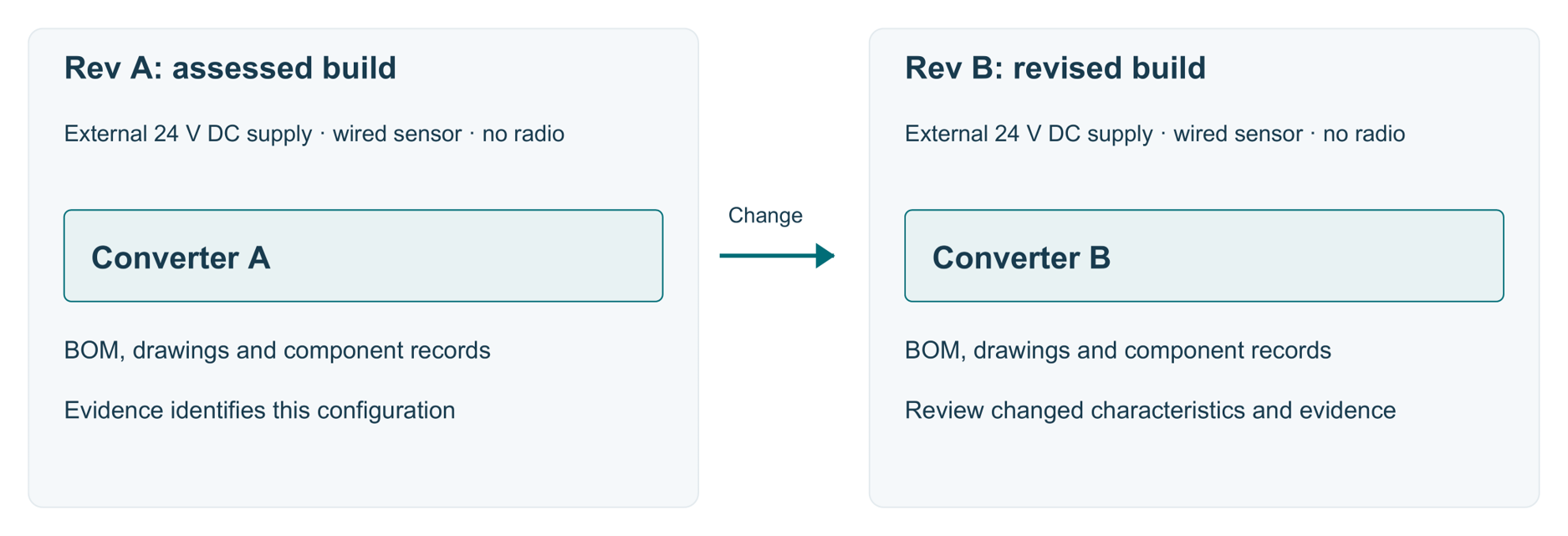
Consider a fictional wired industrial sensor supplied from an external 24V DC source, with no radio transmitter. Procurement replaces converter A with converter B after a supply interruption.
Both provide the required output. But switching characteristics or implementation requirements may differ, potentially affecting electromagnetic performance. The previous supplier’s materials records may also fail to identify the new component.
Functional compatibility is a fact to record. Equivalent compliance performance is a conclusion to support.
Step 1: Identify the changed build and the assessed build
Start with two configurations: the product now being manufactured and the product represented by the evidence.
Record the old and new part numbers, suppliers and datasheet revisions. Capture associated changes to the PCB, enclosure, cables, accessories or firmware. Then check the report’s hardware revision, relevant operating modes and test setup. Under EMC Directive Annex II, point 2, the assessment must cover the configurations the manufacturer identifies as representative of the intended use.
The useful output is a traceable change record, linking the engineering change notice, updated bill of materials and affected reports. A shared product name is not enough to establish that link.
Step 2: Map the substitution to an evidence gap
Ask what the changed characteristics could affect.
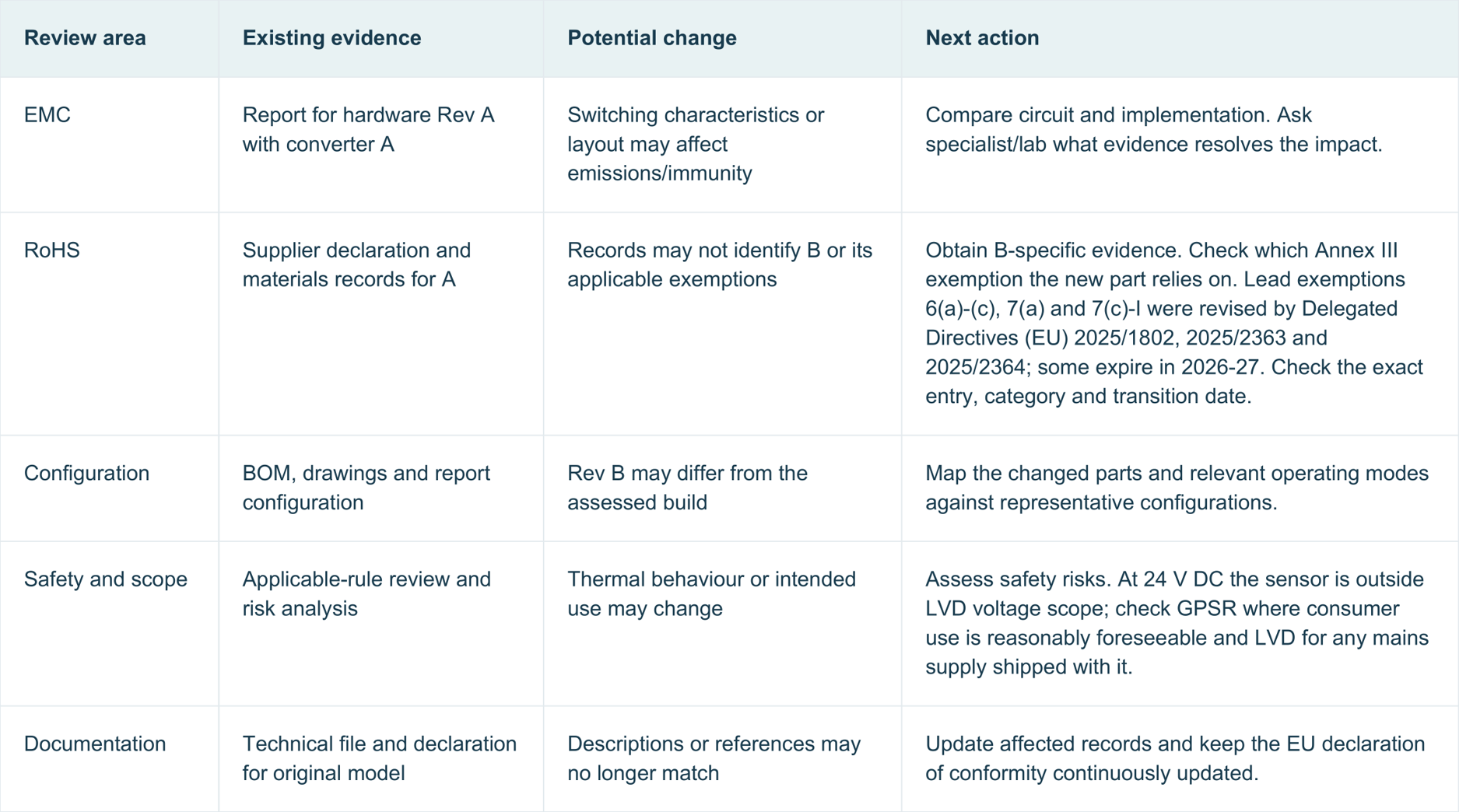
For the converter, an EMC specialist may need to review the circuit differences, operating conditions and earlier emissions or immunity assessment. For RoHS, obtain replacement-part evidence and assess whether it supports the applicable restrictions and any claimed exemptions.
Also check REACH: a new part containing a Candidate List substance above 0.1% by weight in an article triggers Article 33 communication duties and, for EU suppliers within scope, SCIP notification under the Waste Framework Directive.
Use a compact matrix to connect each review area to the original evidence, possible gap, and next action. Separate confirmed information from assumptions.
Other substitutions need their own reasoning. A radio-module or antenna change may affect radio evidence; a new enclosure material may affect safety characteristics.
Step 3: Help the laboratory understand what changed
‘Do we need to retest?’ is difficult to answer without the differences.
Provide the original report, old, and new bills of materials (BOMs), relevant datasheets, circuit or layout changes and intended operating modes. Explain the uncertainty you need resolved.
Ask the laboratory the following questions.
- Which earlier results remain relevant to the revised build, and why?
- Which changed characteristics could affect conformity?
- What additional information or targeted assessment would resolve the gap?
- Which configuration, accessories, and limitations will the resulting report identify?
Record the agreed scope. A test quotation is not a completed evidence review. Where the EMC EU-type examination route is used, Annex III, Module B, point 7 requires the manufacturer to inform the notified body of modifications that may affect conformity or certificate validity; these need additional approval. RED Annex III, point 7 is the corresponding reference for radio equipment, not this wired sensor.
Step 4: Record the release decision
Close the review with evidence and an accountable decision.
Update the affected technical documentation and keep the EU declaration of conformity continuously updated, as required by EMC Article 15(2). Check the instructions and identification information for necessary changes. Keep the historical reports and connect each product revision to the records supporting it.
If the change touches firmware or adds connectivity, reassess cybersecurity scope: RED cybersecurity requirements concern specified categories of radio equipment. The Cyber Resilience Act’s main requirements apply from 11 December 2027 to products within its scope; its vulnerability and incident reporting duties already apply from 11 September 2026.
Procurement supplies replacement-part information. Engineering explains the implementation. The designated conformity owner coordinates the assessment; the manufacturer retains its responsibilities.
A useful internal release gate asks one question: can the reviewer explain which evidence supports this build and why? If a material evidence gap remains unresolved, record the action needed before approval.
Download the component change review briefing
EcoComply’s Component Change Review for Electronics includes the worked example, a reusable evidence matrix, laboratory questions and a release worksheet.
Download the Component Change Review for Electronics