





Advanced packaging has become the place where AI system performance is won or lost. High-end performance packaging revenue is forecast to grow to more than $51 billion in 2031, a 27% CAGR during 2025-2031, with package unit volume expanding at a 33% CAGR and wafer demand at 30%. The gap between those three figures tells the story: packages are not only shipping in greater numbers but are becoming larger and more complex.
Against this backdrop, Yole Group releases the new edition of its annual report, High End Performance Packaging 2026. It defines what qualifies as high-end performance packaging, analyses the market drivers, benefits, and challenges by application, describes the technologies and their roadmaps, maps the supply chain and competitive landscape, and provides a market forecast for the coming years.
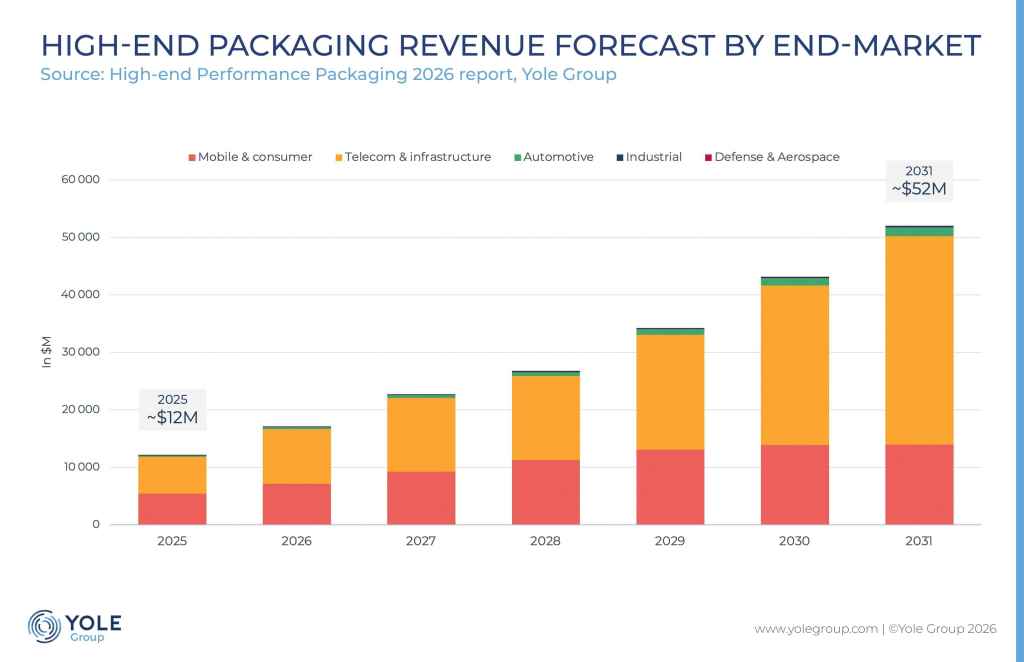
Telecom & infrastructure is the key driver, growing to more than $36 billion in 2031 and rising to 70% of total revenue, driven by surging demand for AI GPU/ASIC packages, HBM integration, and CPO optical engines. Mobile & consumer remains the second-largest end market, anchored by Apple, Huawei, and Intel client CPUs, while automotive is the fastest-growing in relative terms at a 36% CAGR, as ADAS and high-density compute modules adopt 2.5D and 3D packaging.
By application, 3D NAND with wafer-to-wafer hybrid bonding is currently the largest segment by revenue, growing at a 22.2% CAGR, reports Yole Group’s semiconductor packaging experts.
The mould interposer segment of CoWoS-L remains the largest and fastest-growing 2.5D segment with a 28.1% CAGR, driven by ever-larger AI GPU and ASIC packages pushing toward reticle-size limits.
Co-packaged optics engine packaging grows from a negligible base in 2025 to several hundred million dollars by 2031, marking the arrival of 3D integration, including hybrid bonding, TSVs, and microbumps, in AI data centre optical networking.
3D hybrid bonding for logic, memory, and chiplets splits into two paths: die-to-wafer is the larger, at around 65% CAGR, led by TSMC SoIC adoption in AMD 3D V-Cache, Apple M Series SoCs, and NVIDIA Feynman GPUs, while wafer-to-wafer is smaller but faster-growing, driven mainly by Huawei Kirin mobile APUs using SMIC-manufactured LogicFolding technology.
“The reticle limit has become the constraint that shapes the roadmap. AI packages have grown to the point where current interposer formats cannot economically support the next generation of architectures, which is why CoPoS and CoWoP are being prepared for 2028-2029 rather than left as research topics,” said Yik Yee Tan, PhD, Principal Technology & Market Analyst, Semiconductor Packaging at Yole Group.
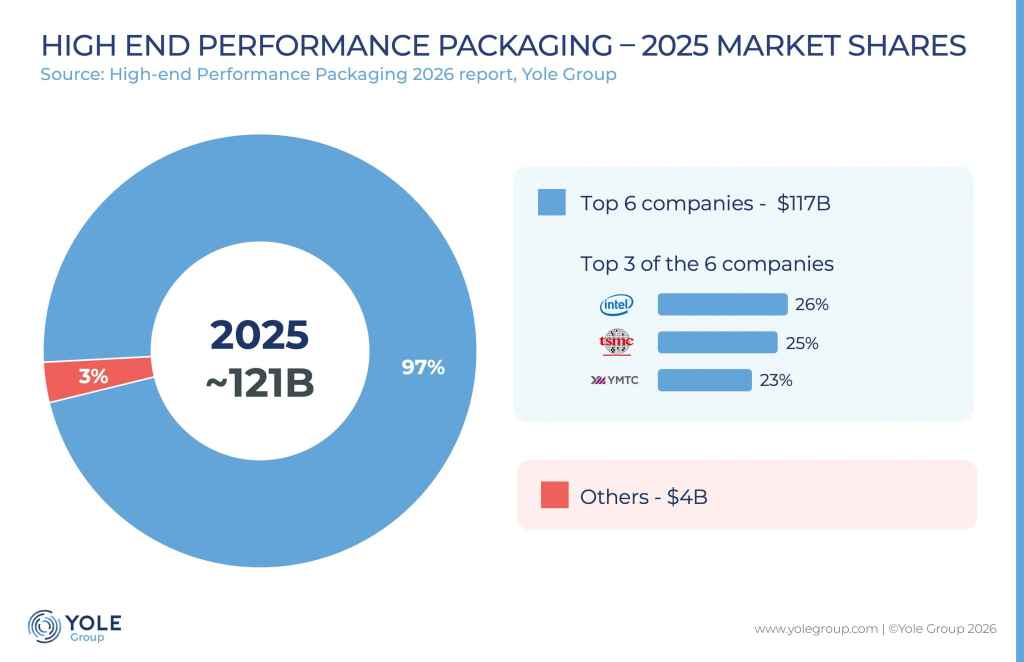
The ecosystem remains highly concentrated, with the top six players capturing around 97% of 2025 revenue.
TSMC anchors the whole 2.5D supply chain: chip-on-wafer stays foundry-captive, mainly in Tainan and Chiayi in Taiwan today and in Arizona in the future, while foundries such as UMC act as second-source interposer suppliers and on-substrate overflow builds a second supply chain at ASE/SPIL in Taiwan, Amkor in South Korea and later Peoria, and PTI in Taiwan. ABF substrates remain the concentrated upstream chokepoint. Intel runs an IDM-captive, US-centred flow with its Foveros silicon interposer and its EMIB and EMIB-T embedded silicon bridges, the latter adding TSVs for vertical power toward HBM4 and HBM4E, across Rio Rancho, Chandler, and Hillsboro, with capacity expanding in 2026 to Penang in Malaysia and a first OSAT outsourcing at Amkor Songdo in South Korea.
“Heterogeneous integration has turned packaging into a multi-vendor exercise. More than seven companies can now be involved in a single AI accelerator package, so supply chain design is no longer settled after the product is defined; it is part of product development from day one,” said Gabriela Pereira, Senior Technology & Market Analyst, Semiconductor Packaging at Yole Group.
With revenue set to nearly quintuple by 2031 and the technology roadmap splitting into several competing formats, the direction of high-end performance packaging has never been more critical for foundries, OSATs, memory makers, substrate suppliers, and their customers. The High End Performance Packaging 2026 report from Yole Group provides the market intelligence and technology insights needed to navigate this landscape and identify growth opportunities.