






The global electronic components market continues to be dominated by the exponential growth in demand for hyperscale computing (HC), creating what is effectively a two-speed market: growth in ‘traditional’ market sectors – industrial, automotive, medical, aerospace, and military – has been sidelined to a distant second place and particularly so in Europe. Sales revenue from HC applications in Europe is currently small but the impact that demand for parts to support the new applications is having a huge impact on our ‘traditional’ sectors.
In this article for Procurement Pro readers Adam Fletcher, Chairman of both the UK’s Electronics Components Supply Network (ecsn) and the International Distributors of Electronics Association (IDEA), reviews the latest European electronic components market performance data and provides some insight into what’s happening and what’s likely to happen over the next 12 months.
Manufacturer authorised distributors serve over 98% of the global customer base for electronic components but so far, their direct exposure to hyperscale computing applications has been minimal. Semiconductor suppliers such a NVIDIA, SK Hynix, Micron, and Samsung support the largest HC customers directly, who in turn install ‘systems level solutions’ into their new data centres, effectively bypassing their need for local sources of supply. A little local content still remains but it’s a relatively insignificant part of the overall investment.
Customers for electronic components in the European market principally engaged in the ‘traditional’ sectors are being negatively impacted by the triple whammy of restricted component availability, extended lead times, and escalating pricing, due primarily to inadequate manufacturing capacity but also to recent changes in the USA’s international trade policies and armed conflict in the Middle East. The latter two factors are unlikely to change anytime soon, but semiconductor memory manufacturing capacity is being added at a frightening pace. I predict that the extra capacity that will start to come on-stream by the end of this year will lead to, if not a collapse, a very significant fall in high bandwidth memory (HBM) pricing during the first half of 2027.
Q2’26 European semiconductor market overview
European suppliers of electronic components are also experiencing a two-speed market, driven primarily by demand for semiconductors. Tightening supply and increasing prices are driving ‘Bookings’ (new orders) to ridiculous, and totally unsustainable highs. There is evidence that demand for some passive components is following the semiconductor trend but demand for interconnect and e-mech components currently remains stable.
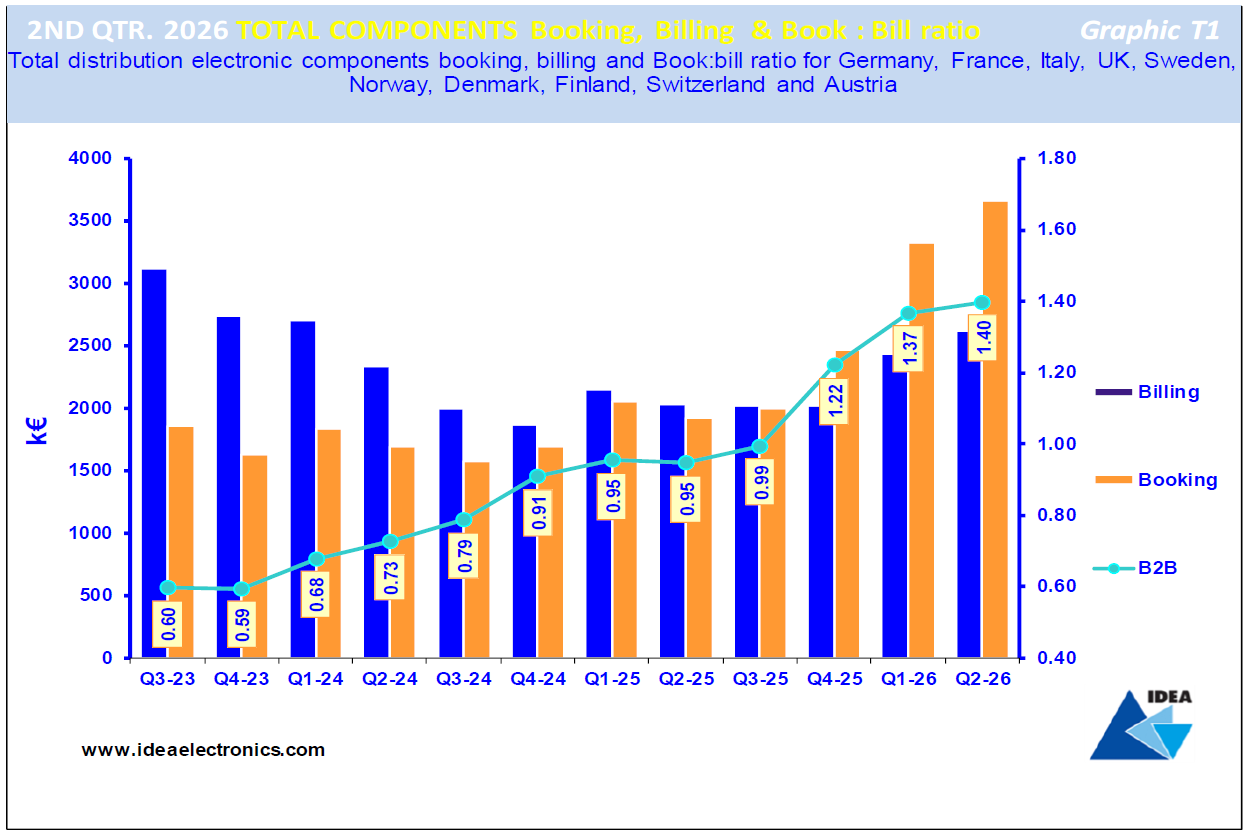
Graphic T1 Total Components Booking Billing and Book to Bill Ratio is a snapshot of the past three years. The orange bars in the graphic show how ‘Bookings’ started to grow in Q1’25 as customers in central Europe began to ramp up their order cover as a defence against extending manufacturer lead times. The blue bars show that ‘Billings’ (shipments invoiced to customers) failed to follow the same trajectory and remained essentially flat throughout the year before increasing modestly in 1H ’26. By Q4’25, customers in other European countries had also concluded that extending manufacturer lead times were indeed a reality and they started to add significant new order cover, primarily for semiconductors, but not always in a controlled manner. Authorised distributors have seen a significant increase in ‘double ordering’, a cynical practice which totally distorts the market and creates a much bigger problem for the entire industry to cope with.
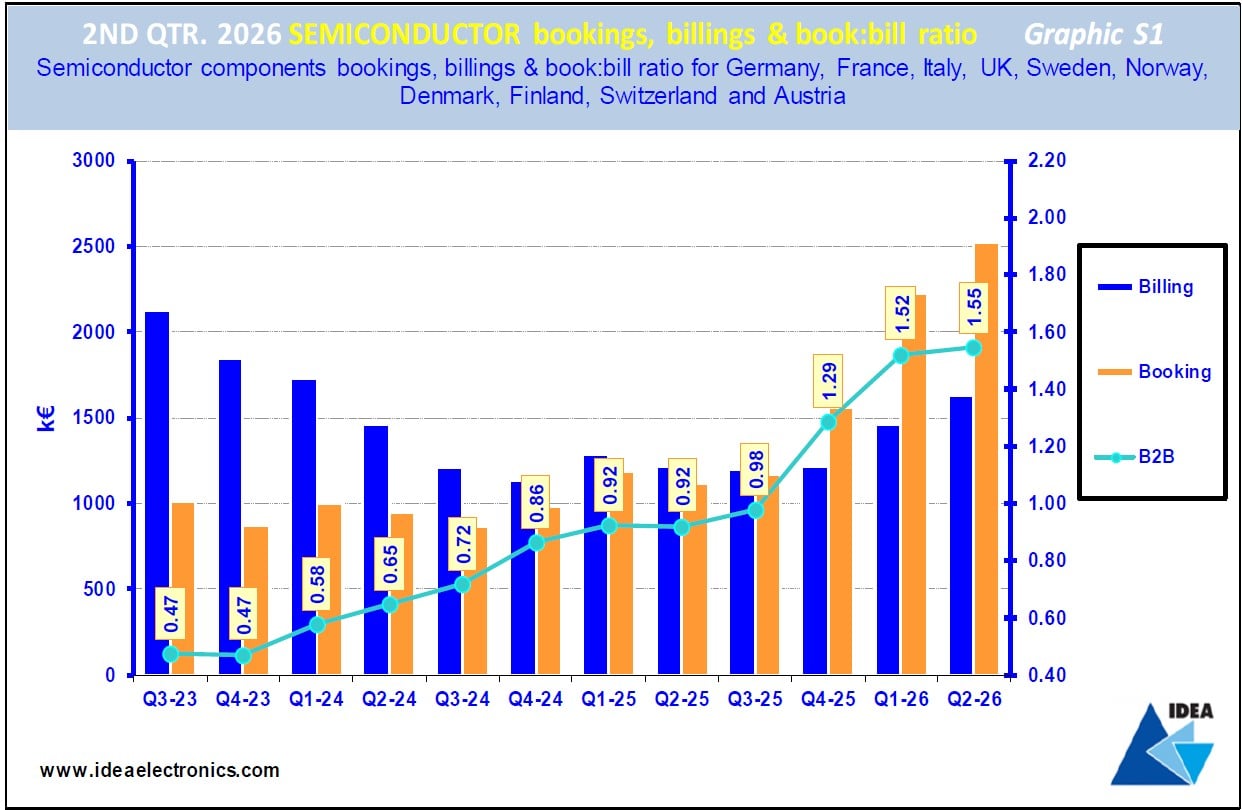
Graphic S1 shows what has been happening in the semiconductor sector over the past three years. The semiconductor Book to Bill (B2B) ratio remained massively below unity for nine consecutive quarters (27 months!) as customers began to consume (or scrap) the excess inventory they purchased during the COVID-19 pandemic. Unsurprisingly, ‘Billings’ also declined in the same period. Growth started to return in Q4’24 and continued to grow slowly throughout 2025 before accelerating slightly into 1H’26. The B2B ratio provides a very good indication of future demand and the ‘Billings’ (sales revenues) that will follow. However, the S1 graphic also highlights the current huge disparity between ‘Bookings’ and ‘Billings’ that is indicative of overstocking by both customers and the channel that will in turn inevitably trigger a rash of order cancellations and industry recriminations.
Real growth?
It is very difficult to determine what the real underlying growth rate is across the entire electronic components market. I generally resort to looking at what’s happening in the interconnect and e-mech sectors, which are highly influenced by overall market conditions but generally exhibit a lot less volatility. Accepted industry data suggests that the growth rate in Europe in 1H’26 was in the range of 11-13% but this was calculated only from reported sales revenues (not units shipped). If we add an element of price increases within this data, probably in the range 3-5%, the ‘real’ growth rate comes out at @8%, only slightly higher than IDEA members forecasted for the period.
Average Selling Prices (ASP) have been rising alarmingly, distorting the entire semiconductor market and significantly hampering investment. This is especially so in HBM products required for HC infrastructures. In most semiconductor cycles growth is defined by the increase in units shipped, but in the current cycle unit growth has been highly fragile and almost unprecedented low. Tae-won Chey, Chairman and CEO of SK Group recently noted that “a projected $100 billion operating profit environment during the AI transition period carries an equal and opposite $100 billion loss risk, due to rapid market shifts…” Chey’s comment demonstrates that industry executives understand the risks but are committed to making huge and potentially high-risk investments in new manufacturing capacity in a bid to capture market share and gain a dominant market position.
And into 2H’26
I suspect that in ‘traditional’ European markets – industrial, automotive, medical, aerospace, and military – ‘Bookings’ will cool off slightly towards the end of 2026 alongside low single digit ‘Billings’ growth. But in the interim, it’s likely that manufacturer lead times will remain extended and there will be sporadic shortages. Prices will, however, stabilise at close to current levels, where they will remain for some time. In the long-term, however, I expect pricing for electronic components in ‘traditional’ market sectors are going to rise because of falling economies of scale due to dispersed manufacturing locations and oil price driven inflation.
The HC market will continue to grow at pace. NVIDIA has recently advised financial analysts that demand for its products has the potential to double its sales revenues in the next 12 months but due to capacity constraints at its semiconductor foundry and assembly partners, the company will probably only achieve 70% revenue growth. The primary manufacturers of HBM will not be so fortunate: demand for these parts will remain robust but output from new manufacturing capacity investments by companies such as SK Hynix, Micron, and Samsung will far exceed this demand for at least five years, resulting in a price collapse for HBM parts. The demand for DRAM products for mobile phone and computer applications is slowing down somewhat but I expect that manufacturers will rejig their manufacturing capacity away from HBM towards conventional DRAM products, but I fear pricing here will also decline in line with the underlying demand.
In conclusion
The current supply situation in ‘traditional’ European technology markets is a big problem for all partners right across the global electronic components supply network, and there is zero chance that it will improve in the next quarter. A greater focus by purchasing professionals on identifying and honestly reporting ‘real’ customer demand rather than artificially inflating order books will go a long way towards mitigating current problems and minimising the exposure of all partners in the electronic components supply network to higher levels of risk. Continued successful collaboration is essential if we’re to successfully mitigate the current problems, the known potential issues just around the corner, and the other unknowns looming just over the horizon.
This article originally appeared in the Sept/Oct issue of Procurement Pro