




With the current industry upcycle, electronics manufacturers, procurement professionals, and distributors are seeing strong innovation and renewed demand, which is accelerating product velocity, shortening lead times, and increasing pressure on the global supply chain. The real test is whether fulfilment operations can scale efficiently while maintaining speed, accuracy, and customer experience.
At DigiKey, that challenge is uniquely tied to our operating model. Every day, thousands of products are managed, picked, packed, and shipped from a single fulfilment hub in Thief River Falls, Minnesota, to customers in more than 180 countries. As order volumes reach record levels, our focus has been on continuously improving the systems, processes, and logistics capabilities that make global fulfilment at this scale possible.
While many distributors have expanded through regional warehouse networks, DigiKey has continued to invest in a centralised model built around inventory depth, operational consistency, and global logistics excellence. By consolidating inventory into our highly automated nearly 300,000sqm product distribution centre (PDC), customers have access to the full breadth and depth of our product portfolio, no matter where they’re ordering from.
We’ve seen a strong, sustained growth trajectory for some time now, but growth doesn’t automatically translate into smooth fulfilment. On the procurement side, the challenge is maintaining sufficient inventory to ensure the right product is on hand when customers need it. At the same time, the reality of DigiKey’s labour force is unavoidable. A tight labour market in northern Minnesota requires a creative and proactive staffing approach, along with capacity planning, while remaining focused on meeting customer demand.
The good news is that this growth didn’t arrive unexpectedly. DigiKey began preparing for the current upcycle well before demand accelerated, investing in automation, inventory capabilities, production planning, export compliance, and logistics infrastructure. Those investments help us serve more customers, process more orders, and maintain the fast delivery experience that has become a cornerstone of the DigiKey difference.
Predictable flow beats daily chaos delivery
In fulfilment operations, volatility can be the enemy. Peaks and valleys, hour to hour, can make staffing feel like whacka-mole if your system isn’t designed for flow. One of the most meaningful continuous improvement steps DigiKey is taking is a return to lean fundamentals, a management approach focused on eliminating waste and improving flow by creating a consistent, predictable process from order drop to order ship.
When flow becomes more consistent, staffing becomes more efficient, and operations run more smoothly. Warehouse automation systems are designed to absorb much of the natural variability in demand, allowing teams to focus on maintaining a steady rhythm rather than constantly reacting to spikes.
Continuous improvement isn’t only about big projects. It’s often about re-grounding the organisation in the fundamentals of understanding flow, standardising work, and stabilising processes, then building on that foundation.
Standardisation first
Improvement cannot be made on a process that isn’t stable. This is why DigiKey has invested in standardisation, operational controls, and visibility throughout our operation. Leaders must be able to see what’s happening in real time, understand the causes of variation, and empower teams to solve problems at their source.
A key enabler has been an investment in engineered labour standards, production planning, and labour management tools. Partnership with a third party helps define a roadmap to a true production planning system. The team has also implemented a new labour management system that simplifies views for leaders, helping them understand what they’re accountable for, how performance compares to goals, and what actions are needed to improve.
The combination of production planning, engineered standards, and labour management helps stitch together a cohesive approach for leaders to plan and execute work more predictably.
Logistics as a competitive advantage
Few aspects of DigiKey’s business are more important than logistics. The advantage of a centralised fulfilment model is that inventory remains consolidated instead of fragmented across multiple regional warehouses. Customers gain access to the full breadth and depth of DigiKey’s inventory without worrying about stock availability varying by location.
Centralisation also simplifies inventory management, reduces duplication, and enables operational consistency. Rather than maintaining multiple inventories around the world, DigiKey can focus investments on a single, highly automated facility capable of scaling with customer demand. Strong partnerships with global carriers including FedEx and UPS are essential to this strategy. These relationships, combined with sophisticated export compliance capabilities and localised customer support, enable fast delivery to customers across EMEA, APAC, and the Americas regions.
Around the globe, tariff complexity has increased significantly over the past year, making mitigation more important than ever. Tools like foreign trade zones (FTZs), bonded shipping, bonded warehouses, and duty drawback programs reduce exposure. About one-third of core suppliers ship into DigiKey’s FTZ, enabling tariff deferral. The next opportunity is deeper integration with suppliers and stronger partnerships to collectively manage tariffs.
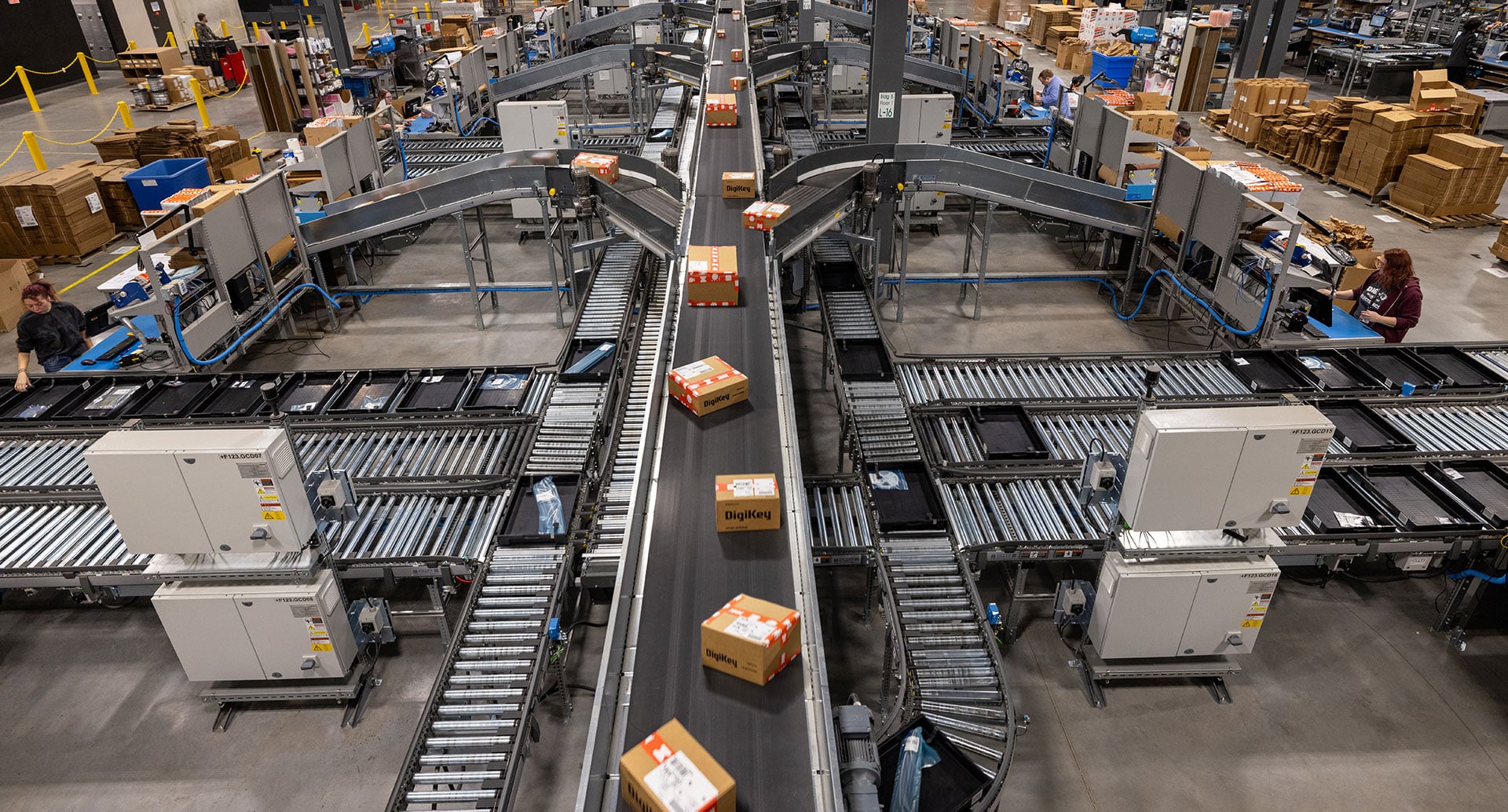
Further, the DigiKey PDC is fully automated, with product stored in trays that can be configured in various ways to support bulk, tube, reel, or other manufacturer packing conventions. At the centre of the operation is the order storage and retrieval (OSR) system, which delivers the correct parts to the picker every time, eliminating walk time and creating an ergonomic environment. The high level of automation improves picking efficiency by up to 35%, along with packaging quality and efficiency.
As demand and product complexity increase, inventory accuracy is critical to customer experience. Quality is measured daily, with focus on defects and ‘bin health’ within the OSR system. If a bin is short, empty, or contains incorrect product, fulfilment is immediately impacted, so resolutions are tackled quickly.
Digital transformation: stabilise, optimise, then automate
Automating a legacy company that has been picking, packing, shipping, and exceeding customers’ needs for more than 50 years comes with its own set of complexities, including integrating new digital systems and automation processes. Digital transformation hasn’t been without hiccups, but improvements continue daily because the team shares a common understanding that stabilisation and optimisation of manual operations come first, and only then can automation succeed.
Automating an unstable process does not eliminate problems; it automates defects, which then reappear in different forms. Operations are already highly automated, with further automation anticipated to support projected growth over the next five years. However, the prerequisite is bulletproof current-state processes, ensuring that investments reduce touches and increase quality rather than amplify underlying issues.
Automating profitability in the future
Looking ahead, the biggest opportunity for advancing fulfilment performance remains scalability. In a labour-constrained market, finding more efficient ways to do the work is essential. Getting the most out of current automation, adding new automation where it makes sense, and eliminating waste in existing process paths are ways to meet demand while maintaining staffing levels that the community can support.
I always tell my team, “Don’t boil the ocean.” Work one problem at a time and make sure it’s the biggest problem. That mindset, paired with stable processes, greater visibility, stronger leaders, and strategic partnerships, is how DigiKey intends to continue delivering for customers, no matter what the market does next.
This article originally appeared in the Sept/Oct issue of Procurement Pro