




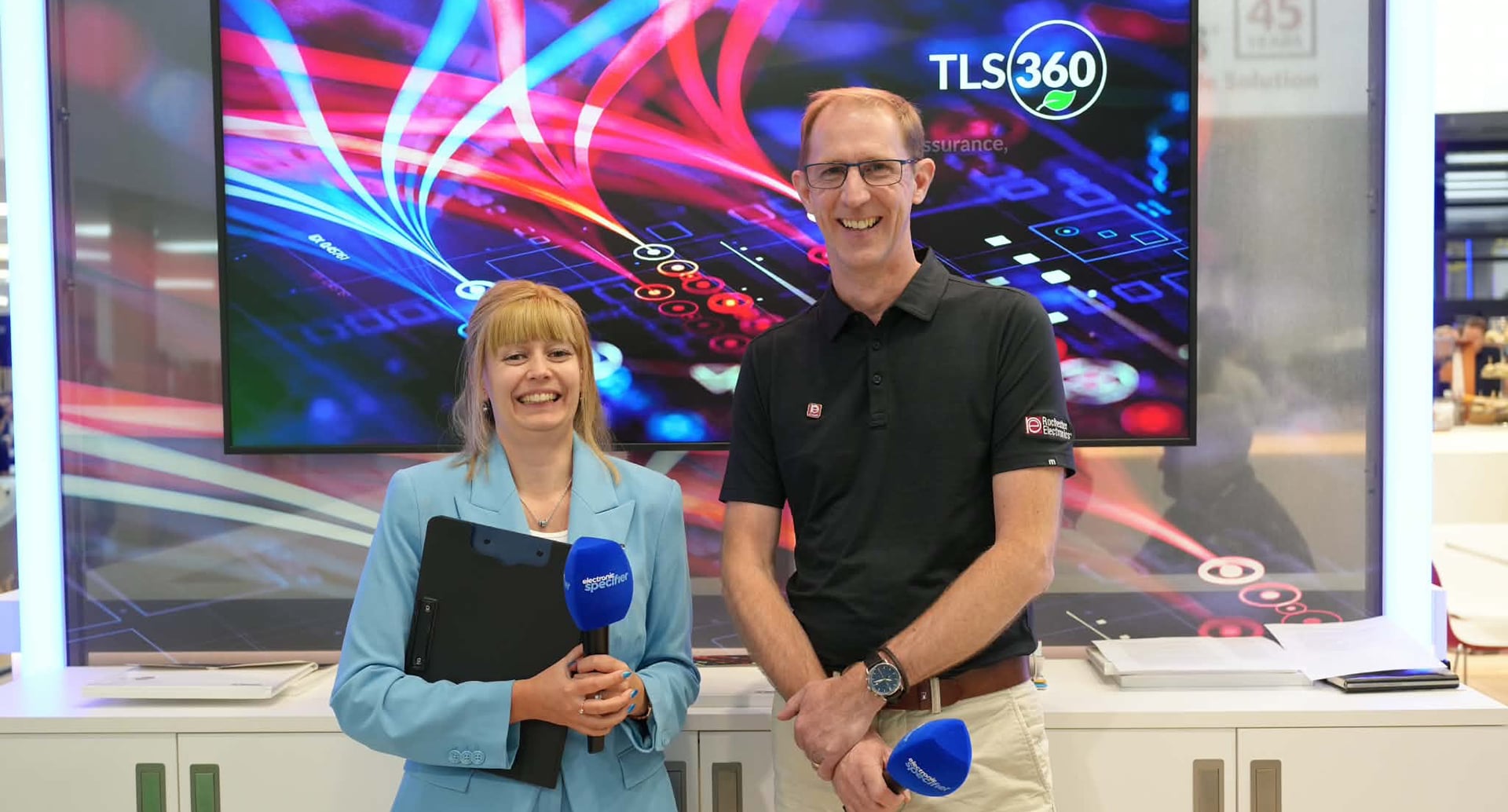
At electronica 2026 in Munich, Electronic Specifier’s Paige Hookway spoke with Paul Green, General Manager, EMEA, at Rochester Electronics, about how the company’s new lifecycle management program, Through Life Support 360 (TLS360), aims to take some pressure off buyers.
A managed route for hard-to-replace parts
TLS360 focuses on legacy devices that are difficult to design out or redesign. These are the parts procurement teams can least afford to lose. Rochester works with the original chip manufacturers on critical product lines to keep those parts available, and it has committed real resources to doing so. “We’ve invested … significantly to support in terms of inventory and ongoing manufacturing in some cases,” Green said.
Better visibility for planning
TLS360 uses AI to help inform lifecycle classifications. Green explained that it helps Rochester assess how long product lines are likely to remain available, when they may reach end of life, and how that could affect market conditions. Rochester uses that insight to decide where to invest in support. For buyers, it means the parts most likely to cause supply headaches are the ones being planned for.
Changing the last-time-buy calculation
Any buyer who has managed a last-time buy (LTB) knows the questions it raises: how many units to commit to, when a redesign will be needed, and whether production can continue at all. TLS360 is designed to remove that guesswork. “Actually, it becomes active product again from Rochester because it means that we continue to supply that product,” Green said.
However, the program cannot “stop a last-time buy.” Its value lies in early engagement. Green urged customers to work with Rochester proactively, identifying critical parts before they become a problem. If a customer has bought LTB stock to cover, say, 12 months, Rochester can use that window to transition the product and technology, so supply continues, and the impact on the customer is minimised.
The earlier critical parts are flagged, the more options remain open.
No change to the BOM
A common concern with alternative sourcing is whether a replacement part will trigger requalification or approved-parts-list changes. Green said: “Absolutely everything that we manufacture is exactly the same as the original manufacturer’s product.”
Rochester obtains the die and full test data from the original manufacturer, making each part “effectively … a Rochester manufactured Intel or TI or ADI or NXP device.” Importantly for buyers, “that part number will stay the same.”
Supply certainty for long-life programs
Green pointed to the pace of technological change as a key reason demand for long-term supply is growing. Customers building high-reliability products with lifespans of 10, 20, or even 50 years face a mismatch when components may only be available for a short period. If a company is “designing in a product that is going be only around for a year or two, that’s a problem,” he said.
Fewer forced redesigns mean fewer unplanned costs and fewer disruptions to production schedules. Green said that support gives customers “that little bit of breathing space.”
Reducing counterfeit exposure
When parts go obsolete, buyers often have little choice but to turn to the open market, and that is exactly where counterfeiters operate. Green noted that counterfeiting focuses on hard-to-find, obsolete components.
Buying from an authorised source removes that risk. As an authorised distributor and authorised manufacturer, Rochester gives customers a dependable alternative. “Customers can be reliant on the fact that we’re able to supply them good quality, absolutely warrantied product for a long period of time.”
Sustainability that supports the business case
Longer component life also supports sustainability goals. “Everything about Rochester here is really the long term,” he said, adding that the company “could be manufacturing or supplying a part for… decades.” He said a number of customers have been able to maintain legacy products, and in some cases bring products back to life, because Rochester can continue to support the parts they rely on.
What to plan for in 2027
On the outlook for next year, Green said: “I wish I had a crystal ball to properly really answer that.” He noted that 2026 brought supply issues across several manufacturers and commodities, and he doesn’t expect that to change. “I think that … memory continues to be an issue,” he said, with other commodities heading towards allocation, if not there already.
With political and geographical uncertainty adding to the picture, he questioned whether the industry still knows what a stable market looks like. “Normalisation, what is that? I don’t think we know exactly what that is anymore.”
For buyers facing supply constraints or obsolescence, Green pointed to Rochester’s stock of around 15 billion parts and its role as an authorised distributor as a source of stability, whatever 2027 brings.
Watch the full video interview with Paul Green here: