




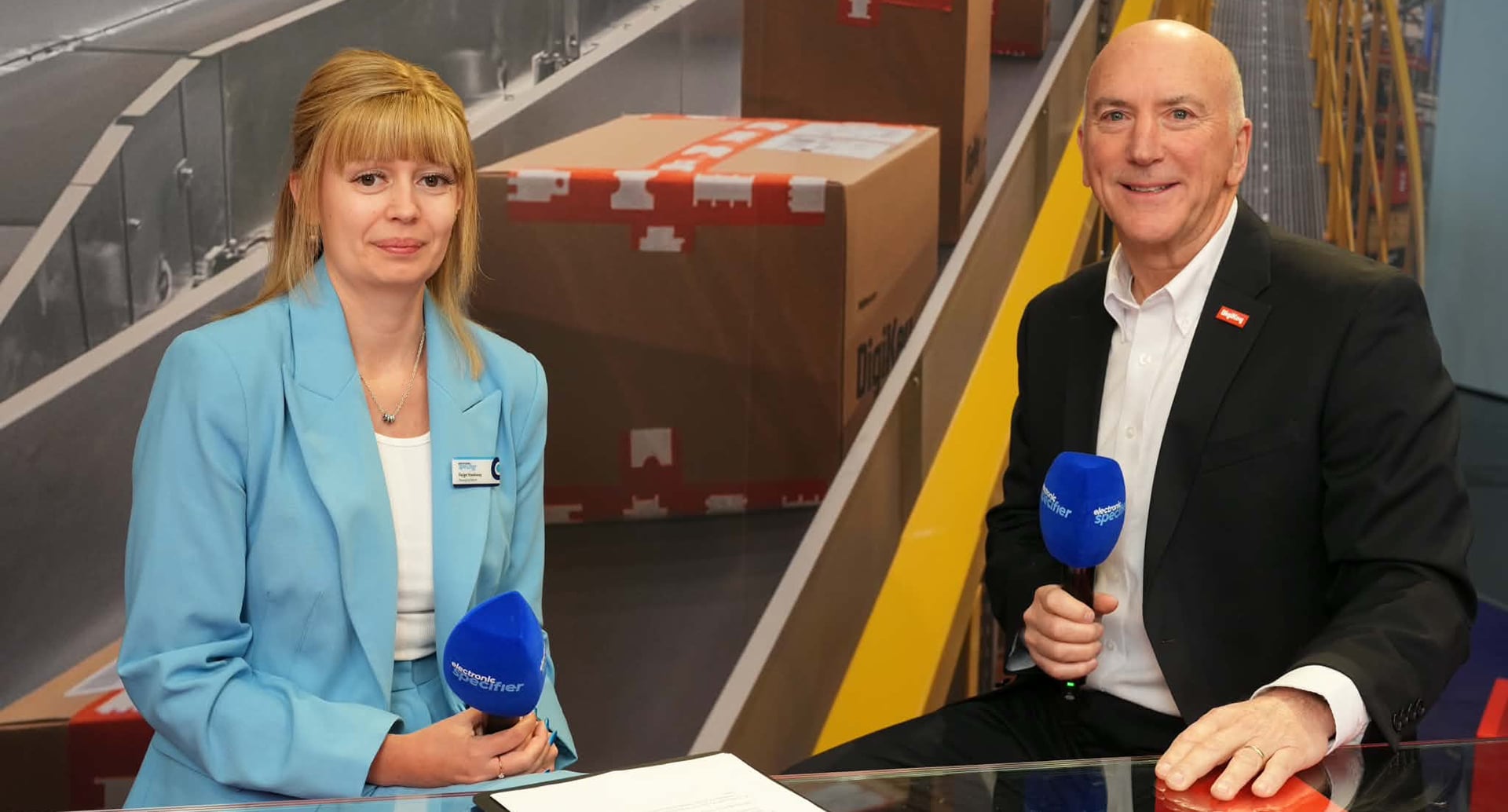
For procurement professionals, electronica is a chance to take the market’s temperature before planning for the year ahead. On the opening day of the Munich show, Electronic Specifier’s Paige Hookway spoke with Dave Doherty, CEO of DigiKey. During the conversation, Doherty covered demand, availability, geopolitical exposure, and how DigiKey is using AI to answer customer questions faster.
Stable, yet complex, conditions
Asked whether the market has settled after several turbulent years, Doherty says: “We’re always in an up and down.” Conditions feel relatively stable at the moment, but the industry is at a peak part of the cycle. “I don’t know that it’s any less complex than it ever is in the industry, he says. Stable demand at a cyclical high is not a reason to relax sourcing discipline.
Sourcing decisions now reach further up the supply chain
Tariffs and geopolitics have changed the questions customers ask DigiKey. The specific causes keep changing, but, Doherty says, they tend to have the same effect: disruption.
Second sourcing used to be the main safeguard. Now customers want far more detail about tariff exposure and geopolitical risk. The questions have become: “Where’s my product coming from? Where is that supply chain upstream of where your products are produced?’
He says as a result, engineers should “continue to widen their breadth of what they should be concerned about.” For procurement teams, it means that sourcing risk is increasingly being designed in, or designed out, before a bill of materials reaches purchasing. “They’re trying to build in some resiliency into their designs,” he says. Teams that work alongside engineering early are better placed to influence those choices.
Record demand for DigiKey
DigiKey is having a record year. In May, at the EDS Leadership Summit in Las Vegas, Doherty set three targets: 8-10% customer growth, 15% growth in details (shipments), and 30% revenue growth. DigiKey typically grows details by 4-6% from a large base, so the first two targets were stretching that reach. Even so, “[…] 15% details was aggressive, but we hit it right on the nose, the high end of those forecasts.” Revenue has gone well past its target: “[…] here we are 10 and a half months into the year, and we’re about a little over 50% growth, so it’s been quite the year.”
DigiKey now has more than one million customers. To keep stock available across that base, it has made a deliberate choice, “even if it means constraining the amount of product any one customer can buy, to make sure that we spread that out to support that new design activity.” Buyers should expect DigiKey to protect breadth of availability rather than fill very large single orders. Doherty said its focus is early design support, supporting engineers, and “purchasing professionals”. It leaves large orders and big quotes to competitors who specialise in them.
The aim is to make sure customers can get started. “Our space is to make sure that we have information … at engineers’ fingertips so that they can get started, support not only today’s demand, but tomorrow’s demand,” he said.
Where demand is coming from
AI is the strongest force in DigiKey’s order data, and Doherty says it is having a major impact overall. That demand is concentrated among a handful of hyperscalers, extends to companies building out infrastructure, and reaches the Edge. The resulting growth spans “every region, every segment, whether it’s medical, defence, aerospace, autonomous vehicles, robotics, et cetera.”
Doherty says DigiKey has double-digit growth “in all regions … across almost all segments”. Automotive is the exception that hasn’t fully returned yet. He suggests that may be fortunate, given he isn’t sure the industry has the capacity to support it. He expects it is close to getting back to its traditional growth. Buyers in shared commodity categories should keep this in mind. A rebound in automotive would add pressure to a market that is already running at a peak.
Faster answers through AI-assisted service
DigiKey is also using AI internally, which should help the customers its teams support. Based in Thief River Falls, Minnesota, the company can’t simply scale its headcount. “So it forces us to be smart with both automation and AI,” Doherty said.
The aim is to take repetitive work off experienced staff, such as pulling up several screens to put together an answer to a customer’s question. “So it’s more of an augmentation where it’s more agent supporting our people,” he explained, because “[…] even if we wanted to, we don’t have the ability to just double, triple the head count.”
The question every buyer is asking
Doherty said his main goal at the show was to listen to customers and suppliers. “The conversations I hope is really with my two ears listening,” he said. He also named the question that every procurement team planning for 2027 is asking: “When you’re in an upmarket… when does it end?”
Watch the full interview with Dave Doherty here: