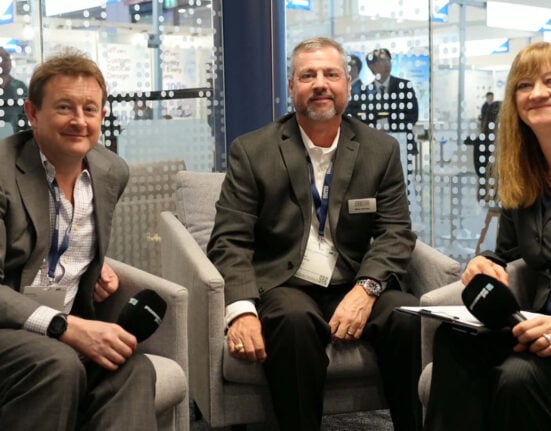






Speaking to Paige Hookway, Managing Editor, Procurement Pro, at electronica 2026 in Munich, James Hill, President and COO of Rand Technology, explained why buyers who treat their independent distributor as a partner, rather than a last resort, will be better placed for what comes next.
For many buyers, the independent distributor is the number they call when a part can’t be found anywhere else. Hill thinks that view is out of date, and the most effective relationships now start long before a shortage hits – with the distributor working alongside the customer’s own team to spot risk in the bill of materials and deal with it early.
More than a transaction
Rand recently marked 34 years in business. It is a global independent distributor that helps customers when supply and demand fall out of step, and its core offer is to provide “support for shortages, sell excess, help them reduce cost, help them mitigate risk.”
The emphasis is shifting towards understanding what each customer actually needs, “not just a transactional interaction with the customer.”
Right now, much of that work is shaped by AI. Hyperscalers and neoclouds building out infrastructure are one part of Rand’s customer base. Just as important are “the companies that are impacted by all of the supply that they’re taking up and the capacity that they’re consuming.” For those buyers, the goal is prevention: “[W]e try and help them … to mitigate the risk, to work with them to understand their bill of material and where the risk is so that they can prevent the issues from occurring.”
Why the distributor’s role has grown
Hill links the bigger role of independents directly to pressure on buyers’ own resources. “[T]heir teams have actually gotten smaller in many ways, or they’ve become fully consumed by the build-out of AI.” Contract manufacturers and ODMs used to absorb some of that load, but “even those companies now are becoming stretched in what they can do.”
That leaves the independent distributor as the next point in the chain, and trust is what makes the handover possible. Over three decades, Rand has invested in its operations and quality capability. “We’ve built up our testing and authentication,” Hill said, adding that the company holds aerospace-level certifications for authentication. With that credibility established, customers “feel more comfortable to come to us for more and more of their activities, really as an extension of their teams.”
The distinction he draws is between efficiency and responsiveness. “[M]anufacturers and franchise distributors are really built around efficiency.” Independents fill the gaps that efficiency can’t cover: “So we’re responding within lead time. We’re responding to those unpredictable conditions that come up.”
A harder market in 2027
Buyers who struggled with memory in 2026 may not want to hear it, but Hill expects the coming year to be more demanding. The 2026 memory shortage was widely anticipated, which made it, in relative terms, easier to plan around. Next year’s pressures will be spread across more industries and more component types: “[T]here’s going to be a lot more opportunities, but it’s going to be more challenging to … execute on those.”
Memory won’t go away as a problem. But the mix of parts under pressure will change as AI moves out of the data centre, from training and inference towards the Edge and physical robotics. “[Y]ou’ll need more low-power components, for example,” Hill said, and those will become harder to source.
The upside for buyers is that shortages rarely affect everyone equally. Because Rand operates globally across industries and sectors, “there’s always going to be those imbalances,” and surplus in one region or segment can be redirected to fill gaps in another.
Managing life cycle risk before it bites
Obsolescence planning is getting harder for procurement teams. Many customers are keeping products in the market for longer than planned, either because components can’t be found or because they have become too expensive. As a result, “they’re making changes to the … design, and they’re changing the life cycle of their products.”
“So it’s less predictable, and so they engage with us earlier in that process to do a risk assessment,” Hill said. A common starting point is a heat map. The customer shares its bill of materials, and Rand assesses each line for cost, lead time, and life cycle risk, “so to highlight those areas that are the biggest risk, and then work with them to come up with mitigation strategies.”
Beyond sourcing mitigation, Hill described helping customers with value engineering and with designing in alternatives “to qualify additional components on the AVL”, giving buyers more than one route to supply. At the other end of the cycle, Rand also sells customers’ excess inventory, moving it to the geographies and segments that need it.
Tariffs, trade, and country of origin
Trade policy remains a moving target, especially after the recent elections in the US. “So we’re prepared. We have to be agile in our being able to support that,” he said.
For buyers, the practical impact often shows up as restrictions on country of origin. Rand is strengthening its engineering capability to address this, alongside its logistics, trade compliance, and sourcing expertise, so that “we really have a cohesive team that’s able to respond, whether that’s engineering work, whether that’s trade compliance, whether that’s … on the sourcing side.”
What buyers should do next
Hill’s message to procurement teams preparing for the next 12 to 18 months is to build partnerships rather than chase one-off deals. He cautioned against “just putting it out there to standard brokers … because you have a transaction to complete.”
Instead, he encouraged buyers to share information early so Rand can apply what it knows to their specific applications. “We’ll leverage our data, we’ll leverage our expertise to be able to help them identify and prevent issues up front and respond to them as needed.”
It is a straightforward proposition, and one he summed up by saying: “[W]e do that through collaboration and information sharing.” In a year that looks set to test supply chains more broadly, that early conversation may prove one of the most valuable tools a buyer has.
Watch the full interview here: