




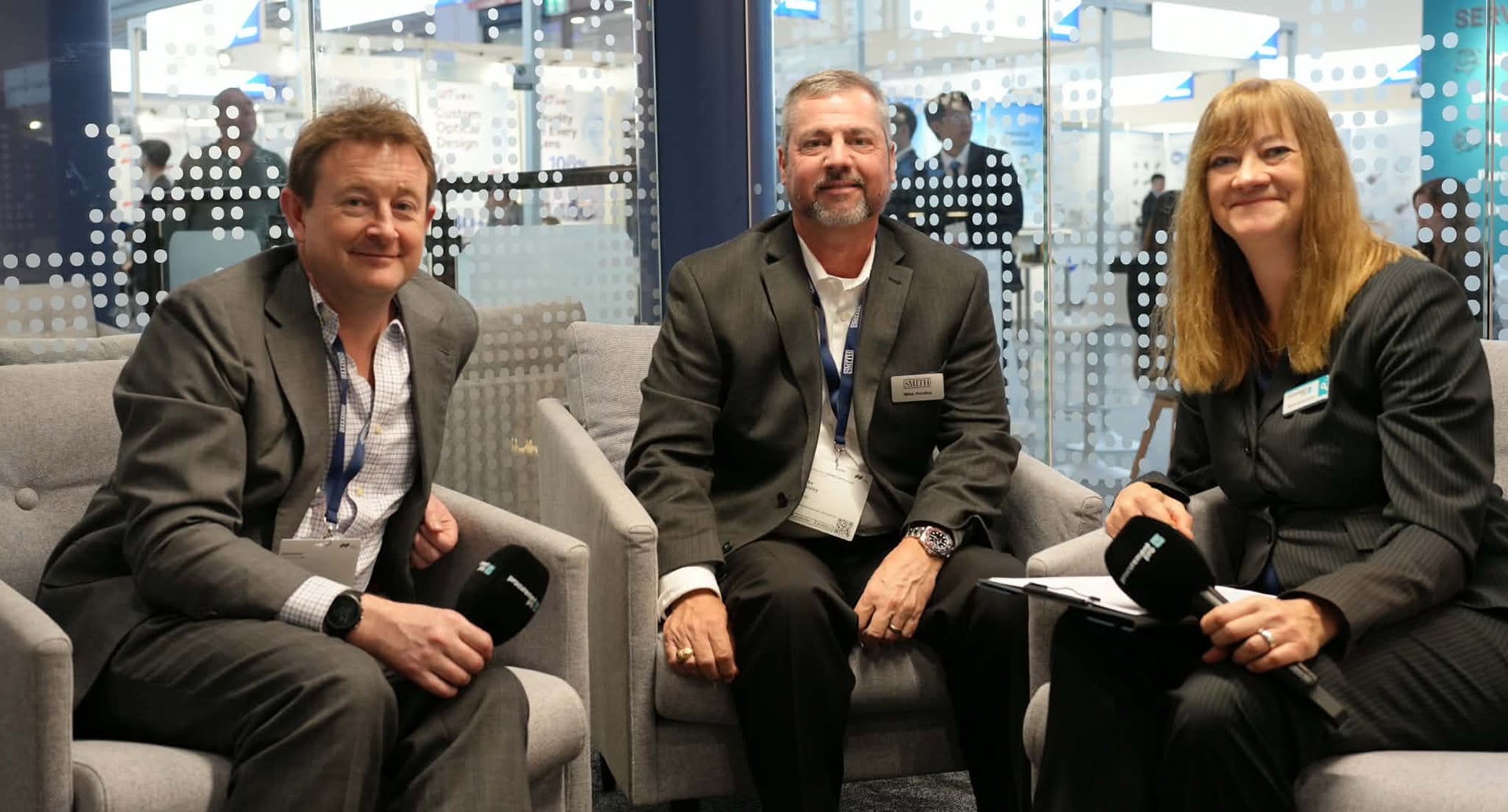
Procurement Pro’s Lucy Barnard met with Smith CEO Nick Bedford and Chief Trading Officer Mike Pursley at electronica 2026 in Munich to talk about the outlook for the semiconductor and electronic components market. And if there was one message buyers should take home from electronica 2026, it might be that the component crunch is not over.
Talking about being one of the largest global independent distributors of electronic components, Bedford said: “Independent means we’re not franchised. We’ll buy and sell to anyone.” The company is family-owned and, he notes, “still owned by the same two brothers that started it” back in 1984. “It’s our job to help people that can’t find product, which in 2026 is a problem.”
A year rewritten by AI
The sheer speed of the rise of AI has defined 2026 for Bedford: “I don’t ever remember an industry growing so quickly,” he says, adding that AI may now be the largest buyer of chips of any industry – ahead of laptops, refrigerators, and automotive – having got there in roughly 12 months. “It’s completely upended everybody’s supply chain.”
Pursley says that memory parts that once sold for around $135 are now changing hands for about $3,000, and the industry has become far more capital intensive. “Right now, every customer transaction, every conversation we have with a large customer, there’s a financial background to the deal,” he says.
Memory shortages set to deepen
Both executives expect the memory squeeze to intensify. “Speaking to every memory manufacturer, they tell us to expect it to be worse in 2027 than it was in 2026,” says Bedford. He points out that just two years ago, Micron, Samsung and SK hynix were all reporting losses on memory. Wary of the industry’s boom-and-bust history, they held back from building expensive new fabs, and now the pendulum has swung the other way. “The plants they have just simply aren’t capable of producing what both AI needs and all their historic customer needs.”
“If you’re looking for memory right now, you can’t find it. If you place orders for memory, you might get half of what you’re looking for,” said Pursely. As manufacturers shift capacity towards AI products such as RDIMMs, he explains, other customers, for example, automotive firms relying on DRAM, feel the gap.
Shortages spreading beyond memory
The knock-on effects are already visible across the show floor. Pursley highlights MLCCs (multilayer ceramic capacitors) from Murata and Samsung as being in serious shortage, alongside difficulties sourcing parts from automotive-focused suppliers such as Texas Instruments and onsemi. Add in flash, DRAM, and legacy DDR3 memory, and “really, it’s a perfect storm”.
Bedford believes the pressure could spread further. AI is still a loss-making industry, yet it can outbid everyone else. “If AI, even with its losses, can outpay what everyone else is willing to pay, then that means there’ll be shortages in other areas until they can bring up the production capacity.”
Rethinking inventory strategy
So how should manufacturers respond? Bedford advises to order early, understand your allocations, and stop relying on the ‘spot market’. He says electronics buyers have historically “just relied on the fact that if they needed it, it would be there, and that’s no longer the case.”
Pursley agrees that just-in-time sourcing is now a high-risk approach. “In this environment, just in time is not going to make your life very easy. It’s going to make your life very stressful.” He suggests thinking in terms of “just-in-time plus 10%”, with that buffer potentially coming from the open market, particularly as suppliers increasingly ask for non-cancellable, non-returnable orders and payment in advance.
The independent distributor’s role
If everyone is struggling to find stock, what can an independent distributor add? Bedford explains that Smith doesn’t take on speculative inventory risk, but acts as a facilitator between companies. A manufacturer holding 80% of the parts it needs faces a choice to either source the final 20% or release the 80% it can’t use. “So we’re really here to reallocate the resources because resources ended up at the wrong places. It’s our job to make it find the right home,” said Bedford.
Counterfeits and theft
High prices bring higher risks and, “The reward for counterfeiting’s probably never been higher,” said Bedford, who adds that theft of shipments has also become a real concern in 2026.
Pursley’s advice is to work with a reputable, long-standing partner. Smith has invested heavily in counterfeit mitigation and quality control and invites customers to audit its warehouses. “Authenticating product is probably the most important thing that any distributor can offer a customer.”
Market intelligence is a key indicator of trouble
Intelligence from both suppliers and customers helps Smith spot trouble early. As Bedford explains, one customer chasing a part might simply have a popular product, but when four or five customers across different industries suddenly want the same thing, “you know there’s probably a supply chain issue.” The same insight helps the business decide which stock to hold and which to sell quickly before it loses value.
Looking ahead to 2027
Bedford expects AI demand to grow again next year. While there are early signs of financing strain in the AI sector, his understanding is that most major buyers have funding lined up, meaning 2027 “will probably be a bigger shortage year than 2026.”
Pursley anticipates that parts which aren’t short today could become scarce by spring, with IC manufacturers, automotive, audio/video, and aerospace and defence customers reliant on legacy components among those most exposed. His advice is to engage early, ask questions early, and be prepared. “You never know what’s going to be in shortage tomorrow. There’s always a new technology that drives something.”
Watch the full video interview here: