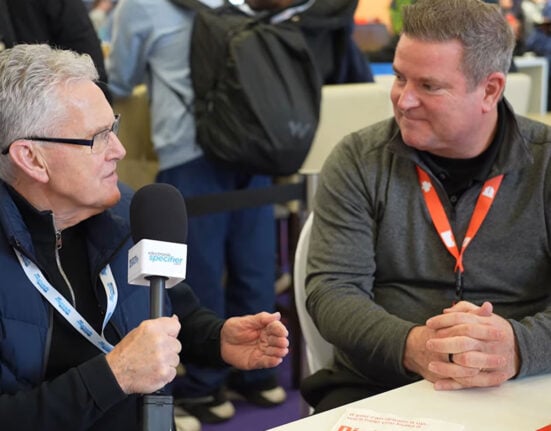


The economic tide is turning for the global electronic components market as the industry-wide inventory overhang that resulted from the COVID-19 lockdowns continues to be consumed and now looks likely to attain manageable levels early in 2026. According to Adam Fletcher, Chairman of both the UK’s Electronics Components Supply Network (ecsn) and the International Distributors of Electronics Association (IDEA), manufacturer authorised distributors in the UK are seeing a marked increase in ‘spot’ (short term) purchases of components by customers, a trend that is in sharp contrast to businesses elsewhere in the global technology market who appear to have adopted a more strategic approach to procurement and are placing order cover on their suppliers well into 2026.
Electronic components – a long design cycle
Globally there are a vast number of active customers engaged in the purchase of electronic components. The UK alone can count over 25,000, with over 99% of these active customers purchasing from multiple manufacturer authorised distributors. The process of getting a component designed into the typical customer’s new project starts early in the design-in phase with the distributor putting forward a range of possible alternatives with the aim of having the engineers select the most appropriate component for their application, usually in competition with other potential suppliers. The next stage is the provision of small volumes (often samples) of the component for ‘A’ and ‘B’ model development and software integration. Once the component is approved, the distributor will support the customer through the prototyping and quality assurance phases and on to initial and finally, volume production either by the customer or their preferred contract electronic manufacturer who may be located in the UK or overseas. The design cycle from concept to volume production typically spans two years during which a considerable investment in time and resource has to be carried by the authorised distributor and the customer before there can be any expectation of financial return.
Inventory classification and lead-time
Given that most electronic products today include several hundred electronic components on the Bill of Materials (BOM), some of which may already be commonly used within the customer’s existing systems, the use of Enterprise Resource Planning (ERP) systems running a version of a Manufacturing Resource Planning (MRP) software is a prerequisite to support procurement professionals with their regular ordering processes. The MRP system holds all the information on the components that the procurement professional is being asked to source, a key element of which is the current components manufacturers’ lead-time to supply. Accurate lead-time information is vitally important because it holds the key to the calculations for inventory holding, safety stock, quantity to be ordered, and delivery dates. By defining the inventory class of the component (‘A’, ‘B’, or ‘C’) based on unit price multiplied by the volume required, the MRP system is able to calculate exactly what is to be purchased, in a specific quantity, and when it has to be delivered to meet the customer’s overall production plan.
Most procurement professionals are pretty good at keeping the manufacturing lead-time data updated for ‘A’ and ‘B’ class inventory items because they are often proprietary products and represent the most valuable assets. Although ‘C’ class items probably represent 80% of the components on any organisations BOM, they often fail to update the lead time records for all these components or simply bulk update them all with a nominal value. To be fair, it takes very significant investment in time and effort to go through all of the many individual ‘C’ class items, so this is probably understandable. Unfortunately, it’s often an unrecognised supply problem with a humble ‘C’’ class part that disrupts production, because for some reason it’s not available when required.
A highly repetitive procurement cycle
In the electronic component supply network, buyers and sellers typically form long-term partnerships – often lasting decades – as both organisations depend on each other for their ongoing business success. Unlike a capital purchase, which is effectively a one-off transaction, the sales and procurement cycle in the electronic components supply network is highly repetitive, with multi-level transactions taking place daily, requiring close coordination between the customer and their multiple suppliers. All parties (and their subcontractors) collaborate closely to ensure that the contract terms are totally fulfilled i.e. the components are of an agreed quality standard, are delivered at the agreed price, on time, and to the correct location. Some customers randomly inspect components at goods-in to ensure they are correct and as ordered, before putting them into storage. However, in many high-volume applications the components are shipped directly to the production line ‘just in time’, where they are ‘consumed’, probably the same day or within a tightly defined time period. As a result of constant interaction between all parties a high degree of mutual trust and respect is maintained across organisations and lasting business relationships are formed. When problems do arise (and inevitably sometimes they do) the relevant personnel from all parties are involved in a joint investigation and solutions are quickly found that meet the agreed objectives.
Negotiated tension
There is always an ongoing tension between a procurement professional and his/her supplier. The former is always seeking the lowest possible pricing and minimum inventory holding, whereas the latter wants to sell at the maximum price and ship the maximum quantity of inventory to the customer. Fortunately, both sides have learned to compromise as partners in a ‘win-win’ scenario. In long-term partnerships, exploitation by either party is typically detected quickly; however, this can sometimes be delayed by the actions of competitors, negatively impacting both partners and potentially causing serious damage to their business relationship.
Order cover – a variable commitment
Placing order cover (a ‘Booking’) on a supplier is a commitment by the customer to purchase a specific quantity of goods, at an agreed price and delivery schedule. However, in the UK electronic components market where customers are predominantly served by manufacturer authorised distributors a ‘Booking’ is a somewhat variable commitment, often comprising ongoing negotiated transactions that will eventually lead to a ‘Billing’ when inventory is shipped and invoiced. Order cover and delivery dates are often modified by the partners over time to reflect changes in both availability and customer demand, in a combined effort to maximise the return on investment for both parties.
Call to action
My concern is that whilst ‘Billings’ globally have been growing in 2025 – albeit slowly due primarily to the poor global economic conditions occasioned by the massive changes to US trade – a significant uptick is overdue and is likely to happen in 2026. When the uptick comes it’s going to be on a global rather than regional scale and is likely to cause a similar ‘leapfrogging’ extension of manufacturer lead-times that we witnessed when COVID lockdowns ended. ‘Bookings’ are already rapidly increasing across the global electronic components supply network and urgent action is needed if we are to avoid a repeat of the world-wide shortages the electronic components market experienced in 2022/3.
I encourage all procurement professionals to check and, where necessary, update their ERP systems with the latest manufacturer lead-time data for the components their organisation is likely to require in 1H 2026. In addition, I urge them to seek the necessary internal executive management authority to enable them to place longer term scheduled order cover with their suppliers. I’m suggesting they place cautious, sensible, order cover at 50-70% of their best estimate of their organisation’s anticipated demand by month for at least six and preferably, 12 months. Having forward order cover in place significantly strengthens an organisation’s negotiating position to secure components when needed, especially if demand for its products increase and deliveries need to be pulled forward. Order cover can always be rescheduled (in or out) to meet an organisation’s changing needs, but it does provide the component manufacturer with a much better indication of likely future demand, enabling them to allocate their investment and production capacity appropriately. The alternative is pleading with suppliers to take orders when the lead-time has bounced out to 40 weeks, and the purchasing organisation is struggling to obtain sufficient components to maintain its production schedules and meet its customer orders.
Concluding thoughts
I know many ecsn members are concerned about maintaining the supply of components to their customers and are having to forward orders based on inaccurate historical data. They are, however, managing their current inventory effectively and, in some cases, are possibly holding additional inventory just to ensure they are able support their customers. Additional inventory is expensive but significantly less costly than having many personnel involved in daily fraught conversations with customers and components manufacturers as they desperately try to cope with component shortages. I continue to encourage ALL partners in the electronic components supply network to actively and positively engage with their partners to negotiate and agree successful outcomes for all. It costs virtually nothing but the benefits of engagement with partners are always beneficial, enhancing the performance of all players in our industry.
About the author:

Adam Fletcher, Chairman of the UK’s Electronics Components Supply Network (ecsn) and the International Distributors of Electronics Association (IDEA)
This article originally appeared in the Nov/Dec issue of Procurement Pro.