




For procurement professionals, sourcing high reliability connectors is rarely straightforward. With supply chains under pressure, counterfeit risks on the rise, and qualification timelines stretching, getting your sourcing strategy right has never mattered more.
The global connector market is on a significant growth trajectory. According to market research, the worldwide connector market is projected to reach $112.4 billion by 2025, growing at a compound annual rate of 7.4% through to 2029 – driven by demand from electric vehicles, AI data centres, defence modernisation, and industrial automation. For procurement teams, this growth brings both opportunity and complexity. As demand intensifies, so does the risk of supply disruption, counterfeit infiltration, and poor supplier selection.
Whether you’re qualifying a new vendor or reviewing your Approved Vendor List (AVL), these seven factors should sit at the heart of your sourcing strategy for high reliability connectors.
1. Certification and standards compliance
The first question to ask any prospective connector supplier is: which standards do your products meet, and can you prove it?
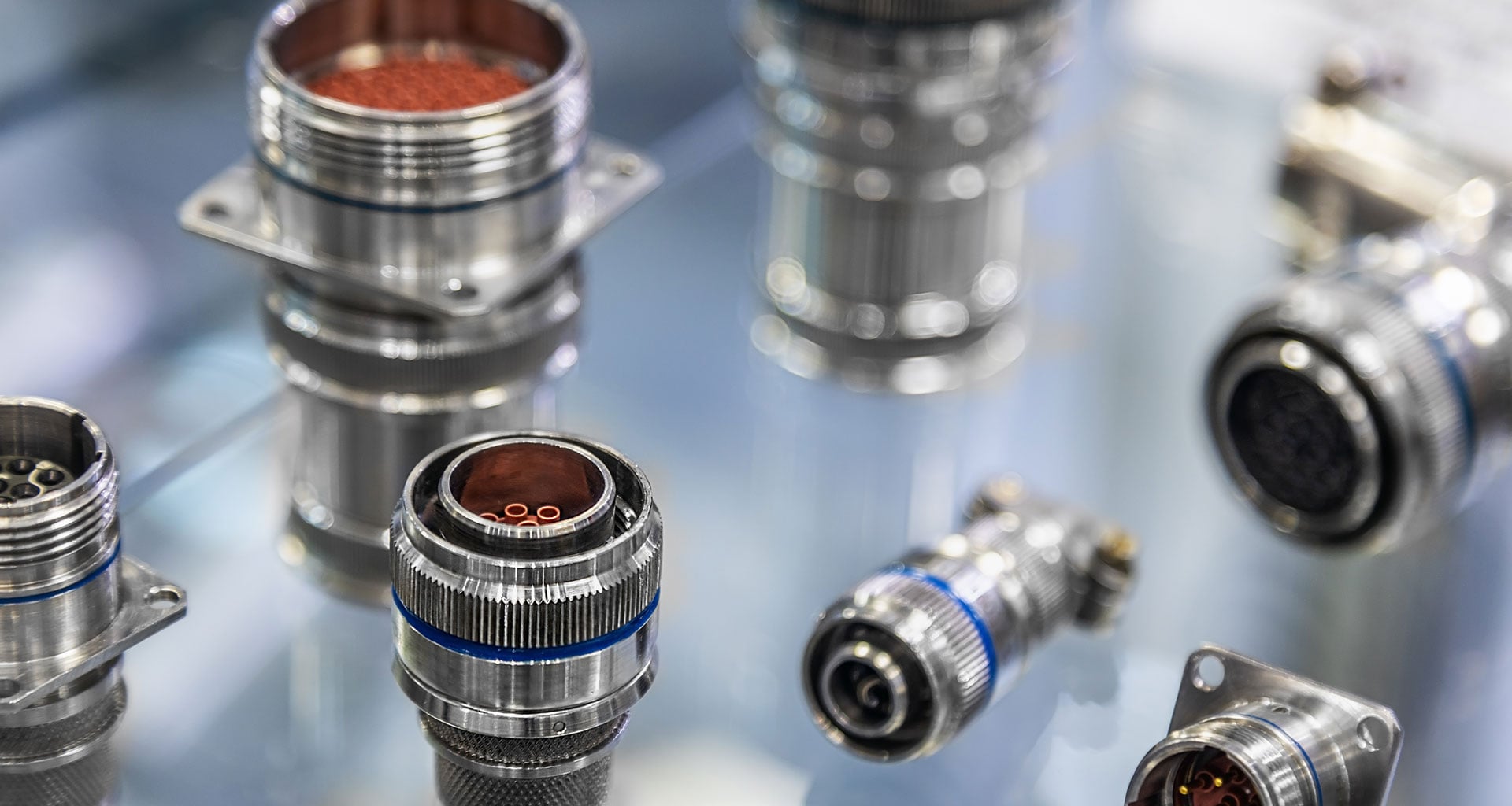
For defence and aerospace applications, MIL-SPEC compliance is non-negotiable. Connectors must appear on the relevant Qualified Products List (QPL) under the applicable MIL-DTL specification to be acceptable for many government contracts. Selecting the correct standard – whether MIL-DTL-38999, MIL-DTL-5015, or others – is critical because these designations indicate specific requirements around environmental sealing, contact type, shell configuration, and vibration resistance that are tailored to distinct operational environments.
For industrial applications, IEC standards and IPC certifications are equally important, as is ensuring RoHS compliance if you’re supplying into European markets. Failure to verify certification status upfront can result in contract non-compliance, component rejection, or – in worst cases – programme delay.
2. Counterfeit risk and supply chain traceability
Counterfeit connectors represent one of the most serious and growing threats to procurement integrity. According to data from Mordor Intelligence, the Defence Counterintelligence and Security Agency recorded a 22% increase in counterfeit connector interceptions during 2024 customs inspections, with the majority of incidents linked to grey market brokers in multi-tier Asian supply chains.
The methods used to introduce counterfeit components into the supply chain are well-documented: remarking (applying false manufacturer or specification markings to real or substandard parts), and the resale of used components as new. China has been identified by industry bodies as the dominant source of these counterfeit and surplus parts.
For procurement teams, the practical response is clear: source only from authorised and QPL-listed distributors, implement robust incoming inspection protocols, and require full traceability documentation – including lot traceability and certificates of conformance – at the point of purchase. Leading prime contractors are now also embedding serialisation and Blockchain-based traceability requirements into new harness contracts to close these gaps further.
3. Total cost of ownership, not just unit price
It’s a familiar trap: the connector that wins on price loses on performance – and costs far more in the long run. For high reliability connectors, the gap between purchase price and total cost of ownership (TCO) can be substantial.
According to the Institute for Supply Management (ISM), procurement decisions anchored purely to unit cost frequently underestimate the downstream financial impact of poor component quality – including unplanned downtime, overtime labour, expedited freight, and warranty claims. For high reliability applications in particular, a connector failure in the field doesn’t just incur the cost of the part; it can trigger system-wide consequences across a platform or production line.
When evaluating high reliability connectors, procurement teams should build TCO models that incorporate incoming inspection costs, lead time variability and associated buffer stock requirements, field return rates, and end-of-life disposal obligations. Pre-configured connector assemblies, while sometimes carrying a higher unit price, can reduce assembly errors and labour costs – making them the lower-TCO option in many use cases.
4. Environmental and mechanical ratings
High reliability connectors are, by definition, required to perform in demanding conditions. It’s essential to match the connector’s environmental ratings to your actual application requirements – not just the most readily available option.
Key ratings to verify include IP (Ingress Protection) rating for dust and moisture resistance, operating temperature range, vibration, and shock resistance, and EMI/RFI shielding capability. For defence applications, TE Connectivity’s DEUTSCH line is widely respected for aerospace-grade environmental performance, while Amphenol’s ISOBUS connectors are well-established in harsh industrial machinery environments.
Mating style also matters. Bayonet couplings allow fast, tool-less connection – useful in field-serviceable systems – while threaded designs offer superior resistance to vibration, making them the preferred choice in high-shock environments.
5. Supplier financial health and qualification stability
The connector market is currently undergoing significant consolidation. In 2024 alone, Amphenol acquired Carlisle Interconnect Technologies to strengthen its position in mission-critical applications, while Molex acquired AirBorn Inc. to deepen its aerospace and defence capabilities. These consolidations can affect product roadmaps, part numbering, lead times, and customer service structures – all of which have direct implications for procurement teams managing long-term programmes.
When evaluating a connector supplier, look beyond their product catalogue. Assess their financial stability, their investment in R&D, and their ability to sustain qualification programmes over time. High qualification costs are themselves a barrier to new entrants, which reinforces the price premium commanded by established, QPL-listed manufacturers – but also means that once a supplier is qualified, the relationship carries strategic weight.
6. Multi-source availability and dual-sourcing strategy
Single-source dependency for high reliability connectors is a procurement risk that has become increasingly difficult to justify. The disruption caused by supply chain failures since 2020 has prompted a fundamental rethink of sourcing structures across the industry.
Research from McKinsey found that 81% of supply chain leaders had implemented dual sourcing by 2022, up from 55% in 2020 – a shift that shows no sign of reversing. For connector procurement specifically, MIL-SPEC standardisation was partly designed to facilitate competitive multi-source procurement; where QPL-listed alternatives exist, there is a strong case for qualifying at least two suppliers for critical part numbers.
Dual sourcing does introduce additional management overhead – more qualification activity, more supplier relationships to maintain, more complexity in planning, and ERP systems. But the continuity of supply benefits typically outweigh these costs for high reliability connector categories where a stockout or quality escape can halt production or delay programme delivery.
7. Lead time transparency and inventory planning
Lead times for high reliability connectors can be long, volatile, and – in the current market – subject to sudden disruption. Stop-shipment orders affecting major manufacturers, such as those experienced in the MIL-SPEC connector sector in recent years, can bring distribution channels to a standstill and trigger immediate second-source qualification activity across the industry.
Procurement teams should insist on lead time transparency from suppliers, treat published lead times as a starting point rather than a guarantee, and factor lead time variability explicitly into safety stock calculations. Just-in-time replenishment models, while effective for non-critical components, carry elevated risk for high reliability connector categories where qualification requirements make rapid substitution difficult.
Building strong relationships with authorised distributors – and ensuring those distributors have genuine visibility into manufacturer production schedules – remains one of the most effective tools available to procurement teams navigating a constrained supply environment.
Final thoughts
Sourcing high reliability connectors is a discipline that rewards preparation, rigour, and strategic thinking. Unit price matters – but it’s rarely the most important variable in the equation. Certification status, supply chain integrity, TCO modelling, environmental suitability, supplier resilience, multi-source availability, and lead time management collectively determine whether your connector strategy will hold up under pressure.
In a market growing as rapidly as this one, with consolidation reshaping the supplier landscape and counterfeit risks intensifying, procurement teams that treat high reliability connectors as a strategic category will be best positioned to protect their supply chains and their programmes.