





The advanced packaging market has entered a new cycle. The historical backend model is being replaced by a system-scaling model in which packaging determines AI-compute availability, memory bandwidth, power delivery, thermals, and system cost.
Against this backdrop, Yole Group releases its latest report, Status of the Advanced Packaging Industry 2026, offering a comprehensive analysis of the market, supply chain, and technology trends shaping the industry’s future. This annual analysis is supported by a quarterly review, the Advanced Packaging Market Monitor.
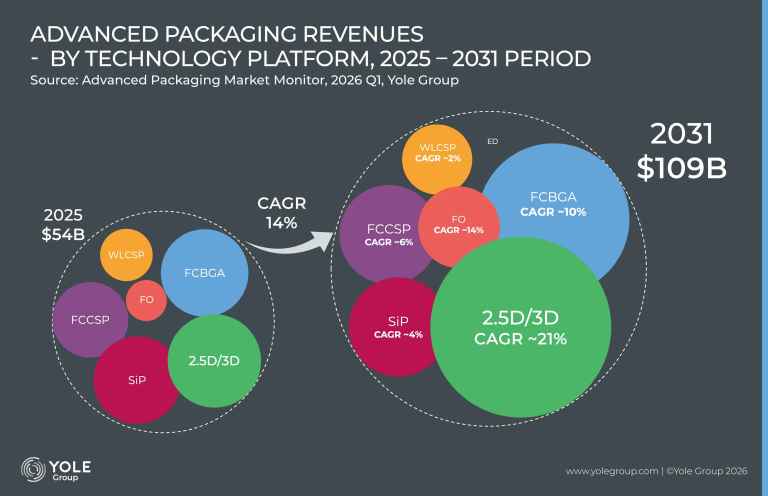
The market reached $55 billion in 2025 and is expected to increase to more than $120 billion by 2031, according to Yole Group’s Packaging Market Monitor. But the crucial point is not simply the growth rate: Yole Group’s analysts highlight the changes in market structure which clearly indicate that advanced packaging is overtaking traditional packaging in value; by 2031, advanced packaging is expected to account for the majority of total semiconductor packaging revenue, becoming the physical layer where system performance is created.
“Advanced packaging is no longer a backend afterthought. It has become the physical layer that decides AI-compute availability, memory bandwidth, power delivery, and system cost. That is a structural shift, not just a growth cycle,” said Bilal Hachemi, Senior Technology & Market Analyst, Semiconductor Packaging at Yole Group.
Pricing power has returned, but it is uneven and not fully structural. AI packaging, HBM packaging, memory test, and high-end substrates have pricing leverage because they sit behind qualification and capacity moats. Mature packaging, by contrast, remains under pressure from FX, gold and copper inflation, China localisation, and commoditisation. The investable part of the market is therefore not ‘packaging’ in general, but the subset of backend capacity connected to AI compute, HBM, memory test, high-speed substrates, CPO, and IDM outsourcing.
“Pricing power has returned, but not everywhere. The players sitting behind qualification and capacity moats, AI packaging, HBM, high-end substrates, are the ones setting the terms. Everyone else is still competing on cost,” said Yik Yee Tan, PhD, Principal Technology & Market Analyst, Semiconductor Packaging at Yole Group.
The competitive landscape reflects this concentration.
TSMC’s CoWoS capacity is effectively the central integration gate for leading AI accelerators, while Ajinomoto’s ABF dominance and Nittobo’s T-glass position make Japan a materials chokepoint for AI substrates. The capacity response is broad but uneven: ASE, PTI, Amkor, TSMC, SK hynix, Ibiden, Unimicron, and multiple regional OSAT projects are all expanding, but project completions cluster around 2027-2028, while test capacity lags packaging capacity by around a year. Yole Group’s Status of the Advanced Packaging Industry report delivers deep, valuable insight into the strategies of leading advanced packaging players, while also mapping the geopolitical landscape that increasingly shapes this industry.
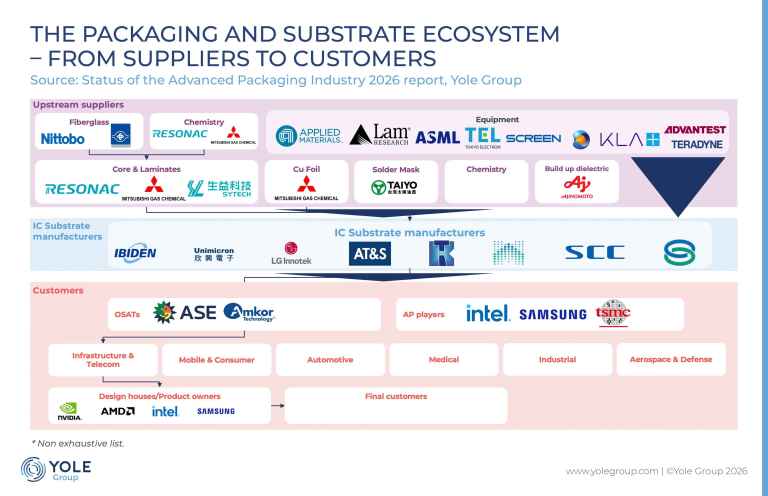
Geopolitics is redrawing the map: US, India, Japan, Vietnam, Malaysia, Korea, and Europe are all building selective backend or substrate capacity. China is scaling domestic OSATs and equipment vendors under export-control pressure. But leading-edge advanced packaging still concentrates in Taiwan, Korea, and Japan. The barrier is not just capital. It is a full ecosystem, including materials, chemistry, tools, and a trained workforce.
“Pricing and capacity dynamics in advanced packaging are moving too fast for an annual snapshot alone. Tracking the market quarterly, as we highlight in the Advanced Packaging Market Monitor, is what lets decision-makers see shifts in leverage before they become structural,” said Gabriela Pereira, Senior Market & Technology Analyst, Semiconductor Packaging, at Yole Group.
Pricing power is concentrating around a narrow set of players and technologies. Capacity additions will not fully close the gap before 2027-2028. Understanding who holds leverage in advanced packaging has never been more critical for device manufacturers, OSATs, and investors alike.