






The MEMS industry in Greater China continues to show solid growth, supported by a diverse range of applications and a maturing ecosystem, announces Yole Group’s analysts. According to Yole Group’s latest report, Greater China MEMS Industry 2025, MEMS revenues from Greater China reached $1.7 billion in 2024, representing 8.4% year-on-year growth and accounting for 10% of the worldwide MEMS market value.
Pierre-Marie Visse, Senior Technology & Market Analyst MEMS & Sensing at Yole Group said: “This momentum will continue, with 2025 marking a return to pre-COVID growth conditions and increased demand driven by megatrends across all end markets, from consumer to automotive and industrial markets.”
Key results and industry megatrends
The consumer market remains the largest segment for MEMS in Greater China, led by applications such as smartphones as well as TWS earbuds, smartwatches, and wearable devices that integrate inertial sensors, microphones, and pressure sensors. Local companies, including Silan, MiraMEMS, AAC, Goermicro, and MEMSensing, have established strong positions in these applications, leveraging performance, reliability, and cost advantages.

In automotive applications, Greater China’s MEMS players are increasingly focusing on in-cabin comfort and sensing. While safety-critical MEMS devices are still dominated by Bosch, NXP, and STMicroelectronics, opportunities are growing for Chinese companies in microphones and inertial sensors for battery monitoring and vehicle status detection.
In parallel, the industrial sector also offers significant potential. For example, MEMS accelerometers and microphones can be used for machine health monitoring and predictive maintenance.
Analysts also identify optical MEMS switches and micromirrors for telecom as a promising segment for Greater Chinese manufacturers, supported by ongoing advances in sensor design and integration.
A growing and strategic ecosystem in Greater China
The Greater Chinese MEMS industry experienced a turnaround in the second half of 2024, with the end of the ‘inventory effect’ and the resumption of strong consumer demand. The foundry business grew 14.3% year over year, led by companies such as SMEI and UNT, particularly in microphone manufacturing.
As detailed in the Greater China MEMS Industry 2025 report, 338,000 MEMS wafers were processed in 2024, with production expected to rise to 438,000 wafers by 2030.
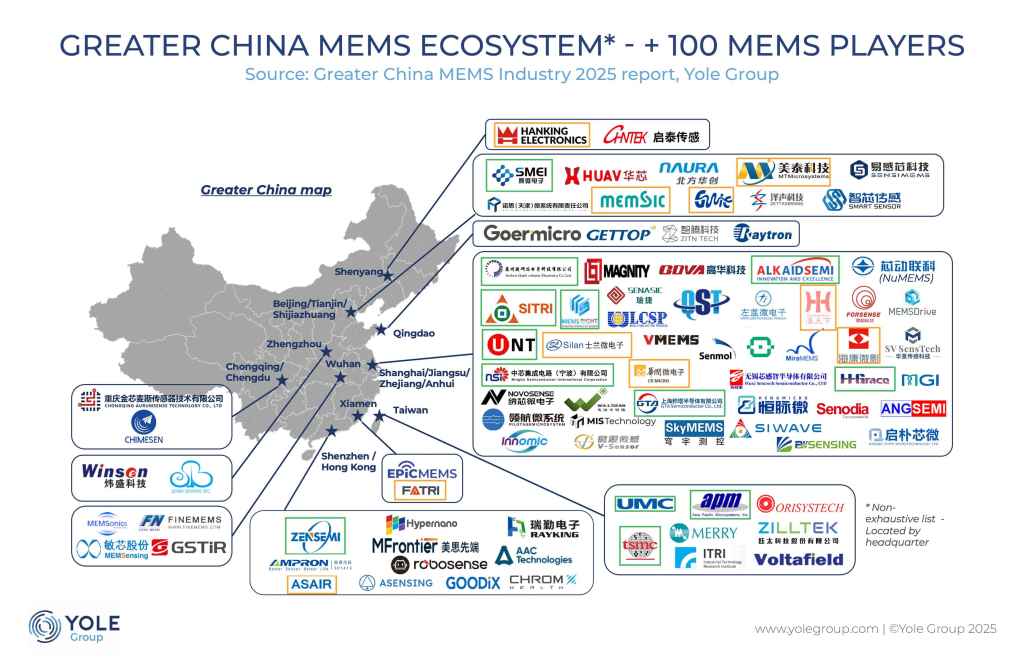
Celia Yuan, Market Researcher in China for Yole Group said: “The region’s ecosystem now covers a wide range of MEMS products, including pressure, microphones, and inertial sensors. Some MEMS companies are building significant collaborations with European and North American companies.”
Most Chinese MEMS companies operate under a fabless or fablite model, while integrated device manufacturers such as Raytron, Silan, and Aosong Electronics are investing heavily in wafer production lines to secure supply chain independence. Sustained capital investments and government support continue to drive this strategic expansion.
Clyde Midelet, Senior Technology & Market Analyst MEMS & Sensing at Yole Group said: “The Greater Chinese MEMS ecosystem is entering a new phase of maturity. Consumer applications remain a cornerstone, but at Yole Group, we are now seeing real momentum in automotive, industrial, and medical domains, all supported by strong local manufacturing capabilities, active investment, and the ambition to localise high-performance MEMS production.”