






The term ‘RAMageddon’, normally used by engineers to describe a memory system overload, has recently been hijacked by industry commentators who are using it in connection with the lack of general availability of memory components due to the unprecedented demands of hyperscale computing applications. According to Adam Fletcher, Chairman of both the UK’s Electronics Components Supply Network (ecsn) and the International Distributors of Electronics Association (IDEA), the electronic components supply industry has been blindsided by a problem that simply wasn’t foreseen by industry analysts or commentators.
In this article, Fletcher shares some hitherto ‘member only’ data and graphics with readers of Procurement Pro to help them make sense of what’s currently happening in the electronic components supply network.
In the UK, Europe, and Japan (and in many other geographic regions) manufacturer authorised distributors of electronic components principally serve customers in the industrial, automotive, medical, aerospace, and military market sectors. They have minimal exposure in hyperscale computing but the relentless growth in this sector is today negatively impacting organisations throughout the world. 2H’25 saw manufacturer lead-times of many component types remain extended beyond customer (but within industry) expectations. The lead-time for many semiconductor and passive components hit 26 weeks (typ.), whilst lead times for e-mech and display components remained extended but stable. In mid-2025 most non-UK customers were placing future order cover in-line with the extending lead times, but according to statistical data, not so in the UK. As a result, ecsn members expressed concern about a looming supply issue, and the association actively encouraged UK system integrators (customers) to urgently review their Bills of Materials (BOM) and increase their order cover in-line with the reality of the extending lead times. This action was largely successful and customer ‘Bookings’ (new or increased orders) in Q4 2025 rose appropriately, resulting in the UK Book to Bill (B2B) ratio improving to >1.05:1. The B2B ratio is a very useful industry metric because it provides a very good indication of future demand and ‘Billings’ (sales revenues).
Sufficient manufacturing capacity?
At the end of 2025, when ecsn released its forecast for the electronic component market for the coming year, there seemed to be sufficient manufacturing capacity across the electronic components supply network to sustain the projected low single digit growth across the professional, industrial, medical, and automotive markets. But the growth in the hyperscale computing sector that greatly exceeded all industry expectations and forecasts resulted in demand outstripping supply of the memory devices and multilayer ceramic capacitors (MLCC) required to support these applications. The small number of companies producing these very advanced, highly specialised (also expensive and highly profitable) components began to focus all of their available manufacturing capacity on these products to the exclusion of other devices, severely limiting the availability of ‘commodity’ memory products for merchant markets – primarily PCs and mobile handsets. Further lead time extensions and massive price hikes encouraged smaller manufacturers of memory components to refocus and ramp up their general commodity memory output and tout for new opportunities in the market. Despite the change to production priorities, these smaller manufacturers could only provide a small increase in the availability of commodity memory but ironically, had the effect of creating longer lead times for the other semiconductor devices that they would otherwise have been making. Many US based customers tried turning to Chinese semiconductor manufacturers to ease the shortages but due to their government-imposed restrictions on technology products, they need specific import licences, which remain very difficult to obtain.
Semiconductor manufacturers simply cannot make sufficient quantities of the components in most demand. The first sign of significant industry stress is semiconductor manufacturers imposing unilateral price increases on their existing customer order backlog and for any new orders, as they desperately try to dissuade customers from placing any more orders. In addition to increasing pricing they are using revenue seeking (read = ‘profit seeking algorithms’) to ensure they only ship the limited inventory they have available to where the greatest profit will be achieved. This may seem incredibly harsh but in this difficult situation, there is not much else they can do to protect their organisation, its employees and suppliers.
ecsn – UK – ‘Book To Bill’ ratio – semiconductors to the industrial market
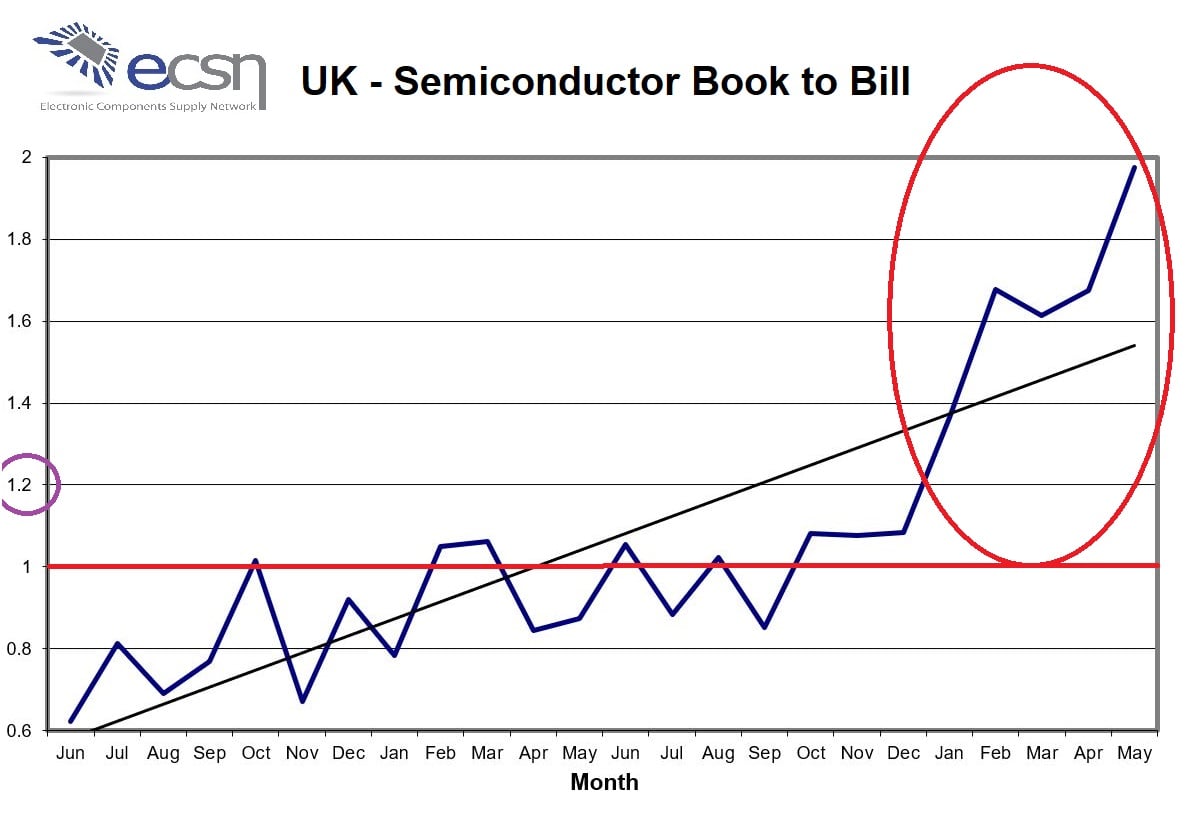
In the last two months of 2025, the Book-to-Bill (B2B) ratio in the UK improved to 1.1:1, encouraging ecsn member companies to forecast that both ‘Bookings’ and ‘Billings’ would likely increase in Q1’26 in-line with the overall UK economic activity. In normal times (and that’s a long time ago!) a B2B ratio in the range 1.05:1 to 1.1:1 would have been considered indicative of a strong industry growth cycle. The ecsn graphic ‘B2B semiconductors to industrial market’ covers the past two years and reveals that the B2B outcome was consistently below unity over the last 16 months (the red line), increasing modestly to 1.15:1 in October, November, and December ’25, in-line with industry expectations. Over the last 40 years of statistical reporting, only at the end of the COVID-19 pandemic has the semiconductor B2B ratio ever breached 1.2:1 (highlighted by the purple circle) but in the first half of ’26 it went ballistic! The B2B climbed to 1.67:1 in February ‘26, fell back (??) to 1.60:1 in March, recovered to 1.67:1 in April and in May hit just below 2:1 (circled in red). If sustained, the crazy ‘Bookings’ trend behind these figures will inevitably herald a return to the major supply problems, pain, and inventory hangover that the electronic components supply network had to contend with at the end of the COVID-19 pandemic.
So, what about UK ‘Billings’?
The ‘Bookings’ metric gives players in the electronic components supply industry a vision of their protentional future performance but the financial metric upon which all organisations are ultimately judged is ‘Billings’, defined as the revenue from goods or services shipped and invoiced to customers. When ‘Bookings’ increase, the new orders feed through to ‘Billings’ with a time delay of typically two to three months, which generally reflects underlying customer demand and associated lead time fluctuations. Analysis of this information, alongside a wide range of other statistical data held by industry associations, confirms that across the global electronic components supply network, customers not involved in the hyperscale computing sector are placing orders far in excess of their actual current or likely future demand. This action unfortunately drives a vicious circle of increasing manufacturing lead times, leading to increased ‘Bookings’ etc.
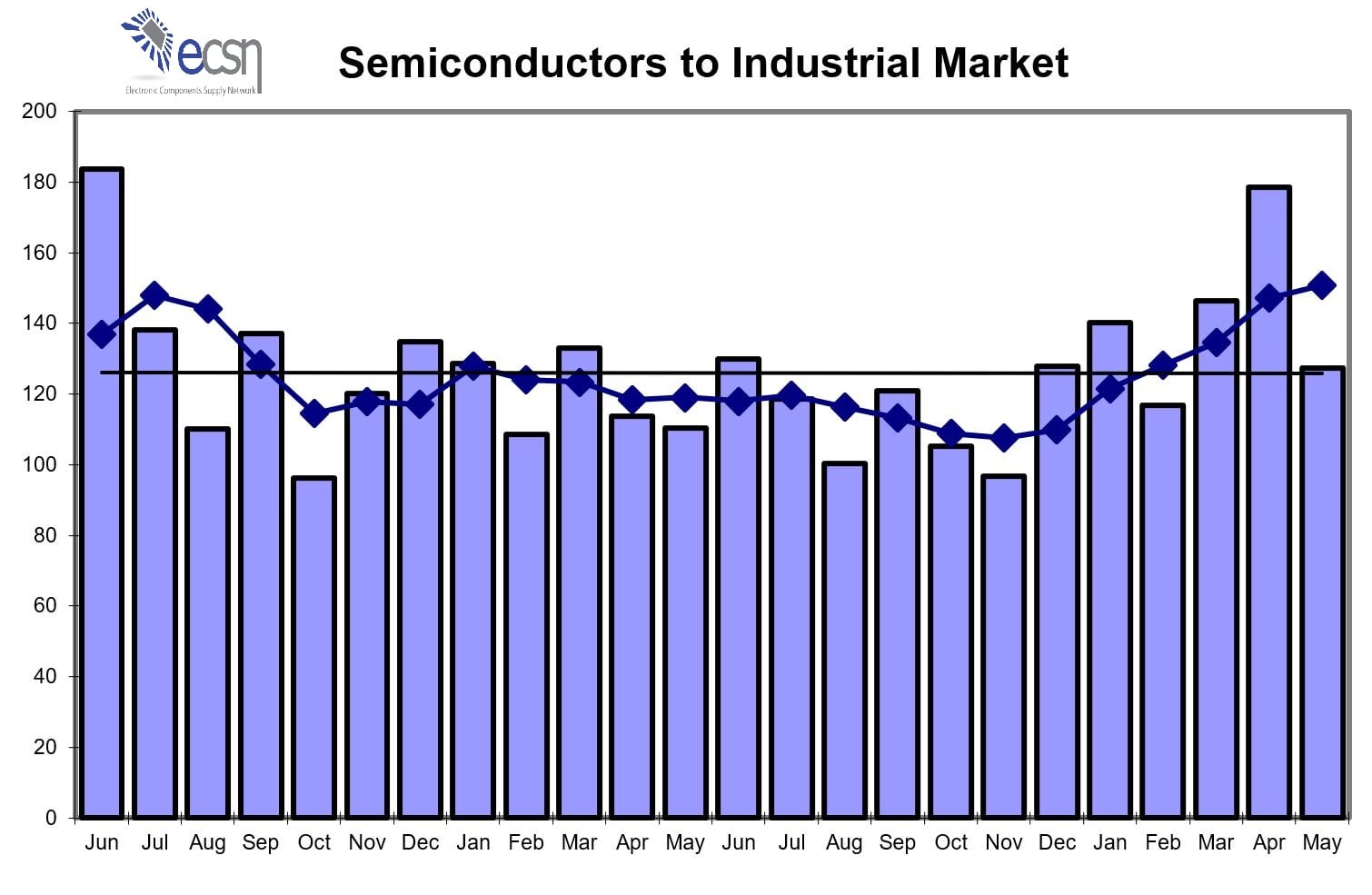
The graphic ‘Semiconductors to industrial market’ covers the past two years and shows the actual UK ‘Billings’ by month (expressed as the ‘average daily sales’ which is the most accurate analysis). The polynomial trend line confirms that real demand for semiconductors in the UK in the period has been at best ‘flat’ and improved only very slightly in the first five months of 2026.
Inadequate demand forecasting
Electronic components manufacturers and their authorised distribution partners need their customers to provide them with a rolling six-to-nine-month order cover, linked to a reasonably accurate longer-term forecast of their organisations’ likely demand. Unfortunately, for many years, most customers have been unable to provide either and, as a result, and compounded by the current spurious order patterns, authorised distributors (who serve 99% of customers) continue to struggle to provide accurate forecasts to component manufacturers, who in turn are struggling to effectively allocate their existing assets, let alone plan future investment in manufacturing capacity. Authorised distributors are forced to forecast their future demand for electronic components based on historic customer order and shipment pattens, but experience has shown that relying on regression analysis post-COVI-19 is extremely risky and could deliver deeply flawed results in a classic case of ‘RIRO’ (Rubbish In = Rubbish Out). This forecasting conundrum is being exacerbated by customers ‘multiple ordering’ the same components on many suppliers at the same time, a practice that ‘masks’ or distorts the true market demand for the products. If it proliferates, this practice will trigger the reintroduction of ‘Non-Cancellable and Non-Returnable’ orders (‘NCNR’ in the jargon). An ‘NCNR’ agreement binds the customer company to take delivery of the goods ordered and pay for them in accordance with the agreed terms and accept all the subsequent financial liability.
An ‘NCNR’ almost always leads to an ‘inventory hangover’ because even as the demand correction takes place and lead times normalise, the component manufacturer will exercise his contractual right to ship the products ordered under the ‘NCNR’ to the customer, resulting in highly inflated component inventories that may take months or years to run down to a normal level. In the meantime, the component manufacturers receive no significant new orders, which negatively impacts their revenue. No organisation wants to invoke ‘NCNR’ contract terms. It’s a very negative action to take especially between customers and suppliers who have enjoyed many years of successful business relations.
In conclusion
The current supply situation is a BIG problem for all partners right across the global electronic components supply network, and there is zero chance that it will improve in the next quarter. In these difficult times I encourage purchasing professionals in the electronic components supply network to actively and positively engage with all of their partners, both up and down their supply network.
A greater focus on identifying and honestly reporting ‘real’ customer demand rather than artificially inflating order books will go a long way towards mitigating current problems and minimising the exposure of all partners to higher levels of risk. Continued successful collaboration throughout the electronic components supply network is essential if we’re to successfully mitigate the current problems, the known potential issues just around the corner, and the other unknowns looming just over the horizon.
This article originally appeared in the July/August issue of Procurement Pro