




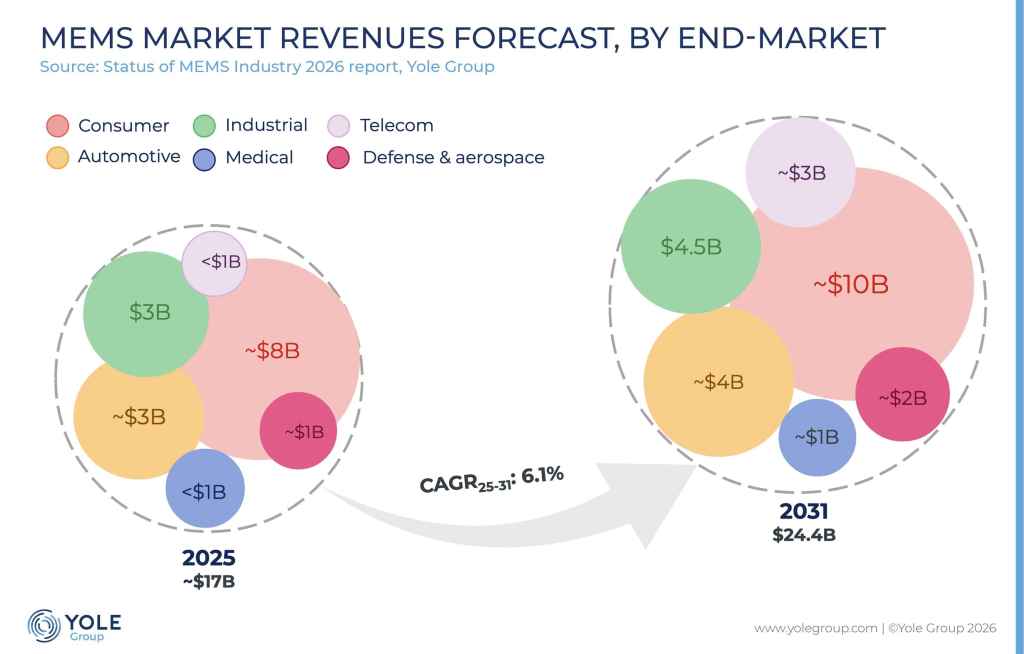
As expected, 2025 was a better year for the MEMS industry than 2024, with global revenue exceeding $17 billion (+7.6% YoY). Yole Group’s analysts highlight data centres and humanoid robots as the next major growth drivers.
Against this backdrop, the market research & strategy consulting company releases its latest report, Status of the MEMS Industry 2026, which offers a comprehensive analysis of the market, technology, and ecosystem trends shaping the industry’s future.
Looking ahead, Yole Group forecasts a 6.1% CAGR through 2031, with volumes surpassing 40 billion units and revenue climbing to $24 billion. This growth is underpinned by application diversity: from consumer wearables to data centres, automotive, industrial, medical, and defence.
The MEMS ecosystem transformation has led to significant consolidation of the players at the IDM level. First, STMicroelectronics reinforced its position in the automotive and industrial market with the acquisition of NXP’s MEMS business. Then, ams OSRAM decided to concentrate its activities on optical sensing, selling its non-optical sensing activities to Infineon. The Greater Chinese MEMS ecosystem is also continuing to consolidate around a few industry leaders to serve the microphone, accelerometer, and microbolometer markets. Growth is expected to accelerate in China in the next few years; some players are looking to start producing gyroscopes, and therefore, we expect the launch of IMUs.
“The recent growing investments by the top pure MEMS foundries to expand manufacturing capabilities and serve low-volume and high-margin markets show that the consolidation of the MEMS ecosystem that started in 2025 is continuing,” said Pierre-Marie Visse, Senior Technology & Market Analyst, MEMS & Sensing at Yole Group.
The consumer market remains stable, held back by stagnation in the smartphone market and the current memory shortage. However, demand for MEMS in wearables, such as smart eyewear, is increasing. Inertial sensors, LBS, microphones, and microspeakers are all set for growth, alongside double-digit volume growth expected for MEMS timing devices and rising interest in optical MEMS.
In the automotive industry, even as electrification is reducing the need for engine-side MEMS pressure sensors, there are several opportunities for the MEMS industry. In addition, “automotive becomes IMU” as more IMUs replace stand-alone accelerometers and gyroscopes for ADAS, safety and navigation applications. Electrification also drives demand for thermal-runaway detection sensors, such as MEMS pressure sensors or gas sensors with MOX technology, while in-cabin comfort and connectivity open further opportunities for MEMS.
With hyperscaler capex increasing by 65% last year in the US, data centre growth is emerging as a major new driver. This is fuelling demand for two specific MEMS devices: MEMS OCS, which consumes less power than an EPS and counts Google and Lumentum among its key players, and MEMS timing devices, valued for their immunity to temperature and vibration. Both devices carry greater added value.
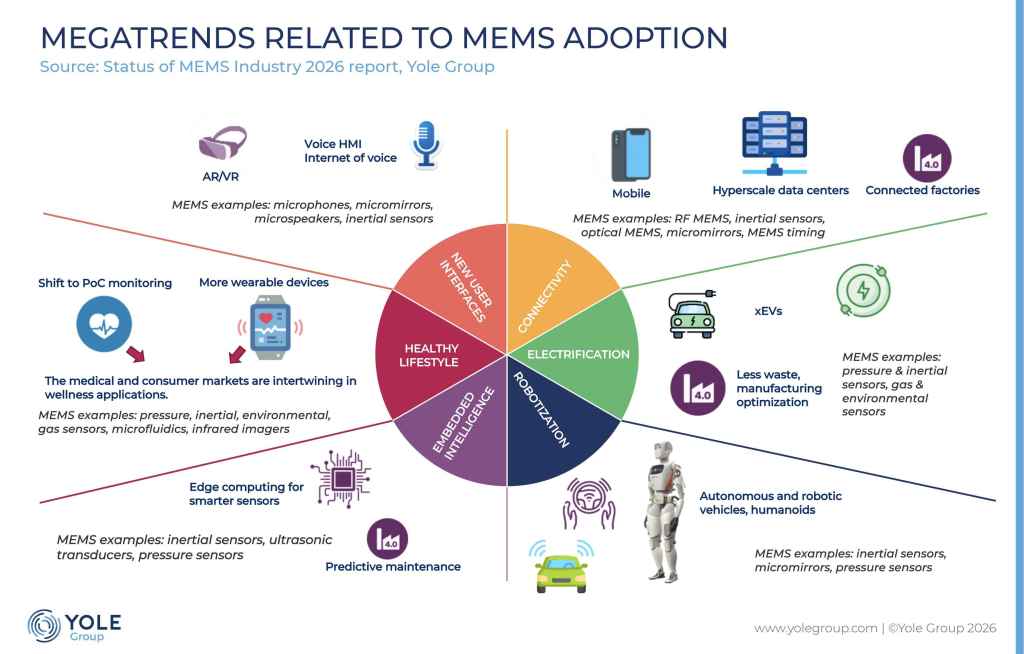
The new trends are driving needs for more complex MEMS devices integrated into advanced systems, shifting from volumes to high added value components. Foundry companies are well positioned to address these new needs, thanks to their expertise in manufacturing complex devices and their production capacities.
Humanoid robots represent an emerging opportunity for the MEMS industry, as they embed several MEMS sensors, including pressure sensors, ultrasonic transducers, magnetic sensors, microphones, and optical devices. As the required performance levels are higher than those in consumer applications, the revenue opportunities are not negligible even though volumes are still relatively low.
In the medical market, the OTC hearing aid remains an interesting opportunity for MEMS microphones, microspeakers, and motion sensors, while expanded use of ultrasound in diagnostics and handheld point-of-care probes using CMUT and PMUT is opening the door to remote healthcare.
Finally, fostered by the current geopolitical situation, the defence & aerospace market grew again in 2025, with rising demand for thermal imaging, precise localisation of drones and missiles, and antenna stabilisation.