






Every AI cluster now runs on light. As GPU bandwidth needs push optical links beyond the rack and lane rates pass 200G, each of these links needs a laser, and silicon cannot lase. InP and GaAs have therefore become strategic materials for the AI build-out.
Yole Group analyses this shift in a new report, Photonics InP and GaAs for AI 2026. This first edition analyses the lasers, modulators, boosters, and photodiodes used for optical communication in AI data centres, from wafer and epiwafer up to bare die, with forecasts through 2031.
A 13-fold market, captured by InP
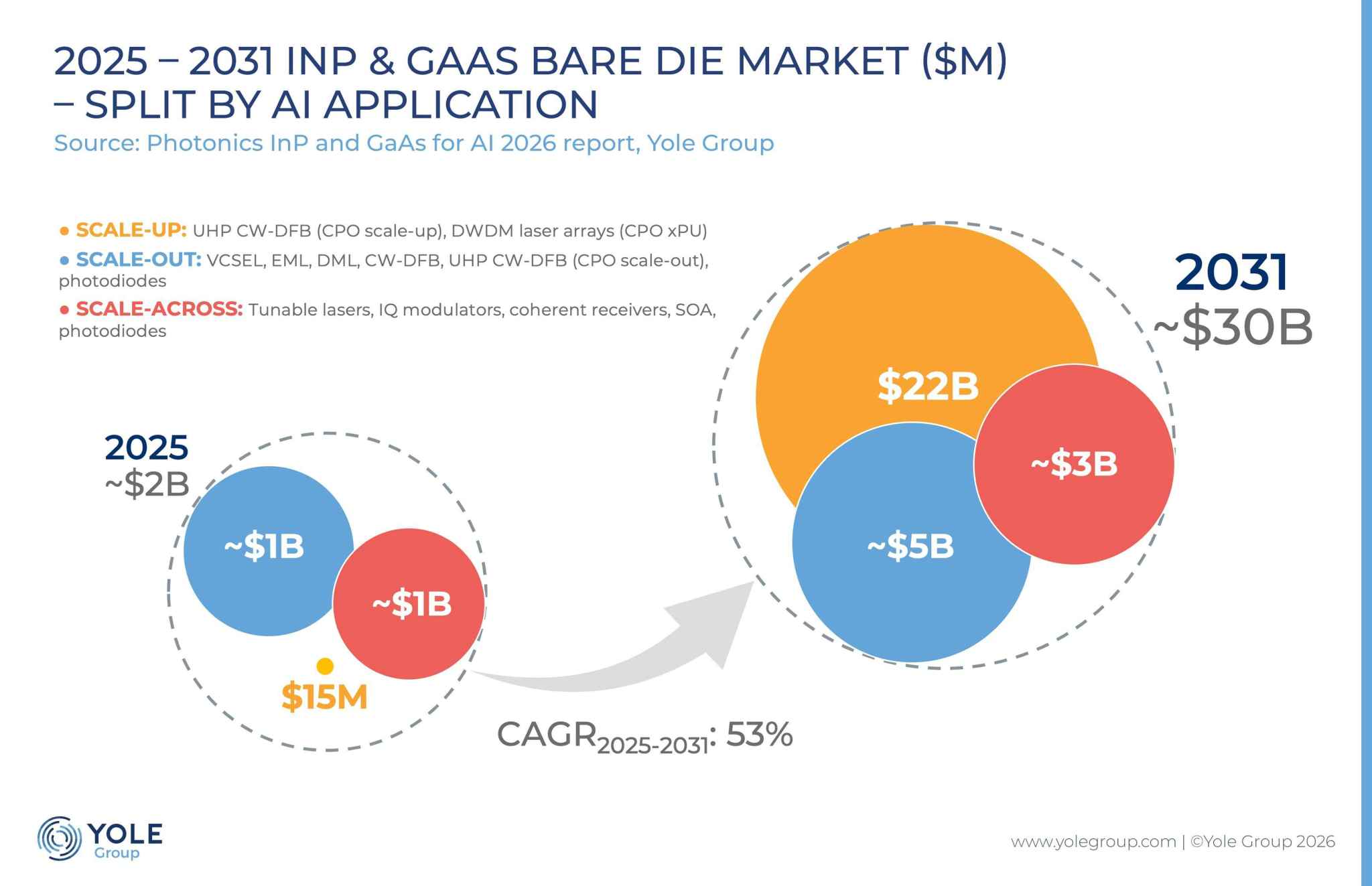
The InP and GaAs bare die market for AI optical interconnects grows from $2.3 billion in 2025 to $30 billion in 2031, driven by the shift from pluggables to co-packaged optics (CPO). Scale-up takes 74% of 2031 value, about $22.2 billion, from near nothing today. According to Yole Group, three InP technologies capture 82% of that value: UHP CW-DFB lasers for CPO, DWDM laser arrays for xPU optical I/O, and IQ modulators for coherent links. GaAs VCSELs fall from 31 to 2% of units, confined to links under about 100m.
“AI is moving optical links inside the rack, and InP is capturing that growth: as GPU bandwidth pushes lanes past 200G, scale-up optics will account for 74% of a bare die market that grows 19-fold to $30 billion by 2031,” said Ahmad Abbas, Technology & Market Analyst, Compound Semiconductor at Yole Group.
An investment surge, yet a wafer gap
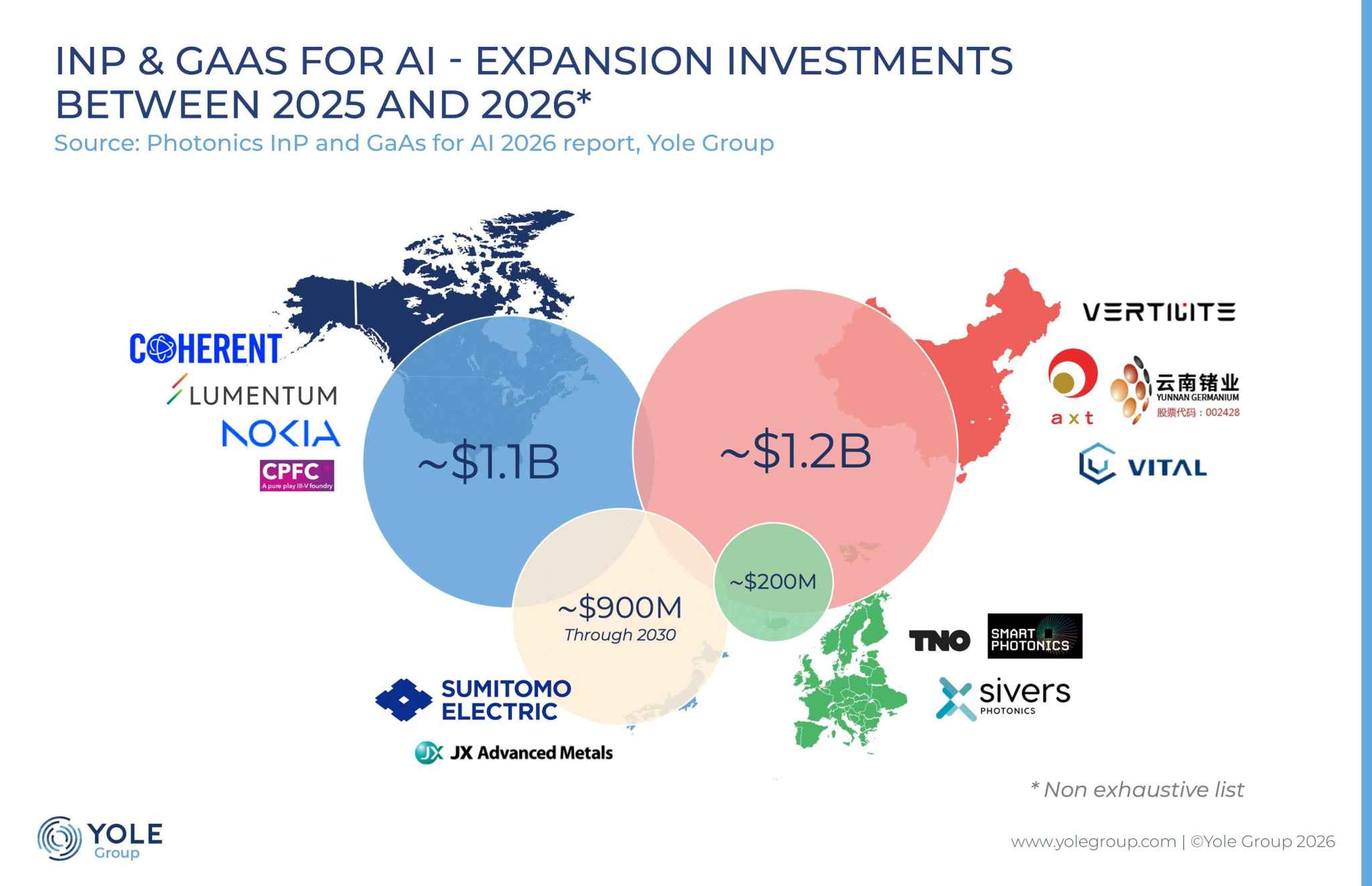
Since 2024, IDMs have shifted from buying companies to building InP capacity. Lumentum and Coherent, the InP device leaders, are each backed by a $2 billion NVIDIA investment and a multiyear purchase commitment.
Coherent has started production in its first 6″ InP fab, and substrate suppliers AXT, Sumitomo, JX, and Vital are all expanding. In total, about $21 billion has been announced across InP and GaAs over five years, but only roughly $4 billion is actual fab and capacity spend.
Although InP capacity appears more than sufficient to meet current demand, available supply covers only 29% of 2026 demand. Since February 2025, every InP shipment from China requires government approval, and allocation at Lumentum is sold out through 2028.
“InP substrate capacity is about twice the demand. But once you remove wafers that miss low-EPD specs, shipments held up by Chinese export licenses, and volumes locked in by long-term agreements, only 29% of 2026 wafer demand is covered. Capacity will need two to three years to catch up,” said Roy Dagher, Technology & Market Analyst, Compound Semiconductor at Yole Group.
With this new comprehensive Photonics InP and GaAs for AI 2026 report, Yole Group’s analysts highlight why InP has become the light source of choice for AI infrastructure, why wafer supply, not demand, will set the pace for the next 2-3 years, and how the race to 6″ wafers will redistribute positions among substrate suppliers, epihouses, and device makers.