





Yole Group announces the release of the Automotive Semiconductor Trends 2025 report, offering insights into the competitive dynamics of the fastest-growing segment of the semiconductor industry.
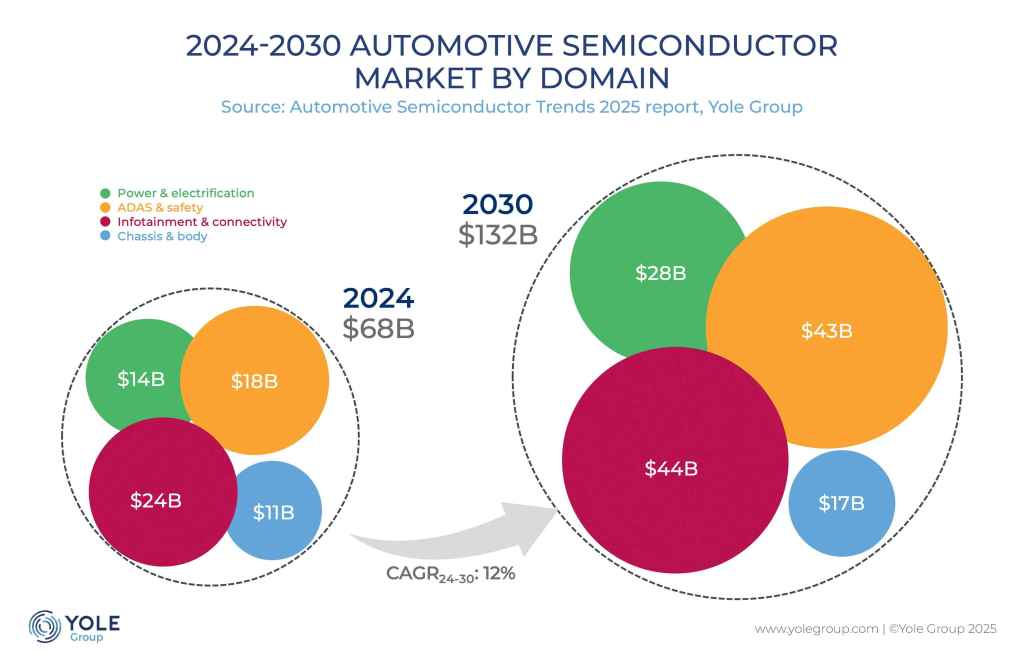
While the global automotive market grows at a modest ~2% CAGR between 2024 and 2030, automotive semiconductors are accelerating five times faster, surging from $68 billion to $132 billion. At the centre of this transformation lies an increasingly fragmented and competitive supplier landscape, shaped by electrification, advanced computing, and regional policy.
“The era of static automotive supply chains is over. Indeed, power, performance, and geopolitical alignment are redrawing competitive boundaries while the gap between leaders and challengers is narrowing faster than ever,” said Pierrick Boulay, Principal Analyst, Automotive Semiconductors at Yole Group.
Automotive semiconductor leaders hold the line for now
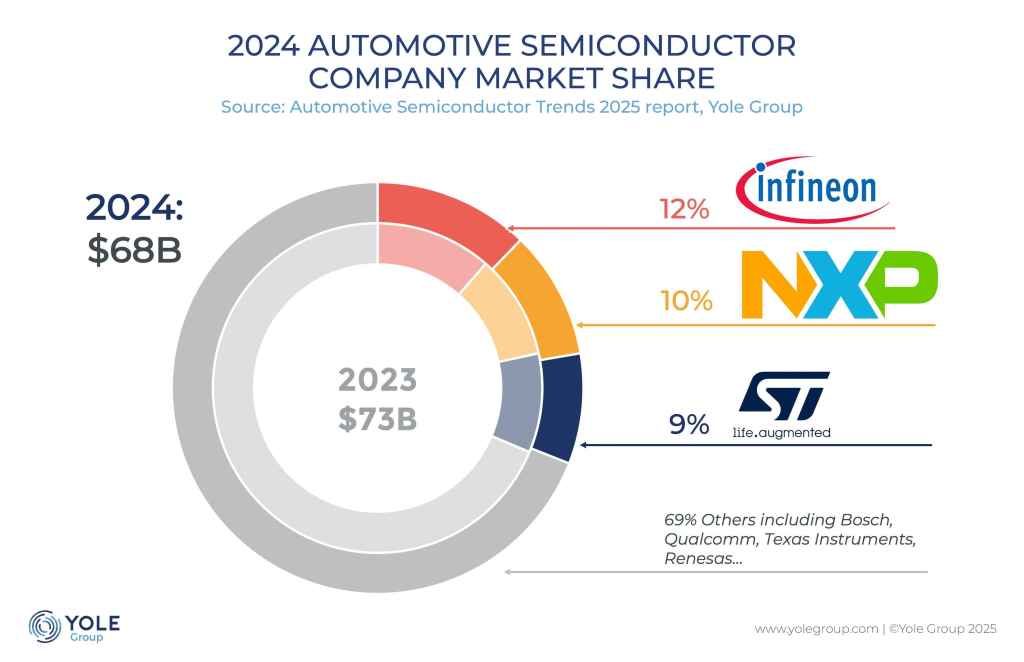
As of 2024, five semiconductor companies command nearly half the global automotive market, but face growing pressure from both geographic rivals and vertically integrated OEMs:
- Infineon Technologies leads with more than $8 billion in sales, dominating Si/SiC power modules, drivers, and MCUs
- NXP follows closely, strong in in-vehicle networking MCUs, radar, and transceivers
- STMicroelectronics maintains its edge in discretes, electrification, and MCU platforms, targeting long-term growth
The three European semiconductor companies have built scale and specialisation. However, at Yole Group, analysts see that challengers are multiplying.
US & Japan: at the core of computing and sensing
US companies account for 36% of the market. Their primary activities are in analog, memory, and high-end SoCs solutions. NVIDIA, AMD, and Qualcomm are bringing AI computing to the vehicle Edge, while their future growth hinges on SoC penetration into ADAS, autonomous systems, and cockpit compute.
In Japan, semiconductor companies such as Renesas, Rohm, and Denso remain strong in legacy MCUs, sensors, and SiC, rebuilding momentum post the pandemic-induced shortage.
“Renesas is regaining market, while Rohm and Denso are growing in SiC MOSFETs for EV inverters,” explains Boulay.
China’s strategic acceleration
China’s 25% domestic content mandate by 2025 is already reshaping the automotive landscape. Yole Group’s analysts highlight:
- Horizon Robotics, SiEngine, Black Sesame: targeting cockpit and ADAS chips
- BYD Semiconductor, StarPower: expanding in SiC and IGBT
- Nio: designed its own 1,000 TOPS domain controller on TSMC’s 5nm node
- SMIC: building four 12″ fabs for 28/40nm automotive production
Without doubt, China’s strength lies in its domestic policy, expansion of its fab capacity, and agile vertical integration. As an example, OEMs like BYD and Nio now design their own semiconductors, once considered a Tesla-exclusive advantage.
In the automotive semiconductor industry, competition is being redefined, and leadership itself is being actively challenged.
With every OEM becoming a tech company, and every chip company chasing automotive growth, the competitive dynamics of this market have fundamentally changed. Technology differentiation, supply chain control, and regional alignment now matter as much as device performance.