




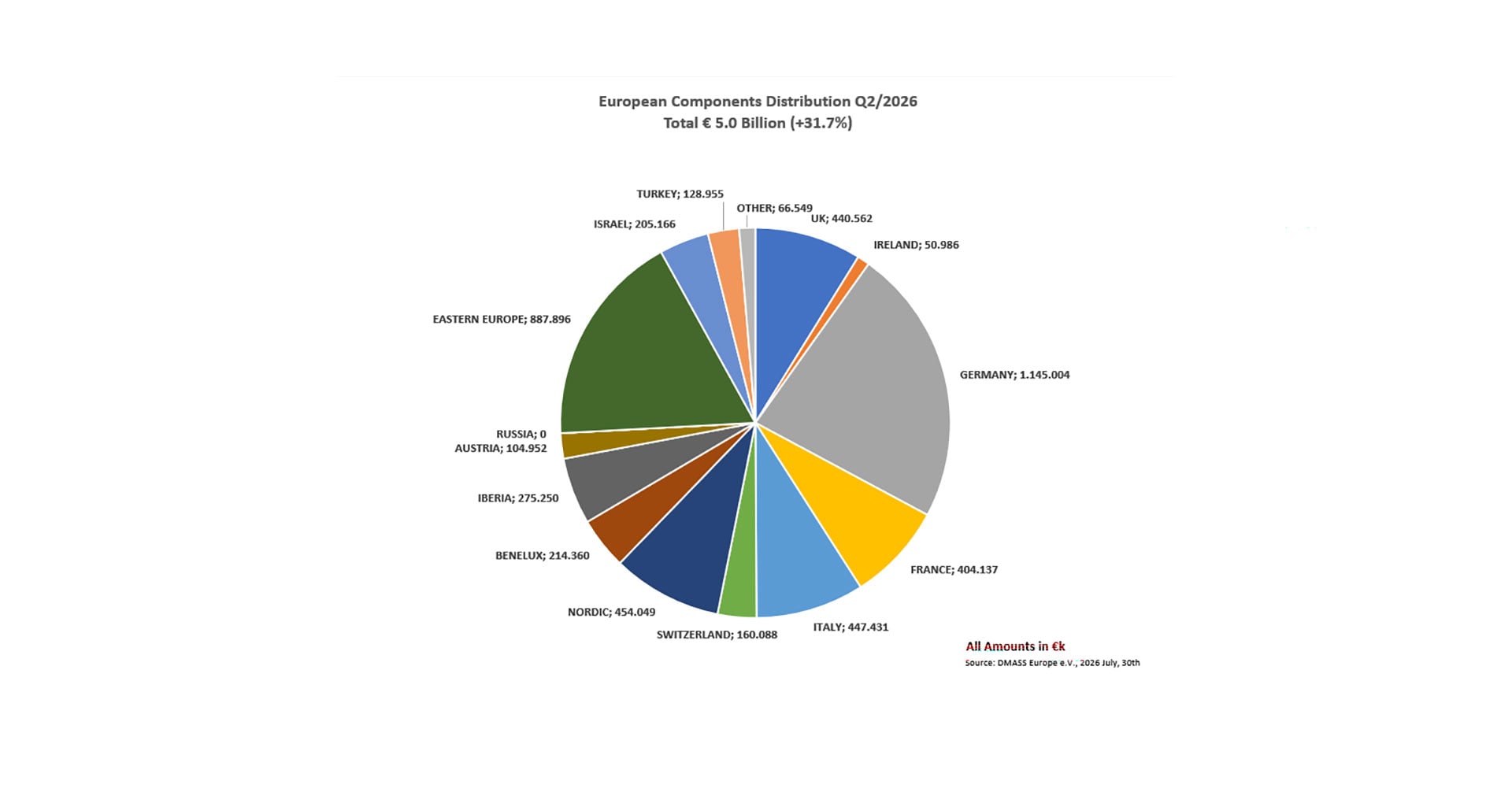
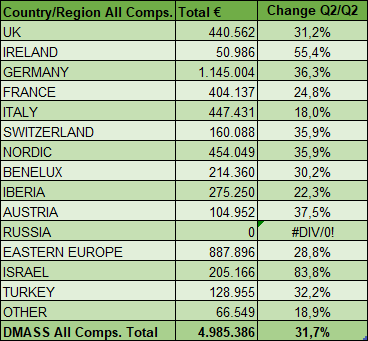
The European electronic components market accelerated sharply in the second quarter, reaching €5.0 billion (+31.7%), with broad yet uneven momentum across the region. Southern Europe remained slightly softer, though France (+24.8%), Italy (+18.0%), and Iberia (+22.3%) continued to expand solidly.
Northern and Central Europe all exceeded the 30% mark, led by Ireland (+55.4%) as the fastest growing market, while Germany, the largest regional economy, recorded an encouraging +36.3%. The exceptional surge in Israel (+83.8%) reflects strong demand in aerospace, defence, and AI/Cloud applications, sectors that are particularly dynamic within the Israeli ecosystem. The Nordics (+35.9%), Austria (+37.5%), and Benelux (+30.2%) also delivered solid double-digit gains.
Product wise, the Q2 upswing reflects a broader industrial rebound across Europe’s manufacturing base. Demand from automation, energy, and infrastructure sectors remained the key growth engine, supported by renewed investment in digital and industrial modernisation. Memory (+189.0%) stood out with extraordinary, also price driven growth, reflecting both global supply constraints and speculative momentum. Other areas began to show early signs of tightening and cost inflation, suggesting that the current expansion phase may soon encounter capacity and pricing pressures of global supply constraints and speculative momentum.
“The global semiconductor landscape is shifting at remarkable speed, with extraordinary WSTS reported growth in China and across Asia, while Europe sees its strongest impulses in memory, driven by sharp price increases and elevated inventory orders,” says Hermann Reiter, Chairman, DMASS Europe. “Compared with the surges in the US and China, Europe’s overall expansion remains more moderate, yet the cross-sector nature of electronics continues to offer hope that industrial demand will gain momentum in a steadier, more sustainable way. Our strength lies in combining Europe’s deep application expertise with emerging AI driven use cases. We remain cautiously optimistic, but mindful that global tensions and market volatility require close attention as we navigate this evolving environment.”
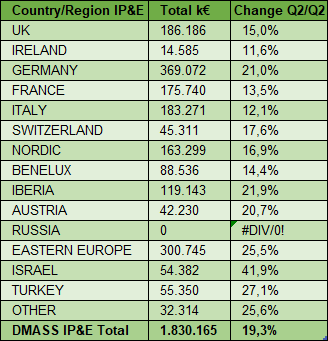
All components consolidated by region (Q2):
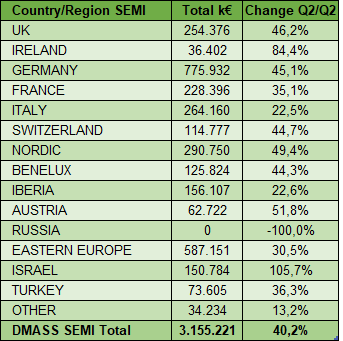
Semiconductors (Q2):
European semiconductor distribution surged to €3.2 billion (+40.2%) in Q2, driven by a mix of price effects, renewed industrial investment, and strong demand from aerospace, defence, and AI/Cloud applications. The most dynamic markets were Israel (+105.7%) and Ireland (+84.4%), reflecting rapid expansion for Israel in aerospace & defence and in high tech and data centre sectors. The DACH region also performed strongly – Germany (+45.1%), Switzerland (+44.7%), and Austria (+51.8%) – while parts of Southern Europe, including Italy (+22.5%) and Iberia (+22.6%), remained softer.
On the product side, memory (+189.0%) dominated growth, fuelled by global capacity bottlenecks and price increases that are now visible across European distribution. Discrete devices (+26.5%), sensors & actuators (+15.0%), analog (+28.8%), and power (+13.4%) continued to expand steadily, while opto (+1.6%) and standard logic (+8.2%) remained under pressure from inventory digestion and slower design ins.
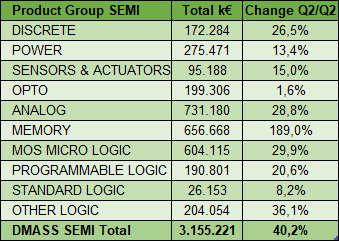
Overall, the market shows strong but uneven momentum. The outlook remains positive, backed by automation and governmental investment in European technological independence, though tempered by geopolitical uncertainty, energy price volatility, and shifting trade flows.
Interconnect, passive, and electromechanical components (Q2):
European IP&E distribution reached €1.8 billion (+19.3%) in Q2, reflecting a more uniform recovery across Europe. Strongest momentum came from Israel (+41.9%), Turkey (+27.1%), Other (+25.6%) and Eastern Europe (+25.5%), while the core market Germany (+21.0%) delivered solid growth. In contrast to the semiconductor trend, Ireland (+11.6%) ranked at the lower end.
On the product side, the IP&E sector provides a clearer measure of Europe’s genuine industrial demand, as it remains less affected by global price speculation and AI related volatility. Growth across passives (€644.5M, +20.2%) and electromechanical components (€1.0Bn, +18.8%) reflects steady, application driven expansion rather than inflationary effects. The only notable exception is tantalum capacitors (+35.6%), where AI driven shortages have begun to influence pricing and availability.
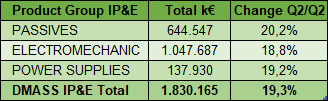
Overall, IP&E confirms Europe’s underlying industrial strength – a steady, demand driven recovery shaped by real application needs.
Reiter concluded: “The second quarter further strengthened the positive momentum established in Q1, with nearly all regions reporting substantial gains across key product groups.
“At the same time, we must acknowledge the geopolitical backdrop – Orgalim explicitly warns that rising tensions, particularly the Iran conflict and its potential impact on Europe’s energy infrastructure, pose a serious risk of external shocks.
“The task now is to translate the momentum into sustained progress, greater resilience, and a stronger strategic position, while reducing supply chain fragility, managing energy market volatility and shaping a competitive, future ready electronics landscape.”