




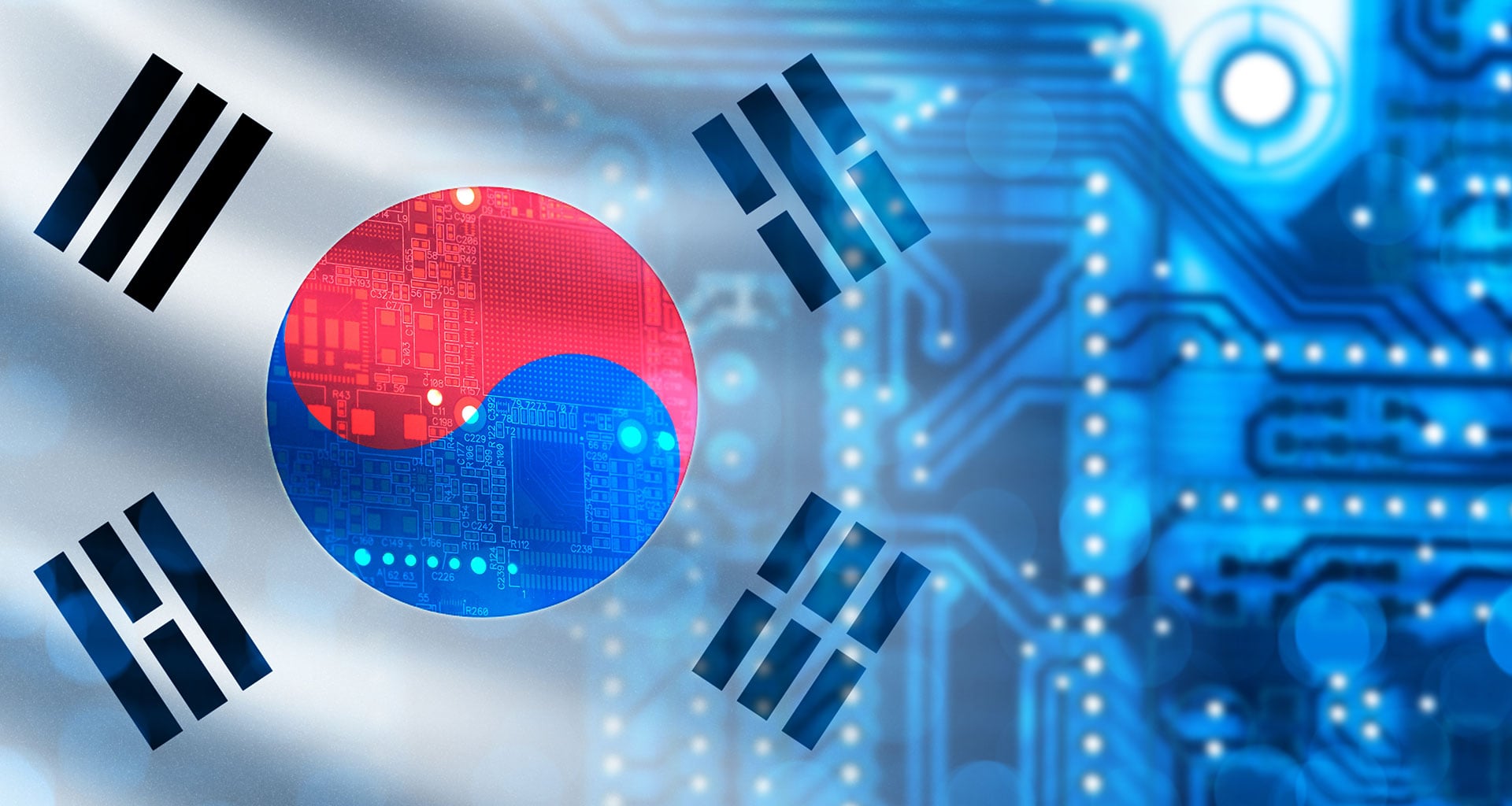
Few countries dominate the semiconductor value chain as visibly, and as decisively, as South Korea. Much like the global wave of K-pop Demon Hunters, South Korea’s cultural breakout, its dominance of advanced memory fabrication is currently in its ‘golden’ era, powered by surging AI demand and record-breaking chip exports.
How it’s done (done done): South Korea’s semiconductor empire
For decades, South Korea has been synonymous with cutting-edge memory chips. The country currently produces around half of the world’s production capacity for Dynamic Random Access Memory (DRAM) and NAND flash chips.
Now, as artificial intelligence, high-performance computing, and intensifying geopolitical fragmentation converge, South Korea finds itself at a new inflection point: doubling down on advanced fabrication while racing to secure its place in the next era of semiconductor leadership.
What it sounds like: the export boom powering South Korea’s growth
Soaring global demand for semiconductors propelled South Korea’s semiconductor exports to reach $173.4 billion in 2025, according to government data, a rise of more than 20% year on year. The surge, it said, was overwhelmingly driven by high-priced memory chips used in AI data centres.
At the centre of this export surge are South Korea’s industrial champions: Samsung Electronics and SK hynix. Samsung remains one of the world’s largest memory chip producers and a growing competitor in logic semiconductors through its foundry division, where it competes with Taiwan’s TSMC. SK hynix, meanwhile, has consolidated its position as a global leader in DRAM and has moved aggressively into high-bandwidth memory, now one of the most strategically important components in AI accelerator systems.
Wafer thin edge
As AI models become larger and more computationally intensive, memory bandwidth has emerged as a critical bottleneck. This shift has played directly to South Korea’s strengths, given its decades-long dominance in advanced memory manufacturing and process engineering.
South Korea’s semiconductor boom began in earnest in the 1980s, when the government identified chips as a strategic sector and backed national champions with coordinated industrial policy, export financing, and infrastructure support. Unlike many countries that specialised in assembly or design alone, South Korea moved aggressively into wafer fabrication, building deep capabilities in capital-intensive production.
That early bet reshaped the structure of the economy. Over time, South Korea became the undisputed leader in memory semiconductors, outcompeting rivals through scale, manufacturing discipline, and rapid technology upgrades.
By the 2000s, semiconductor clusters in Gyeonggi Province, including Suwon, Icheon, and Pyeongtaek, had evolved into some of the most advanced industrial hubs in the world.
Stacked in their favour: the rise of high-bandwidth memory
Today, the scale of that industrial base is immense. Samsung’s Pyeongtaek complex is the world’s largest semiconductor manufacturing hub. In 2025 the company announced it had decided to invest a further 450 trillion Korean wan ($330Bn) into its fifth plant at the campus (P5) which is scheduled to begin operations in 2028. Facilities include extreme ultraviolet lithography, 24-hour cleanroom operations, and increasingly AI-driven process optimisation systems that continuously adjust yield and efficiency parameters in real time.
Spotless operation: the cleanroom arms race
However, South Korea’s dominance in memory also exposes structural vulnerabilities. Memory chips are inherently cyclical, with pricing swings that can rapidly shift profitability across the industry. They are also increasingly commoditised outside the highest-performance segments, putting long-term pressure on margins.
In response, South Korean firms are seeking to actively diversify. Samsung has expanded its logic chip and foundry ambitions, looking to compete more directly with Taiwan-based mega foundry TSMC in advanced process nodes. SK hynix, meanwhile, has leaned further into high-bandwidth memory and next-generation memory architectures, where technological complexity provides stronger pricing power and higher barriers to entry.
Your idol: South Korea’s foundry ambitions
South Korea government policy is reinforcing this shift. In an attempt to copy and outdo the US Silicon Valley, Seoul’s ‘K-Semiconductor Belt’ strategy aims to build an integrated ecosystem spanning chip design, materials, equipment, and fabrication which it hopes will become the world’s largest, most concentrated semiconductor supply chain by 2030. The objective is to reduce external dependencies while strengthening domestic resilience in a sector increasingly defined by geopolitical competition and supply chain fragility.
At the same time, the country is investing heavily in next-generation technologies, including system semiconductors and AI accelerators.
President Lee Jae Myung’s pledge to triple artificial intelligence spending in 2026 underscores the ambition to position South Korea not just as a manufacturing powerhouse, but as a central player in AI infrastructure development.
Takedown: the global context
Yet the global context is becoming more complex. South Korea’s semiconductor industry is deeply embedded in international supply chains, shipping chips to data centres in the United States, consumer electronics manufacturers worldwide, and AI infrastructure providers across multiple regions. This integration brings scale, but also exposure.
For South Korea, the biggest problem is becoming stuck in an intensifying trade war between the US and China. Both markets are critical to Soeul: the US as a strategic ally and leading technology partner, and China as a major trading partner and historical demand base.
Like many countries, over the past year or so, the South Korean government has faced ongoing uncertainty over the level of tariffs imposed on the goods it exports to the US. A trade deal struck between the two countries in October which limited tariffs to 15% on many South Korean goods was called into question in January 2026 when President Donald Trump said it had not been implemented quickly enough.
Export controls on advanced semiconductor equipment and restrictions on technology transfer have forced South Korean firms to adopt increasingly cautious investment and supply chain strategies.
Hot air or helium shortage? Supply chains under pressure
The industry also faces emerging supply chain risks linked to critical inputs. Semiconductor manufacturing depends on highly specialised materials and gases, including helium, which is essential for certain fabrication processes. Disruptions in global energy and logistics systems have highlighted the fragility of these inputs. While long-term contracts have so far provided stability, prolonged shortages could introduce additional constraints on global production capacity.
This article originally appeared in the May/June issue of Procurement Pro