




The printed circuit board industry closed 2025 at about $88 billion in revenue, and a conservative forecast puts it at $140 billion by 2031, following an 8.1% CAGR. That headline figure averages two industries moving in opposite directions: an AI-driven segment compounding at 45 to 70% a year, and a barely growing commodity tail.
Against this backdrop, Yole Group, has launched The Printed Circuit Board (PCB) Industry 2026 report. This first annual, single-source report spans the entire value chain, from copper foil, CCL, and glass cloth through PCBs, IC substrates, and equipment to end demand; furthermore, it models PCB and IC substrate content per platform, and stress-tests a two-speed, geopolitical supply chain in optimistic and pessimistic scenarios.
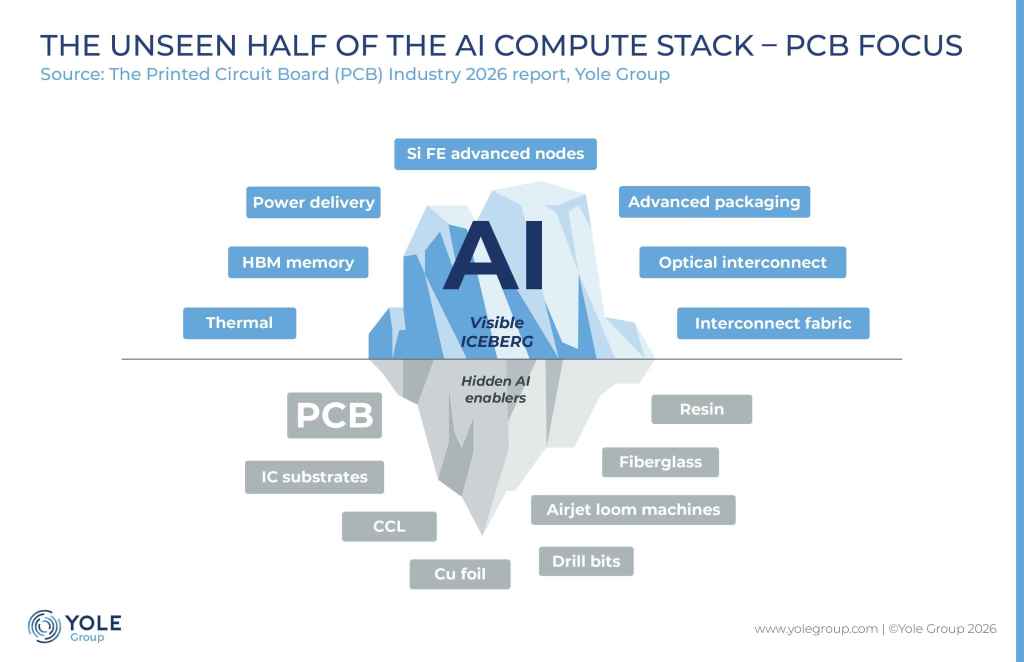
The AI infrastructure story has a familiar cast: 3nm and 2nm logic, CoWoS and the advanced packaging bottleneck, co-packaged optics, HBM generation from 3 to 4E. These are the enablers the market prices and companies celebrate, and almost without exception they sit inside the package. What today’s conversations have missed is the foundation layer beneath it. Indeed, PCBs and their material ecosystem are undergoing a restructuring of the same order, on the same time scale, with a supply structure arguably more fragile than anything in the front end. The industry is watching the die and ignoring the board it sits on.
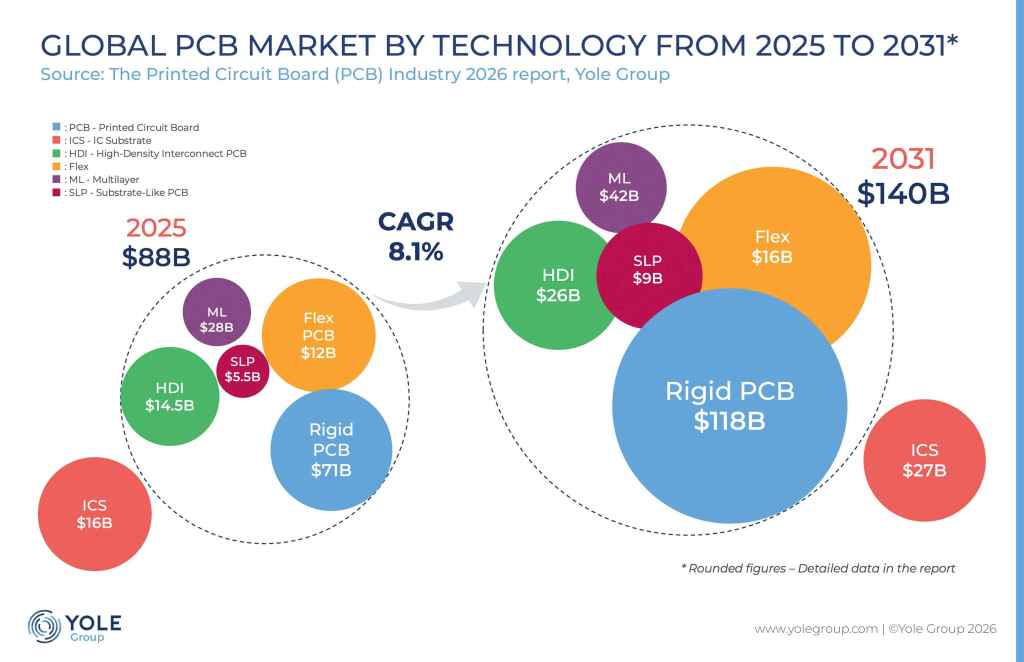
That blind spot carries a cost. Pricing the PCB industry on its 8% average applies the same assumptions to a commodity tail and to an AI franchise growing twenty times faster, missing where value is moving: into boards with more than 18 layers, AI-grade laminates, and board categories that did not exist a generation ago. Yole Group’s PCB analysis gives investors, fabricators, material suppliers, and OEMs a single-source view of the whole chain, with bottom-up content models per platform, segment financials, and a 2027 to 2028 supply/demand balance.
The divergence is visible at every level. Boards with 18 layers or more will grow 15.7% a year through 2031 while 4- to 6-layer boards grow 2.3%; meanwhile, servers and data centres have risen from 16 to 25% of PCB demand since 2020, displacing consumer electronics. Fabricators that define the AI supply chain will grow PCB-related revenue to almost $109 billion in 2028, with the core-AI franchise expanding to roughly $76 billion at 76% a year between 2025 and 2028. These leaders represented about 45% of global output in 2025 and more than half in 2026.
“The industry average is the least useful number in this market. One half is compounding at 45 to 70% a year, the other is barely growing. Those who price the average will misprice both,” said Bilal Hachemi, PhD, Senior Technology & Market Analyst at Yole Group.
The mechanism is value per system rather than unit volume. PCB content per NVIDIA rack rises more than 200% for the new generation, including Vera Rubin, and 57% of the uplift comes from board categories that did not exist a generation earlier. A custom accelerator carries roughly twice the PCB content of a GPU, and ASICs reach about 30% of AI servers in 2026. Upstream, the laminate market doubles to $46 billion as AI dedicated PCB’ material displaces the standard ones.
Automotive is the second vector, and the more durable one, growing to more than $23 billion in 2031, a 14% CAGR. The growth is entirely compositional: EV powertrain boards compound at 30% and ADAS central compute at 46%, while ICE-legacy content contracts 15% a year, and automotive will sustain high-end HDI demand after hyperscaler capex normalises.
Behind the numbers sits a change in what a board is. The laminate roadmap has become a clock, with CCL advancing one generation every 18 to 24 months: M7 for GB300, M8 for Vera Rubin, M9 for Rubin Ultra in the second half of 2027, and M10 for the Feynman generation, targeting 448 Gb/s signalling. Each step changes all four constituent materials, and M9 laminate sells at four times the price of M7.
The board is becoming the package. At 224 gigabits per second, the skin depth is only 0.27 microns, so a copper roughness that was irrelevant a generation ago is now simply loss. That is why Yole Group talks about PCB semiconductorisation in its PCB 2026 report.