




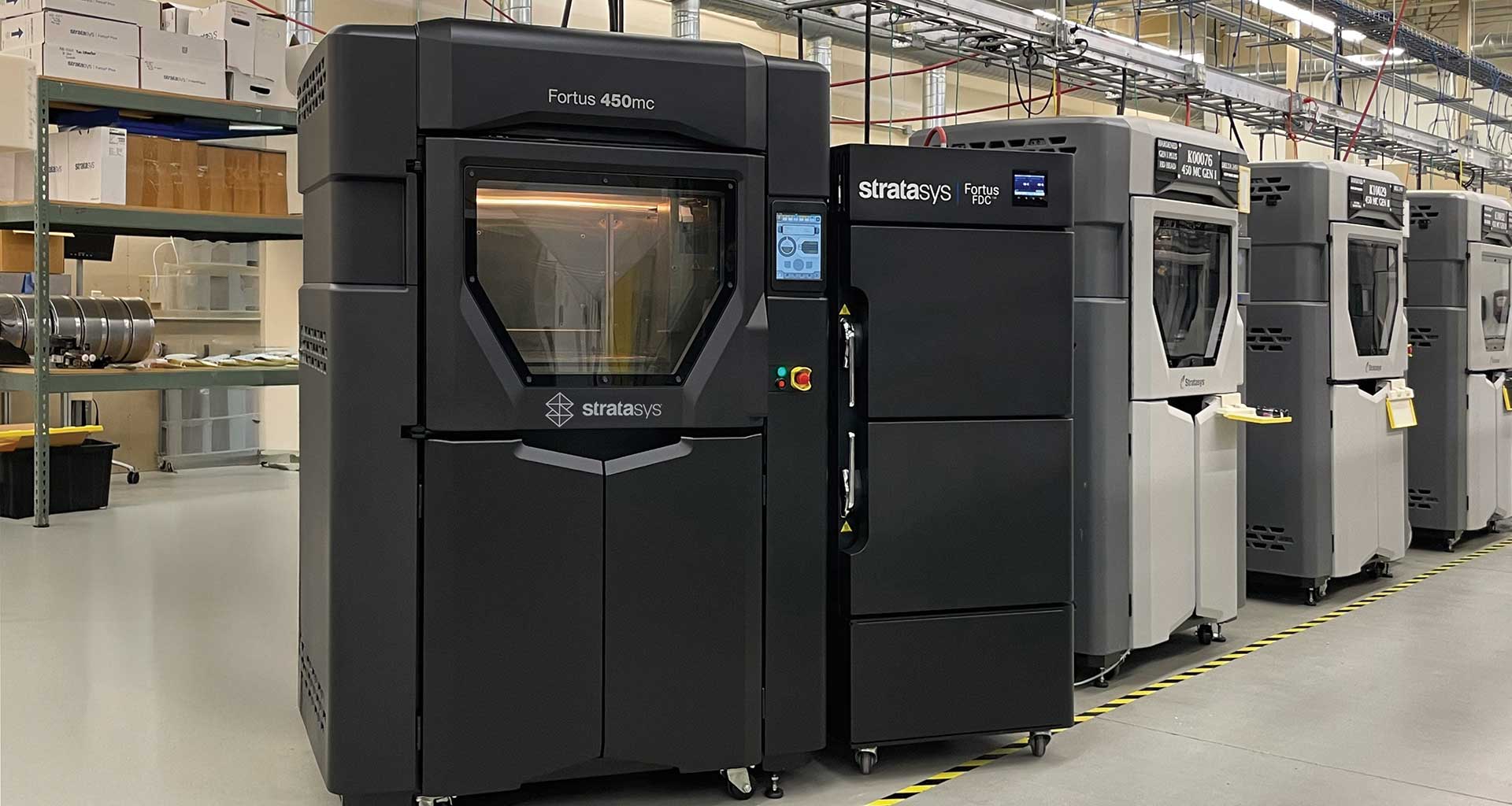
Additive manufacturing provides a flexible means of producing accurate and repeatable parts when needed, therefore mitigating the challenge of supply chain delays, says Foster Ferguson, Vice President, Industrial Business at Stratasys.
Unreliable supply chains are having a significant impact on the global commercial aerospace market, and aircraft manufacturers and maintainers will need to adopt new measures to mitigate the impact on their operations. That’s one of the primary findings of new research from the International Air Transport Association (IATA), which suggests that supply chain challenges will have cost the industry more than $11 billion in 2025.
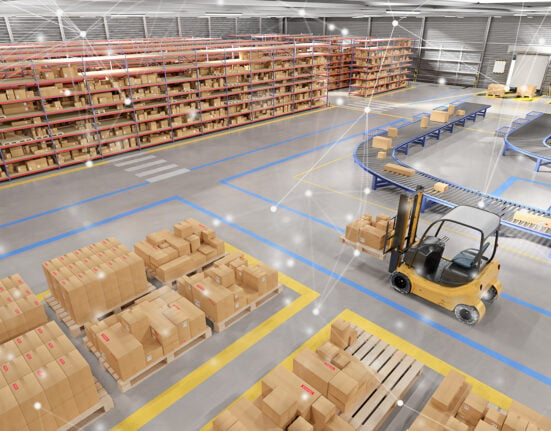
So what’s at the root of the problem? One of the biggest issues is a global spare parts shortage caused by myriad issues, including geopolitical instability, raw material shortages, and tight labour markets. Consequently, many airlines have begun to stockpile excessive inventory just to keep planes flying. This is an expensive and inefficient approach that creates logistical challenges and increases costs.
One solution, says IATA, is to rethink how aerospace parts are produced, with the adoption of advanced manufacturing to ease bottlenecks. The report specifically mentions additive manufacturing as being “well-suited for quick response, low-volume production runs,” (page 63) which could enable a shorter time-to-market.
Many aircraft manufacturers and maintainers would seemingly agree, as additive manufacturing has been increasingly adopted across the aerospace lifecycle. Initially, its usage was primarily restricted to rapid prototyping using polymers. But as AM technologies and materials have advanced, so the process has been deployed for a broader range of applications, such as 3D printed tooling and high-quality end-use aerospace parts.
Additive manufacturing delivers operational benefits in the aerospace industry across several critical areas. First, the decentralised nature of production means manufacturers and maintainers can print parts on demand, in multiple locations at any time. With machines in place on the production floor or maintenance depots, components can be produced quickly and easily, closer to where they are required. This immediately eliminates the problem of unreliable supply chains, where parts often come from the other side of the globe.
Second, printing close to where parts are needed removes shipping delays and reduces transport and logistics costs. This approach also allows for smaller inventories, requires less warehouse space, and improves part security.
There’s a functional benefit, too. With additive manufacturing, engineers and designers can create more intricate geometries and structures and consolidate them with innovative patterns that cannot be achieved with traditional manufacturing methods, such as milling. Aerospace companies can therefore optimise performance and minimise waste, using additive to produce lighter, stronger components that improve fuel efficiency and reduce emissions.
3D printed parts on modern airliners
How does this translate to real-world applications? Additive manufacturing is already used to produce hundreds of thousands of qualified flight-worthy parts every year, manufactured to multiple material and process specifications. These components comply with airworthiness requirements set by regulators such as the European Union Aviation Safety Agency (EASA) and the Federal Aviation Administration (FAA), following established certification pathways that demonstrate material consistency, mechanical properties, and traceability throughout the build process. Properties such as tensile strength, fatigue resistance, and fracture toughness are rigorously validated to ensure structural integrity and long-term reliability in demanding flight conditions.
As a result, additive manufacturing has been deployed across many aircraft systems. In engine and propulsion applications, manufacturers are producing air intake plenums and manifolds. Environmental control systems rely on additively manufactured cooling ducts, ECS ducting, and filter assemblies that manage cabin pressurisation and climate control. Meanwhile, electrical and avionics systems benefit from 3D printed wire guides, conduits, and connector blocks that simplify cable routing.
Perhaps most significantly, structural and mounting hardware, including brackets, clips, clamps, and hydraulic supports, demonstrate AM’s versatility for load-bearing applications. Even seemingly mundane components like gaskets, spacers, and drain fairings are now being 3D printed, highlighting how the technology has matured from exotic applications to everyday hardware.
Real-world aerospace applications
Let’s look at some specific users of additive manufacturing across the aerospace industry. At the top of the supply chain, Airbus now produces more than 25,000 flight-ready 3D printed parts each year, transforming how aircraft are built and maintained across its global fleet. What began with its first part – a spare crew seat component – has evolved into the use of additive manufacturing capabilities across a broad range of applications, with more than 200,000 certified Stratasys polymer parts now in active service.
Recent data reveals that the implementation of 3D printed parts in the Airbus A350 resulted in a 43% weight reduction, the elimination of the Minimum Order Quantity requirement, and an 85 percent reduction in lead time, saving significant costs and multiple weeks of production time. Airbus has parts printed for the A320, A350, and A400M models using Stratasys ULTEM 9085 Certified Grade filament on multiple Stratasys industrial-grade FDM printers.
Distributed manufacturing allows Airbus to produce parts where and when they’re needed, helping reduce aircraft downtime, minimise inventory storage, and avoid costly supply chain delays. Indeed, Serge Senac, Airbus industrial leader for polymer additive manufacturing, said recently that additive manufacturing technology was now an integral part of Airbus’ aviation business because it can produce “certified, repeatable parts faster, with less reliance on complex supply chains,” therefore reducing costs and improving response times.
There is also a strong collaborative effort to maximise the value of both metal and polymer materials. Airbus has taken the lead on a £38 million Digitally Enabled Competitive & Sustainable Additive Manufacturing (DECSAM) collaborative programme that will look to further scale metal additive manufacturing for next-generation aircraft. The project brings together leading organisations from across the supply chain.
Additive manufacturing is also making an impact further down the supply chain. UK-based Marshall Aerospace, for example, has several 3D printed ducting components approved by the EASA and flying on various aircraft. It also uses ULTEM 9085, whose flame, smoke, and toxicity performance characteristics have been crucial to securing certification.
Securing supply chain agility
It is clear that the adoption of additive manufacturing has become a critical tool in the battle to mitigate supply chain problems. It is a process well suited to the quick-response, low-volume production runs required in the aerospace sector, where more traditional techniques might prove prohibitive on time and cost grounds. Additive manufacturing has proved itself across multiple aerospace applications, evolving from prototyping through tooling to certified production parts now flying on aircraft worldwide.
In addressing the $11 billion supply chain crisis identified by IATA, additive manufacturing offers more than incremental improvement – it represents a fundamental shift toward responsive, resilient manufacturing that can help the industry move beyond costly inventory stockpiling toward true supply chain agility.