




The 2025 CMOS image sensor (CIS) competitive landscape confirms a stronger polarisation between Sony, Chinese suppliers, and the rest of the ecosystem, according to Yole Group’s analysts.
Against this backdrop, Yole Group releases its latest report, Status of the CIS Industry 2026, which offers a comprehensive analysis of the market, technology, and ecosystem trends shaping the CIS industry’s future, including revenue, shipments, ASP, and wafer production forecasts through 2031.
Sony accounted for around 50% of global CIS revenue in 2025, gaining significant share and moving closer to its long-standing leadership target.
This performance was mainly driven by premium mobile imaging, Apple-related demand, larger optical formats, higher-resolution sensors, and advanced stacked architectures.
Samsung remains the second-largest CIS supplier, but its revenue is broadly stagnant, reflecting stronger competition from Sony in premium smartphones and from Chinese suppliers in mid- and low-end segments.
Omnivision confirmed its growth with double-digit gains, while SmartSens posted the strongest momentum among major players, supported by expansion in mobile, security, automotive, and consumer applications.
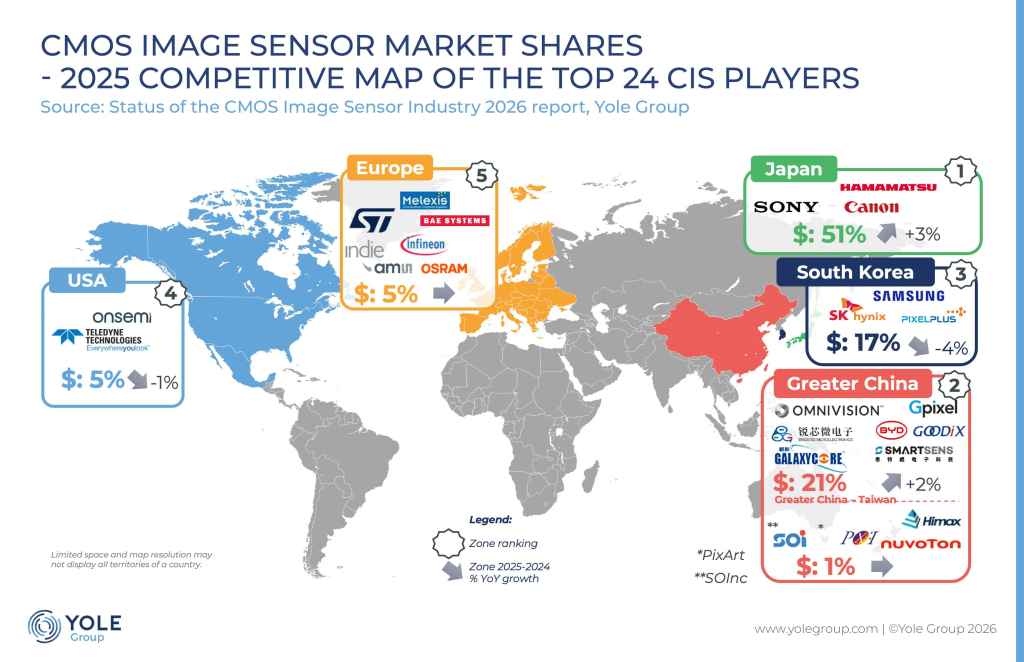
In contrast, onsemi declined amid increasing competition in the automotive market, and SK Hynix continued to reduce its CIS focus, redirecting resources toward its core memory business.
“China’s rise is not only market-driven but also supply-chain-driven. Indeed, Chinese CIS suppliers increasingly combine domestic foundry access, international manufacturing routes, and stronger links with local camera module players to improve cost, qualification, and time-to-market,” said Anas Chalak, Market & Technology Analyst, Imaging at Yole Group.
China has become the second-largest CIS supplier base after Japan, surpassing South Korea in the global revenue ranking, confirming the trend anticipated in last year’s report: Sony and Chinese CIS players are gaining share, while Korean and some Western players are losing. China’s rise is supported by Omnivision, SmartSens, GalaxyCore, and Gpixel, which benefit from strong domestic demand in smartphones, security, automotive, drones, robotics, AIoT, and smart home applications.
Application-level competition is becoming more differentiated, with the various markets reflecting distinct supplier structures.
In mobile, Sony dominates with 57% market share, far ahead of Samsung, while Omnivision, SmartSens, GalaxyCore, and STMicroelectronics address specific mobile and sensing opportunities. In productivity, Sony remains the leader, though growth is limited following the post-COVID normalisation of PCs, tablets, and webcams.
Consumer photography remains highly concentrated around Sony and Canon, while Omnivision, GalaxyCore, SmartSens, Samsung, and Himax lead in smart IoT. This dedicated ecosystem and the strategies of each player reveal the importance of cost competitiveness, compact form factor, and Chinese OEM exposure. In security, SmartSens and Omnivision lead a highly fragmented market driven by multi-camera deployments. Finally, in industrial, Sony remains dominant, while onsemi, Teledyne, Gpixel, and Hamamatsu maintain strong positions in high-performance, long-lifecycle applications.
On the other hand, some challenges might arise. AI-driven demand for HBM and advanced DRAM is tightening memory supply and pushing memory prices higher, while memory makers prioritize higher-margin opportunities. This can indirectly affect CIS through wafer allocation, logic/memory cost, stacked architectures, buffers, and camera-module roadmaps.
Understanding where the next growth segments and the next supply chain risks lie has never been more critical for device manufacturers, investors, and technology providers. The Status of the CIS Industry 2026 report from Yole Group provides the market intelligence and technology insights required to navigate this rapidly evolving landscape.