





In the second blog of this two-part series, Omdia explores how rising memory costs are deepening polarisation across the smartphone market, with vendors cutting or freezing memory capacity in low- and mid-range devices while continuing to upgrade premium models.
If you missed the first blog, ‘Global smartphones priced below $400 will decline by 22% as memory costs soar’, it explains how rising DRAM and NAND prices are reshaping smartphone economics and putting pressure on the budget segment.
The memory price surge, which began in the second half of last year, has intensified through the first half of this year. Driven by a year-on-year memory price hike of up to 200%, rising smartphone retail prices are stifling demand for budget smartphones. Consequently, total global smartphone shipments are projected to contract by 12% compared with last year.
To cope with severe cost pressures, smartphone vendors are scaling back low-end lineups and shifting their focus to mid and high-end segments. For premium models, where consumers are less sensitive to price hikes, smartphone vendors continue to upgrade performance and specifications despite the soaring bill of materials.
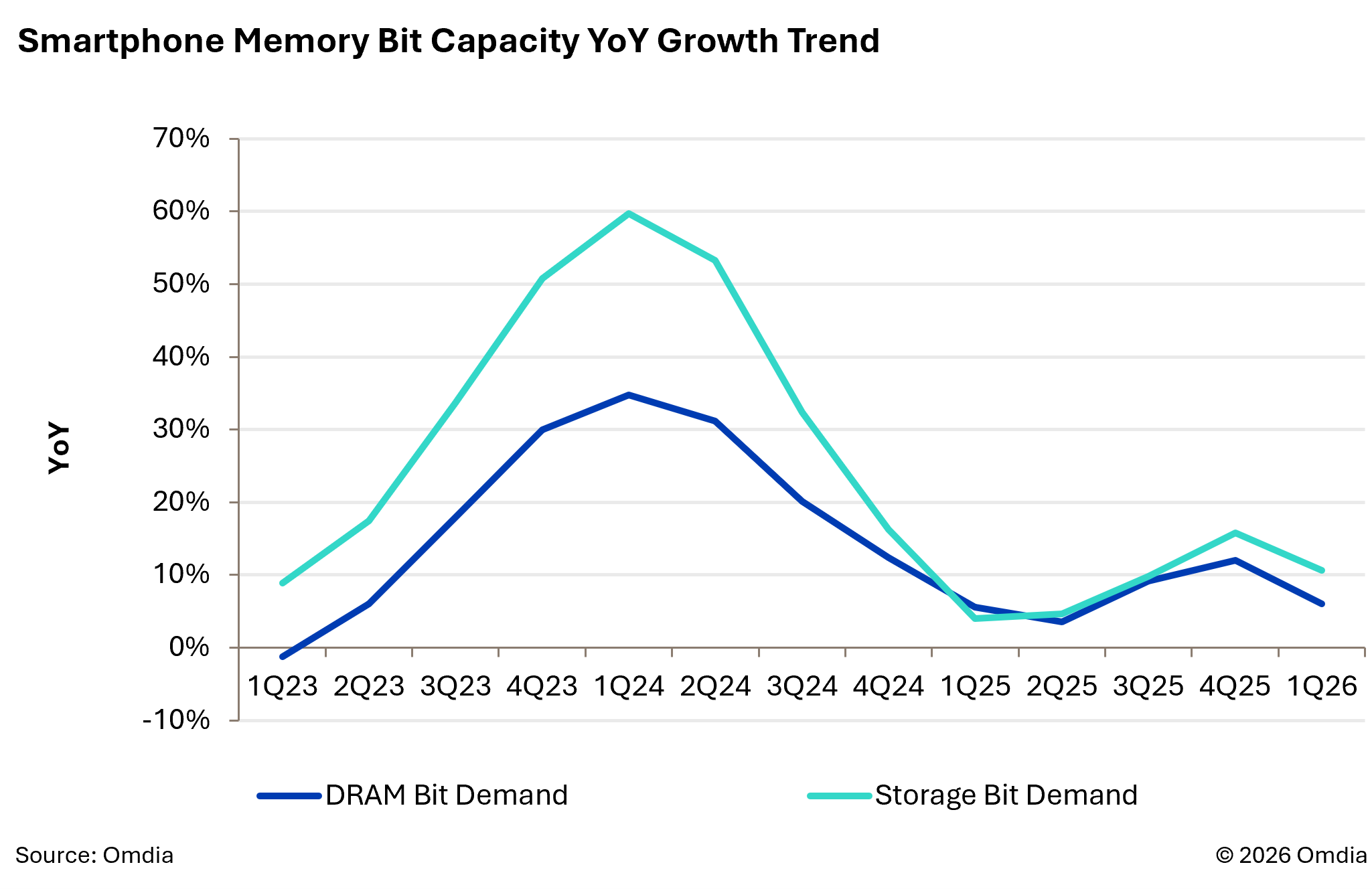
According to Omdia’s Quarterly Smartphone Technology Trends Analysis – 1Q26 report, the total bit capacity of smartphone memory (DRAM and NAND flash storage) has grown steadily despite the steep price trends. While global smartphone shipments edged up by just 0.5% year-on-year in the first quarter of this year, total smartphone DRAM and NAND storage capacities jumped by 6.1% and 10.7%, respectively. Growth in NAND storage growth consistently outpaced DRAM.
Jusy Hong, Senior Research Manager at Omdia noted as smartphone camera resolutions increase and user-generated content, such as video and picture, continues to grow, the growth rate of storage capacity is significantly exceeding that of DRAM.
In the first quarter of this year, the global average smartphone capacity reached 8.3GB for DRAM and 279GB for NAND storage. This marks a 5.5% and 10.1% increase from the 7.8GB and 253GB recorded in the same period last year.
However, this growth is driven entirely by high-end devices. Faced with heavy cost burdens, low- and mid-range smartphones are seeing their memory capacities slashed.
The global average DRAM capacity for smartphones reached 8.3GB in the first quarter of this year, marking a 0.5GB increase compared with the same period last year. Average DRAM capacity has been growing continuously over recent years, climbing by 3GB from the 5.3GB recorded four years ago in the first quarter of 2022.
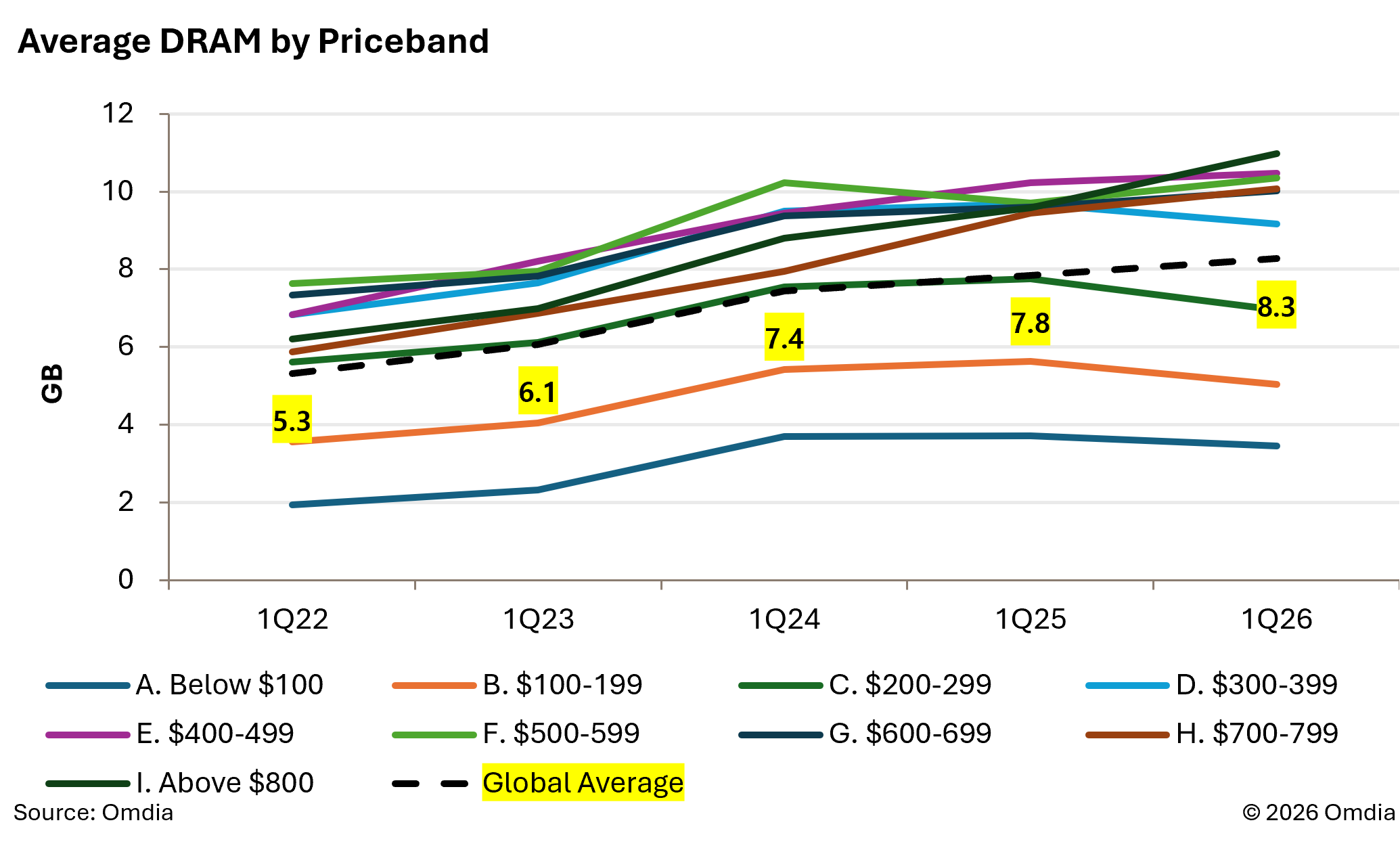
The upward trend highlights how smartphone vendors have historically expanded DRAM to satisfy consumer appetite for heavy mobile gaming and smoother multitasking. However, facing heavy cost pressures from recent memory price surges, smartphone vendors are scrambling to ease their financial burdens. For low- and mid-range smartphones, vendors are freezing memory capacities at previous-generation levels or eliminating higher-capacity variants that were previously available within the same product lineup. As a result, the average DRAM capacity for smartphones priced below $400 declined compared with the previous year.
A similar phenomenon has emerged in NAND storage. While the overall global average capacity continues to rise, a breakdown by price tier reveals that storage capacities in the budget and mid-range segments have actually decreased.
As the financial strain of rising memory costs intensifies, smartphone vendors are shrinking their budget portfolios and shifting their product mix toward high-margin devices. For premium and high-end smartphones, vendors continue to boost memory capacities to meet elevated consumer expectations and justify retail price hikes. Due to these diverging strategies, Hong added that the polarization of memory capacity in the smartphone market – where higher-end devices continue to gain more memory while budget devices face reductions – will intensify further this year.