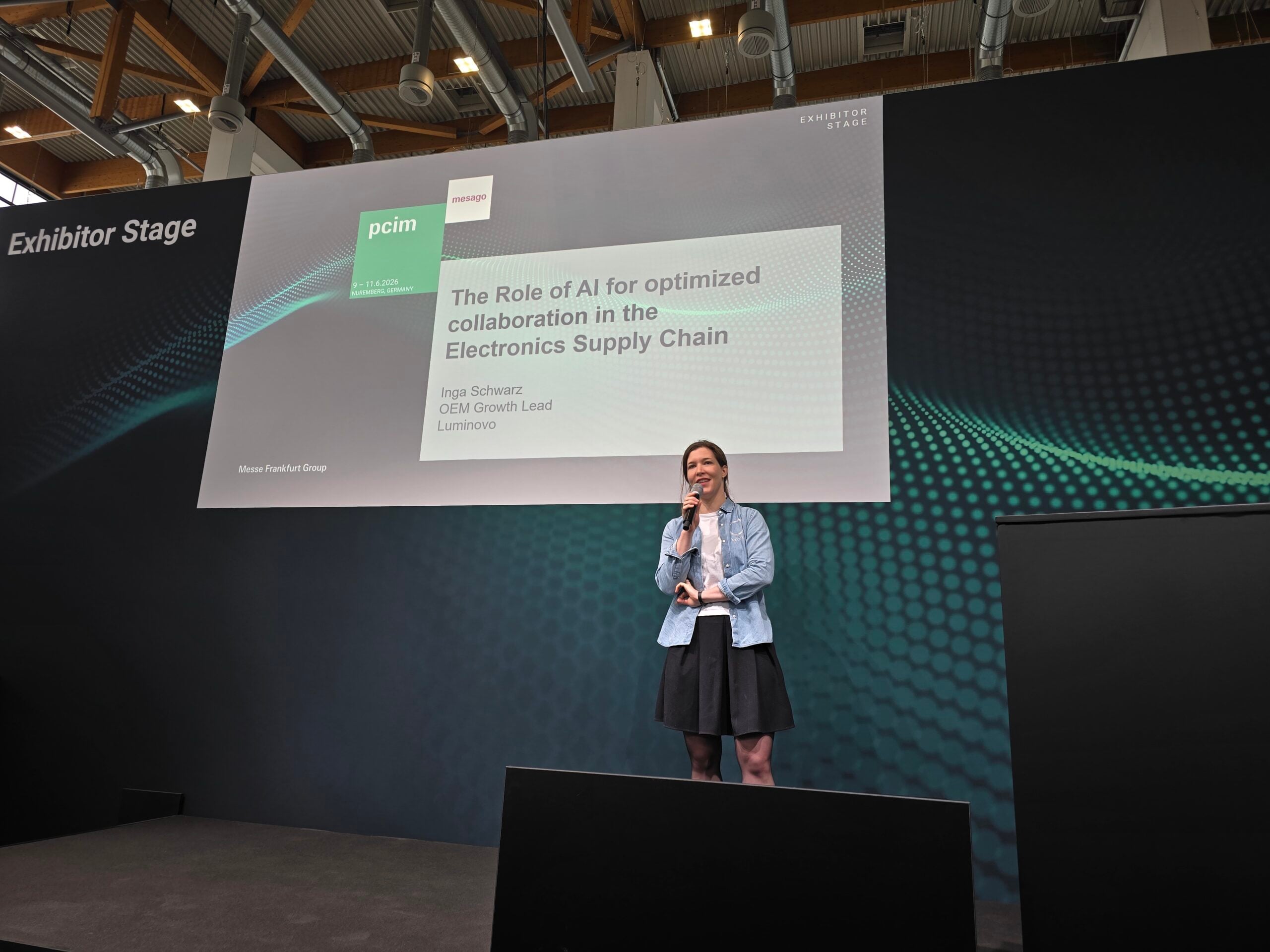






Products are becoming smarter, more connected, and more complex. But supply chains are stuck in silos, with isolated data, and in tools that aren’t up to today’s demands. At PCIM 2026, Inga Schwarz, OEM Growth Lead at Luminovo, delved into AI’s role for optimised collaboration in the electronics supply chain, and how LLMs need to be combined with deep domain expertise to leverage the technology’s full potential in today’s complex supply chains.
“Every company now is a semiconductor company,” Schwarz argued. “Ten years ago, you were a hardware company that used some chips. The supply chain was relatively stable. Lead times were predictable. You had a handful of distributors and suppliers, and bills of materials that kept stable across a product lifecycle of ten, fifteen years, or longer.”
That world no longer exists. Today, virtually every physical product contains a processor or connectivity module, and the complexity of the average bill of materials has doubled or tripled as a result. Supply chains have become more global, more fragile, and more fragmented. This is a reality that COVID made visible to the wider business world, even to those without deep roots in electronics procurement.
The problem hiding in plain sight
What makes this complexity difficult to manage isn’t that there are more components to track. It’s that the data about those components is scattered across disconnected systems with no meaningful communication between them.
Engineering teams work inside ECAD tools. Procurement teams live in the ERP. Supply chain teams handle a sprawl of Excel spreadsheets. None of these systems reflects what is actually happening in the supply chain in real time, and few of them speak the language of electronics, where a single internal part number can sit behind multiple manufacturer part numbers, and where components are specified by technical parameters that generic procurement tools simply don’t understand.
The result is costly. Engineering makes a design decision, procurement discovers six weeks later that the new bill of materials contains parts not recommended for new designs, and by the time the first prototype is due, a three-month re-spin is already on the cards. The information existed, however, it never crossed the departmental silo.
Four generations of AI, why now is different
The argument proposed in the talk was that AI has now matured to a point where this gap can finally be closed, but only if the technology is applied in the right way.
Inga traced the evolution of AI through four broad phases: from the rule-based deterministic logic of IBM’s Deep Blue in the late 1990s, through the machine learning and pattern recognition of IBM Watson in 2011, to the deep reasoning of AlphaGo in 2016, and finally to today’s large language model era, ushered in by the public release of ChatGPT.
The key shift in this final phase, she explained is that companies no longer needs teams of data engineers to build and train models from scratch. Foundation models are available off the shelf. What’s needed now is domain expertise – the ability to instruct those models effectively within the specific, highly technical context of the electronics supply chain.
“AI combined with deep electronics domain expertise is what closes exactly that gap,” she said. “Not AI as a general-purpose tool … but AI as a native layer in your workflow that actually understands the electronics database behind it.”
Moving from reactive to proactive
In practice, Luminovo’s platform – launched in 2019 with the stated mission of helping companies bring innovations to life faster and cheaper – translates this into a set of concrete capabilities: AI-powered cost breakdowns, actionable insights on cheaper or more resilient component alternatives, proactive alerts on lead time risks for new designs, and continuous monitoring of entire product portfolios across all active components.
The broader ambition is a shift from reactive to proactive supply chain management – and from siloed to collaborative working between engineering and procurement teams. Tasks like bill of materials imports, component normalisation and supplier data aggregation, which currently consume significant manual effort, should in Luminovo’s vision become entirely automated.
“The goal isn’t to make humans better at doing manual data entry,” Inga said. “The goal is to eliminate the manual data entry entirely. The humans should spend their time making informed, expert decisions based on the data that the systems can provide and analyse.”
For procurement professionals watching component complexity continue to rise with no sign of stabilising, it’s a case that may be worth hearing out.