




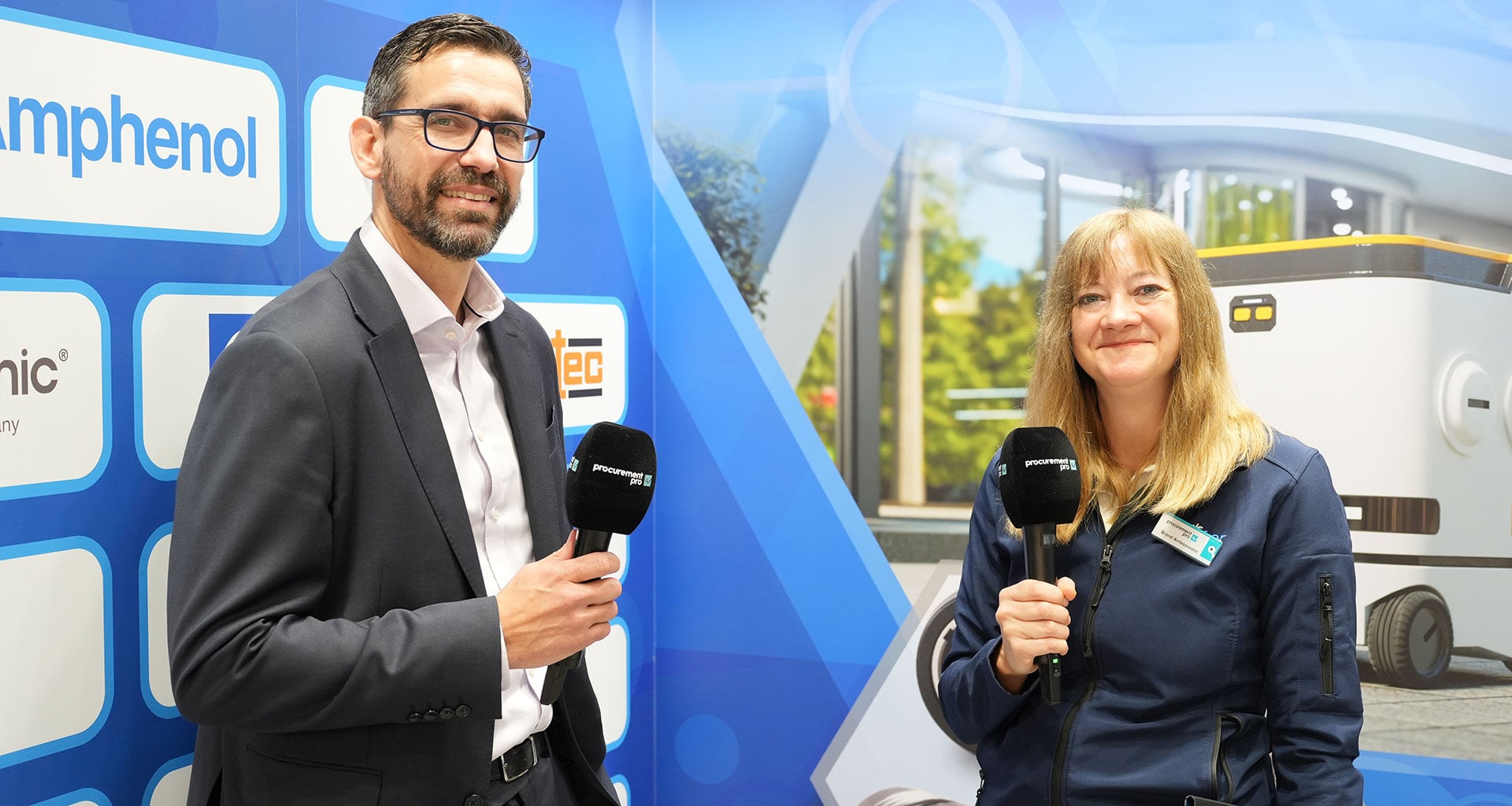
At electronica 2026 in Munich, Procurement Pro’s Lucy Barnard spoke with Robert Webber, Head of International Web Sales at Powell Europe, about connectors, shortages, and why buyers should plan for today.
Connectors rarely make it onto a product’s list of selling points. Yet if they fail or can’t be sourced, the whole build stalls.
Webber came to procurement via engineering. He worked as a design engineer for companies including Sony, then spent around a decade as an applications engineer “out on the road helping customers.” Today he heads international web sales for Powell across Europe and the rest of the world outside North America.
From American roots to global reach
Powell began as an American company but, over the last five years or so, has built a European arm and now a fully international operation that extends to Australia. Webber says its edge is its people, all specialists in electromechanical devices and connectors. “If you were to add up all the years of experience, it’d probably be about 200 years,” he said. That depth means customers trust the team in “an advisory role and not just a salesy role.”
The part nobody wants to think about
Having been a design engineer himself, Webber is candid about how connectors are seen. “It’s not something of interest normally to a design engineer, I can tell you that from my past,” he said. “You don’t want to spend time on it. You just want it to work.”
Unlike a sensor, a display, or a user interface, a connector doesn’t help an OEM sell its product. “This box or this wire needs to talk to this. I just need it to work and not have any quality issues and for the part to arrive,” he said. The job of connector manufacturers and distributors, then, is “just to be fast and efficient and solve problems.”
Still, demand for higher power and faster data rates is pushing manufacturers to innovate, and Webber sees collaboration as essential. A core part of Powell’s role is bringing suppliers and design engineers together, often on joint visits, because “without that voice of the customer, the manufacturers of these parts don’t actually know what the market is looking for.”
Answers in the same hour
When it comes to choosing a connector, fast advice matters as much as fast delivery. “If I don’t know the answer when I’m meeting a customer, I know who will,” Webber said, whether a colleague or the supplier’s own applications engineer.
Expectations have shifted. “They don’t want to wait six weeks for an answer. They want to have an answer the same day, in the same hour,” he said, adding that in a world shaped by AI, “people are used to having answers instantaneously.”
Good advice also means steering engineers away from obscure choices. A part picked from page 826 of a 2,000-page catalogue may look perfect, but “you might be the only customer in the world that wants to buy that.” Webber’s question to customers is simple: “I know you want that, but do you need that?” A widely used alternative is easier to build and to source in future.
Tackling shortages
With component shortages a hot topic at electronica, Webber said Powell is using its new e-commerce platform to read the market. Small-quantity orders can signal a part heading into production, prompting Powell to take a larger stocking package. Working with manufacturers to anticipate demand, including for older parts that are poorly stocked in distribution, means that even if delivery takes three or four months, “we’ll have it on the shelf.”
He also warned against a common trap. “Just because it’s in stock today doesn’t mean it’ll be in stock tomorrow,” he said. A single buyer from an entirely different industry can clear the available stock. “If only they’d spoken to the manufacturer or spoken to a distributor four months ago when they designed it in, this problem wouldn’t exist.”
Rather than singling out problem parts, Webber pointed to existing options: military-standard connectors, for example, come from several manufacturers, some cheaper on longer lead times, others pricier but backed by stock for short lead times.
Just-in-time is broken
On inventory, Webber was unequivocal. Since 2021, he said, “that model is broken.” Customers increasingly want localised stock in their own country or region, with distributors holding inventory and releasing it monthly as needed. Long lead times often trace back up the chain, to something as basic as a resin, in a “cascading effect” felt industry wide.
Plan for today
Webber doesn’t expect a quick return to how things were a decade ago, and he’d rather not make predictions. “Let’s accept what it’s like today is probably what it will be like for the next six months,” he said.
His advice to buyers and engineers is pragmatic: “Don’t hope it’s going to get better. Instead think, ‘Right, this is the state of play now.'” Then adjust how you buy, design in, and choose components accordingly.